Adding tenths to hundredths
TL;DR
Learn how to add fractions with different denominators by re-expressing one fraction into equivalent terms.
Transcript
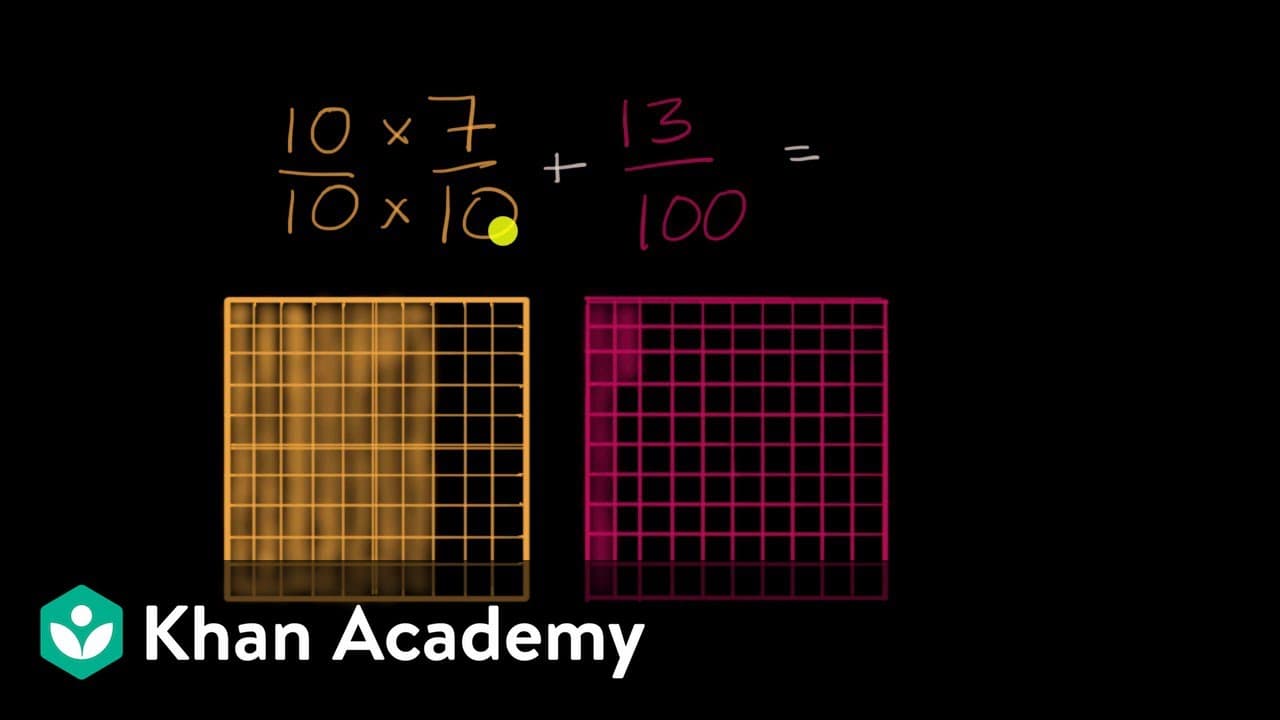
- [Instructor] So what we're going to try to do in this video is add 7/10 to 13/100, pause this video and see if you can figure what that is. Alright so despite being a little bit intimidating at first because we're adding tenths here, 7/10 and we're adding hundredths here 13/100, how do I add a certain number of tenths to a certain number of hundr... Read More
Key Insights
- 😑 Adding fractions with different denominators requires re-expressing one fraction in terms of the other.
- 🗂️ By dividing tenths into hundredths, 7/10 can be converted to 70/100.
- ✖️ Multiplying the numerator and denominator by the same number maintains the fraction's value.
- 🪜 Adding fractions with the same denominator is straightforward; just add the numerators and keep the denominator.
- 🪜 When adding fractions, it is important to ensure they have the same denominator before combining the numerators.
- 🆘 Learning to visualize fractions can help in understanding mathematical concepts.
- 😑 Re-expressing fractions allows for easier comparison and addition.
Install to Summarize YouTube Videos and Get Transcripts
Explore YouTube Video Summarizer or Get YouTube Transcript Extractor
Questions & Answers
Q: How do you add 7/10 to 13/100 when the fractions have different denominators?
To add fractions with different denominators, re-express 7/10 as 70/100 by dividing each tenth into ten equal sections. Then, add 70/100 to 13/100, resulting in 83/100.
Q: Why is it necessary to re-express fractions when adding?
Re-expressing fractions with different denominators allows us to find a common base for addition. It ensures that both fractions have the same denominator, making addition possible.
Q: Can the numerator and denominator be multiplied by different numbers to re-express a fraction?
No, to maintain the value of a fraction, both the numerator and denominator must be multiplied or divided by the same number. This keeps the fraction equivalent while changing its representation.
Q: Is there a limit to how many fractions can be added using this method?
No, this method of re-expressing fractions can be applied to any number of fractions. Each fraction can be converted to equivalent terms, and then they can be added together.
Summary & Key Takeaways
-
Adding fractions with different denominators can be intimidating, but the key is to re-express one fraction in terms of the other fraction's denominator.
-
By visually dividing tenths into hundredths, you can convert 7/10 into 70/100.
-
Adding 70/100 to 13/100 gives you a total of 83/100.
Read in Other Languages (beta)
Share This Summary 📚
Summarize YouTube Videos and Get Video Transcripts with 1-Click
Try YouTube Summary with ChatGPT & Claude or YouTube Transcript Generator
Explore More Summaries from Khan Academy 📚



Summarize YouTube Videos and Get Video Transcripts with 1-Click
Try YouTube Summary with ChatGPT & Claude or YouTube Transcript Generator