How to Use the Shell Method for Volume of Revolution
TL;DR
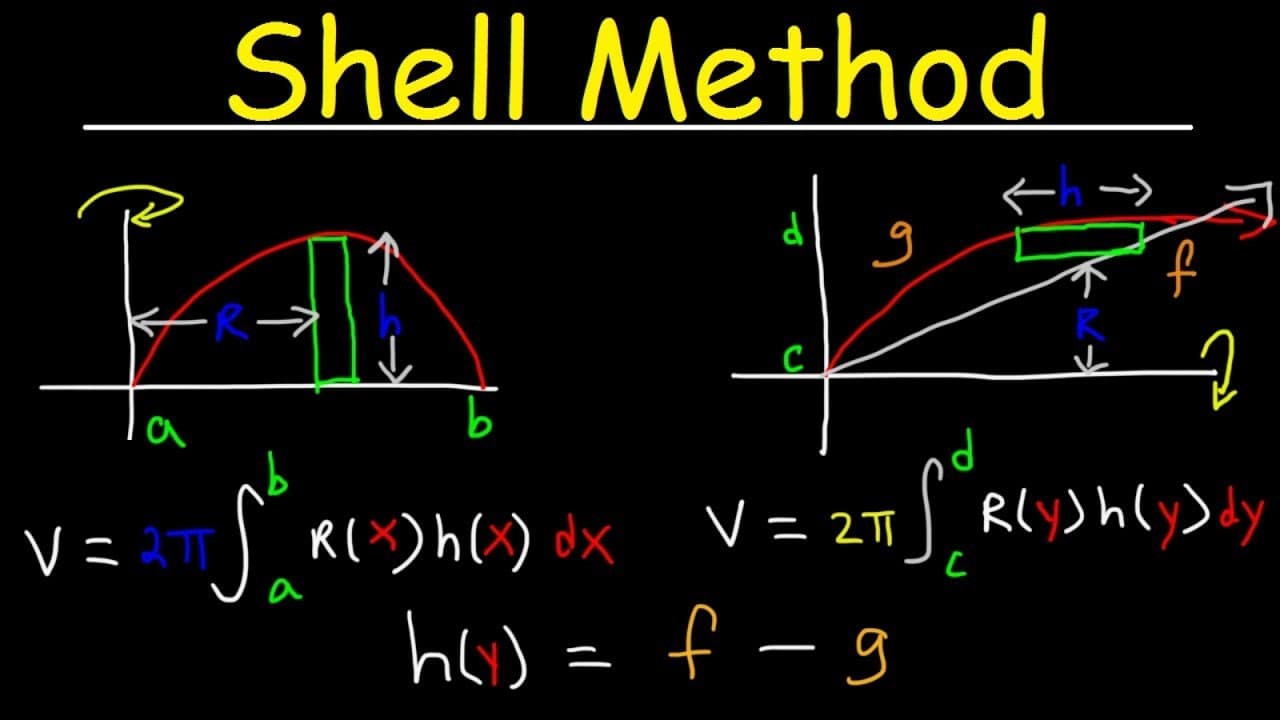
The shell method calculates the volume of a solid of revolution by integrating the product of the radius and height of vertical or horizontal rectangles. For rotation about the y-axis, use the formula V = 2π ∫[x * h(x)] dx; for the x-axis, use V = 2π ∫[y * r(y)] dy. Ensure the variables are correctly defined in terms of x or y based on the axis of rotation.
Transcript
in this video we're going to focus on finding the volume using the shell method so let's begin by drawing a picture now we're going to find the volume when rotated about the y-axis what i'd like to do is draw a rectangle the limits of integration is going to be from a to b the radius is the distance between the x-axis and the axis of rotation by th... Read More
Key Insights
- 🐚 The shell method is an approach to find the volume of a solid when rotating a curve around an axis.
- 😀 When rotating about the y-axis, the rectangle should be parallel to the y-axis, and the radius and height should be in terms of x.
- ☺️ When rotating about the x-axis, the rectangle should be parallel to the x-axis, and the radius and height should be in terms of y.
- 🔇 The volume can be calculated using the formula: Volume = 2π ∫ [radius(x) * height(x)] dx.
Install to Summarize YouTube Videos and Get Transcripts
Explore YouTube Video Summarizer or Get YouTube Transcript Extractor
Questions & Answers
Q: What is the shell method used for?
The shell method is used to find the volume of a solid when rotating a curve around an axis.
Q: How do you find the height of the shell when using the shell method?
For curves with one function, the height of the shell is the difference between the top and bottom functions. For curves with two functions, it is f(x) - g(x).
Q: When rotating about the y-axis, what should the rectangle be parallel to?
The rectangle should be parallel to the y-axis when rotating about the y-axis.
Q: What is the radius when rotating about the x-axis?
The radius is the distance between the rectangle and the axis of rotation when rotating about the x-axis.
Q: What are the limits of integration when rotating about the y-axis?
The limits of integration represent x values when rotating about the y-axis.
Q: How do you convert the height from y to x when rotating about the y-axis?
Replace y with a function of x to convert the height from y to x when rotating about the y-axis.
Q: What is the formula for finding volume using the shell method?
The formula is: Volume = 2π ∫ [radius(x) * height(x)] dx.
Q: Can you provide an example of finding volume using the shell method?
In the example of y = √x rotated about the y-axis, the volume would be (128π/5) cubic units.
Summary & Key Takeaways
-
The video demonstrates the process of finding volume using rectangles parallel to the axis of rotation and the shell method.
-
It explains how to find volume when rotating curves about the y-axis and the equation to use.
-
It also covers finding volume when rotating curves about the x-axis and provides an example for each scenario.
Read in Other Languages (beta)
Share This Summary 📚
Summarize YouTube Videos and Get Video Transcripts with 1-Click
Try YouTube Summary with ChatGPT & Claude or YouTube Transcript Generator
Explore More Summaries from The Organic Chemistry Tutor 📚




Summarize YouTube Videos and Get Video Transcripts with 1-Click
Try YouTube Summary with ChatGPT & Claude or YouTube Transcript Generator