Tabular DI | Data Interpretation | Price of Farmer Products | Reasoning | Part - 16 | Bharath Kumar
TL;DR
The session explains how to interpret and analyze farmers' product prices.
Transcript
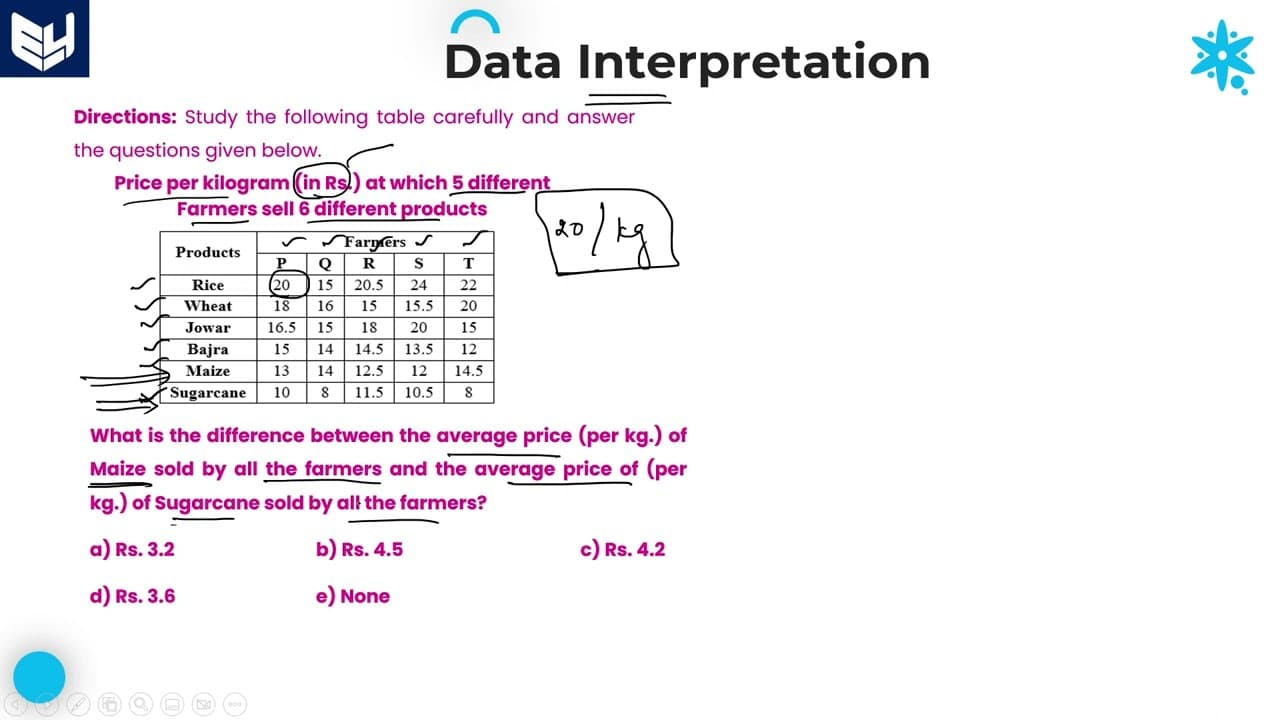
hi everyone welcome to the session in this session i will continue the problems based on tablet data interpretation first of all read the information which is provided in the question study the following uh table carefully and answer the questions given below here the information is about price per kg price per kg all the values are given in terms ... Read More
Key Insights
- 🆘 Understanding average calculations helps determine product pricing strategies effectively.
- 🥳 Ratios of earnings can assist farmers in comparing their sales performance directly.
- 🦻 Identifying total revenues from product sales aids in measuring profitability across different farmers.
- ❓ Providing a clear summary of prices per kg can enhance market transparency for consumers.
- ⚾ Farmer's earnings vary significantly based on the price volatility of agricultural products in the market.
- ⚾ The analysis of earnings based on quantities sold provides insights into production efficiencies.
- 💁 Detailed interpretations can guide farmers in making better-informed pricing and selling decisions.
Install to Summarize YouTube Videos and Get Transcripts
Explore YouTube Video Summarizer or Get YouTube Transcript Extractor
Questions & Answers
Q: How do you calculate the average price of maize sold by the farmers?
To calculate the average price of maize, sum all the prices per kg from the table, which are 13, 14, 12.5, 12, and 14.5 rupees. Add these values to get a total of 66 rupees, and then divide by the number of farmers (5) to find the average, which is 13.2 rupees per kg.
Q: What steps are required to find the ratio of total prices of products sold by farmers Q and R?
First, add the prices per kg for all products sold by farmer Q, which include 15, 16, 15, 14, 14, and 8 rupees. This totals 82. Then, add the prices from farmer R, which are 20.5, 15, 18, 14.5, and 12.5, totaling 90. The ratio of Q to R is then calculated, simplifying to 41:46.
Q: What will be the total earnings if farmer Q sells specified quantities of wheat, juar, and sugarcane?
To find the total earnings, multiply the quantity of wheat (14 kg) by its price (16 rupees/kg), yielding 224 rupees. Next, calculate for juar (21 kg at 15 rupees), giving 315 rupees, and for sugarcane (30 kg at 8 rupees), resulting in 240 rupees. Adding these amounts gives a total earning of 779 rupees.
Q: How do you determine the difference in selling amounts between farmers P and Y?
Calculate the earnings for each farmer by multiplying the quantity sold by the price per kg. Farmer P sells 50 kg of rice at 20 rupees, fetching 1000 rupees. Farmer Y sells 60 kg of wheat at 15.5 rupees, earning 930 rupees. The difference is 1000 - 930 = 70 rupees, indicating that P earned more.
Summary & Key Takeaways
-
The content discusses methods to interpret a table showing different farmers' prices for various agricultural products, focusing primarily on calculating averages and differences.
-
Key calculations included finding the average price per kilogram for maize and sugarcane and the respective differences.
-
Additional questions explored total earnings based on quantities sold and comparisons of profits between different farmers selling the same products.
Read in Other Languages (beta)
Share This Summary 📚
Summarize YouTube Videos and Get Video Transcripts with 1-Click
Try YouTube Summary with ChatGPT & Claude or YouTube Transcript Generator