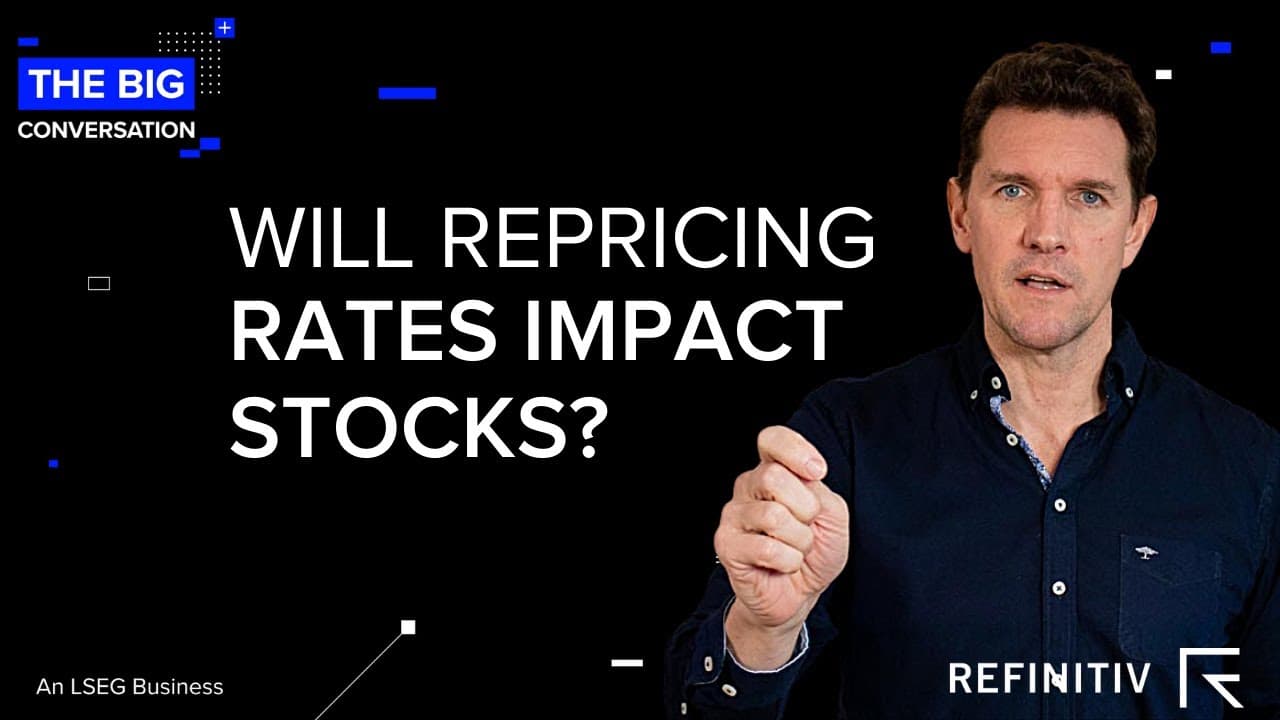
Will Repricing Rates Impact Stocks? | The Big Conversation | Refinitiv
TL;DR
Market interest rates are rising due to supply chain issues, and this may have a bigger impact on financial assets than on demand and inflationary bottlenecks.
Transcript
We are now starting to see a rapid repricing of interest rate risk at the front end of the curve as many investors throw in the towel on the transient inflation narrative. But could a sudden surge on yields at either the short or the long end create the sort of shock that might have a much bigger impact than any rate hike by the Fed? The market is ... Read More
Key Insights
- ☠️ The current repricing of interest rate risk is driven by supply chain challenges, not excessive demand.
- 🥺 Repricing of risk at the front end of the curve can lead to yield curve flattenings.
- 🫢 Long-dated bond yields may rise, potentially causing a VAR (Value at Risk) shock that destabilizes markets.
- ❓ Policymakers may be more dovish in response to trading scandals, potentially impacting policy expectations.
- 😮 Reversal patterns in bond yields are emerging, suggesting the potential for long-dated yields to rise.
- 😮 Various market sectors, such as technology, energy, and emerging markets, may be affected differently by rising yields and inflation.
Install to Summarize YouTube Videos and Get Transcripts
Explore YouTube Video Summarizer or Get YouTube Transcript Extractor
Questions & Answers
Q: How are interest rate markets being affected by the repricing of risk?
Interest rate markets are experiencing a significant repricing of risk at the front end of the curve, with notable sell-offs in certain contracts. The Eurodollar Dec. 2023 contract, for example, has seen an impressive decline. In the U.K., there is even more extreme repricing of rates risk.
Q: What could happen if the yield curves excessively flatten or invert?
Excessive flattening or inversion of yield curves could potentially lead to economic recession. Inverting curves have historically preceded recessions, and this pattern should be carefully monitored. Therefore, while flatter curves may be expected, caution should be exercised regarding the potential for inverted curves.
Q: How might higher bond yields and a stronger dollar impact financial conditions?
Higher bond yields and a stronger dollar would significantly tighten financial conditions. A stronger dollar would also have deflationary effects. However, these measures will have limited impact on supply chain issues and may not be sufficient to address the current problems.
Q: What investment options should be considered in response to rising bond yields?
Investors may want to consider buying protection against a surge in bond yields and look at options such as puts on long bonds. Value plays like banks and certain commodity plays may be affected by flatter curves or a slowdown caused by rising yields. Energy stocks could perform well due to chronic underinvestment in the sector.
Summary & Key Takeaways
-
Interest rate risk is being rapidly repriced at the front end of the curve as investors dismiss the transient inflation narrative.
-
Higher interest rates historically aim to curb a booming economy, but they will do little to address supply chain challenges causing price increases.
-
The tightening of policy may have a larger impact on financial assets and risk pushing economies towards low growth or recession.
Read in Other Languages (beta)
Share This Summary 📚
Summarize YouTube Videos and Get Video Transcripts with 1-Click
Try YouTube Summary with ChatGPT & Claude or YouTube Transcript Generator
Explore More Summaries from Real Vision 📚


Summarize YouTube Videos and Get Video Transcripts with 1-Click
Try YouTube Summary with ChatGPT & Claude or YouTube Transcript Generator