Wage Subsidies
TL;DR
Wage subsidies boost jobs, while minimum wage reduces demand.
Transcript
♪ [music] ♪ - [Alex] In our final lecture on taxes and subsidies, we're going to take a look at wage subsidies and compare them to the minimum wage. Suppose that we are especially interested in increasing the number of jobs for low-skilled workers. That is, we think that the value of these jobs exceeds the wage, the value, to consumers. Perhaps bec... Read More
Key Insights
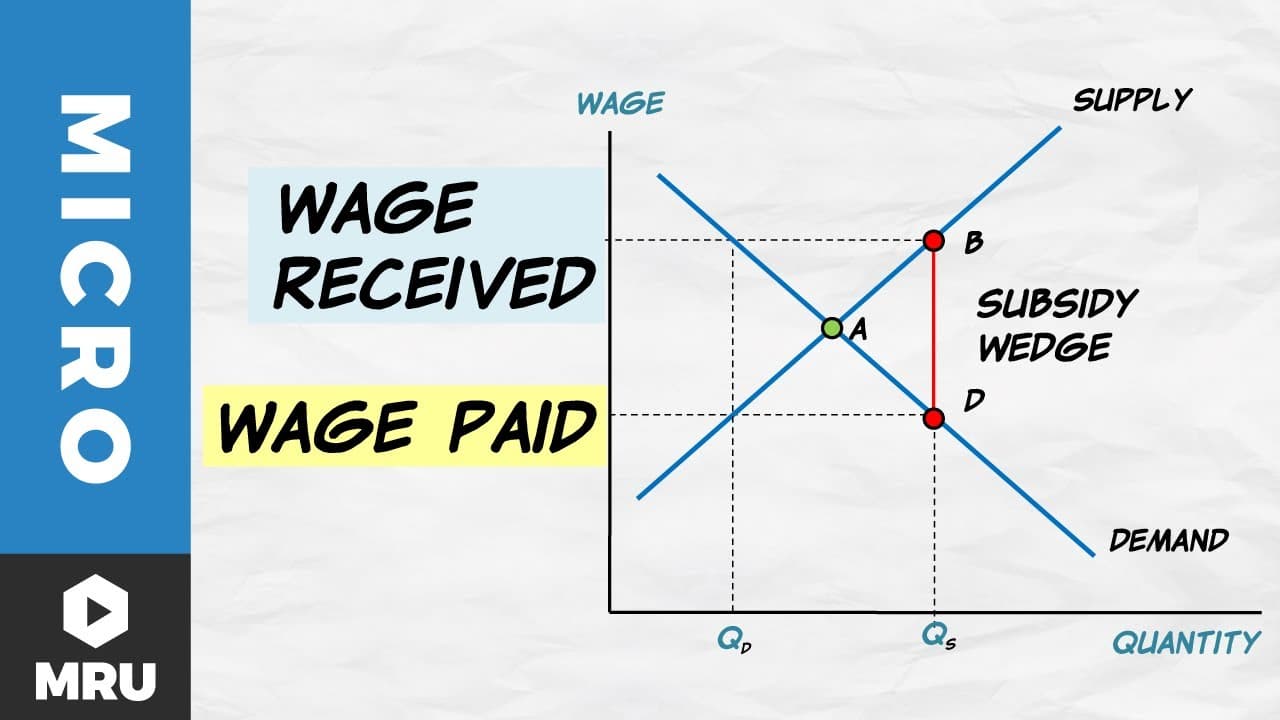
- Wage subsidies can increase the number of low-skilled jobs by making it cheaper for firms to hire and increasing wages for workers.
- The cost of wage subsidies to taxpayers is significant but may be offset by savings on crime, welfare, and increased social cohesion.
- Minimum wage does not cost the government but reduces the demand for labor, leading to fewer low-skilled jobs.
- Economists, including Nobel laureate Edmund Phelps, often prefer wage subsidies over minimum wage due to their positive impact on job creation.
- The Earned Income Tax Credit (EITC) is a major wage subsidy program in the U.S., considered by many as a superior alternative to minimum wage.
- A wage subsidy creates a wage wedge, altering the wages paid by firms and received by workers, influenced by demand and supply elasticities.
- Minimum wage increases costs for employers but does not involve direct government expenditure, making it politically attractive.
- Expanding the EITC could provide broader support for low-skilled workers, enhancing its benefits over a minimum wage approach.
Install to Summarize YouTube Videos and Get Transcripts
Explore YouTube Video Summarizer or Get YouTube Transcript Extractor
Questions & Answers
Q: What is the primary benefit of a wage subsidy?
The primary benefit of a wage subsidy is that it increases the demand for labor, leading to more low-skilled jobs. By reducing the wage cost to firms and increasing the wage received by workers, it incentivizes firms to hire more workers, thus addressing issues like poverty and unemployment.
Q: How does a wage subsidy affect taxpayers?
A wage subsidy imposes a cost on taxpayers, as it requires government funding to cover the subsidy amounts. However, this cost might be mitigated by potential savings in other areas, such as reduced welfare payments and lower crime rates, which can result from increased employment and economic activity.
Q: Why might economists prefer wage subsidies over minimum wage?
Economists might prefer wage subsidies over minimum wage because subsidies increase labor demand and job creation, whereas minimum wage can reduce labor demand. Wage subsidies can lead to higher employment levels without imposing direct costs on employers, making them an attractive policy for boosting employment among low-skilled workers.
Q: What is the Earned Income Tax Credit?
The Earned Income Tax Credit (EITC) is a significant wage subsidy program in the United States designed to support low-income workers by providing them with tax credits. It effectively increases their income and incentivizes work, making it a popular alternative to minimum wage policies for improving the economic standing of low-skilled workers.
Q: How does a minimum wage policy impact employers?
A minimum wage policy increases the cost of labor for employers, which can lead to a reduction in the demand for low-skilled workers. Employers may hire fewer workers or reduce hours to manage the increased wage costs, potentially leading to higher unemployment rates among low-skilled workers.
Q: What role do elasticities play in wage subsidies?
Elasticities of demand and supply determine how the benefits of a wage subsidy are divided between employers and workers. If demand is more elastic than supply, workers may receive a larger share of the subsidy. Conversely, if supply is more elastic, employers might benefit more. This division impacts the overall effectiveness of the subsidy.
Q: What are the potential savings associated with wage subsidies?
Potential savings from wage subsidies include reduced welfare payments, lower crime rates, and increased social cohesion. By boosting employment, wage subsidies can decrease the need for government assistance programs and contribute to a more stable and productive society, offsetting some of the costs incurred by taxpayers.
Q: Why is the minimum wage politically attractive despite its drawbacks?
The minimum wage is politically attractive because it does not require direct government spending, making it appealing to taxpayers. It is a straightforward policy that can be easily communicated to the public as a means of ensuring fair wages, despite its potential negative impact on employment levels for low-skilled workers.
Summary & Key Takeaways
-
Wage subsidies are explored as a means to increase low-skilled jobs by reducing the cost to firms and increasing wages for workers. This approach contrasts with minimum wage policies, which do not incur government costs but reduce labor demand.
-
The cost of wage subsidies is a concern for taxpayers, yet potential savings in welfare and crime reduction could justify the expense. Economists like Edmund Phelps advocate for wage subsidies over minimum wage due to their job creation benefits.
-
The Earned Income Tax Credit is highlighted as an effective wage subsidy program in the U.S., with calls for its expansion to support more low-skilled workers. This program is considered a better alternative to minimum wage by many economists.
Read in Other Languages (beta)
Share This Summary 📚
Summarize YouTube Videos and Get Video Transcripts with 1-Click
Try YouTube Summary with ChatGPT & Claude or YouTube Transcript Generator
Explore More Summaries from Marginal Revolution University 📚

Summarize YouTube Videos and Get Video Transcripts with 1-Click
Try YouTube Summary with ChatGPT & Claude or YouTube Transcript Generator