1.4.7 R1. Understanding Food - Video 6: Summary Tables
TL;DR
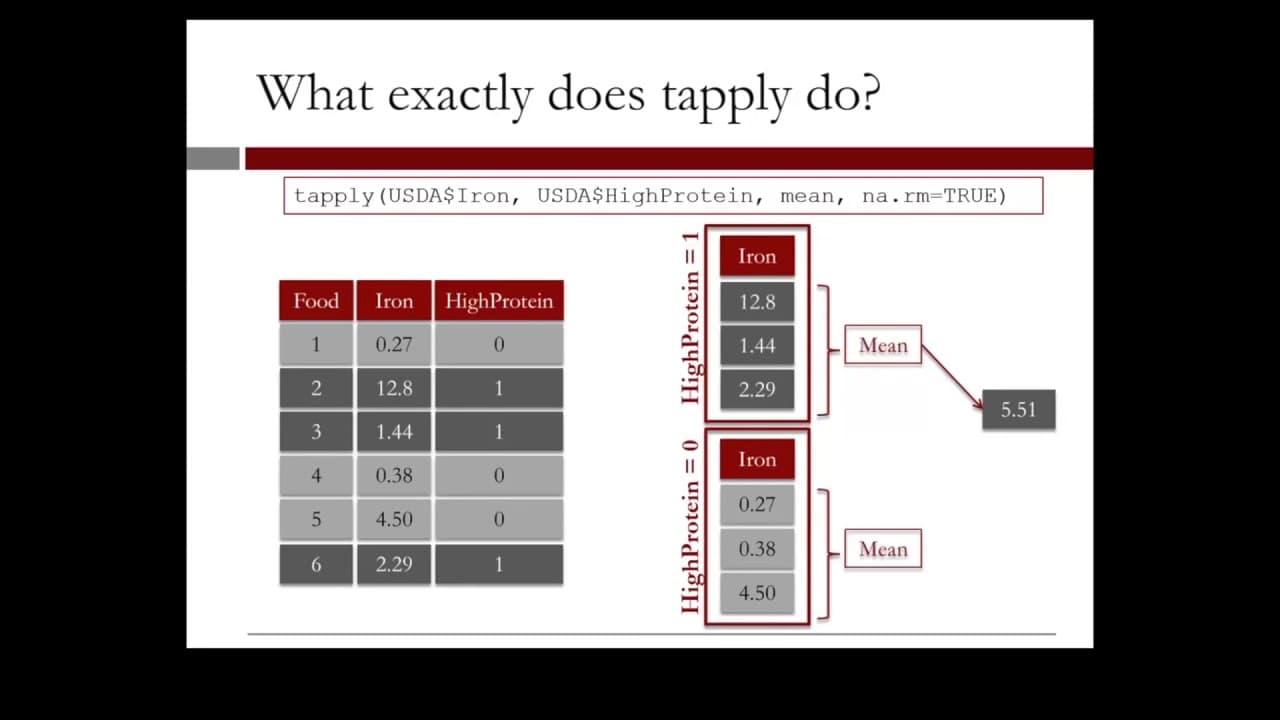
This video demonstrates how to use the table and tapply functions in R to analyze nutrition data, including counting foods with high sodium levels, finding foods with both high sodium and high fat, and computing average iron levels based on protein and carb content.
Transcript
Remember that in our previous video, we created four new variables, HighSodium, HighFat, HighCarbs, and HighProtein. Now in this video, we will try to understand our data and the relationships between our variables better, using the table and tapply functions. To figure out how many foods have higher sodium level than average, we want to look at th... Read More
Key Insights
- 🚰 The table function is useful for counting and analyzing categorical variables in R.
- 👥 The tapply function allows for grouping data based on a specific variable and applying a function to each group.
- 👥 Using the mean function in combination with the tapply function can calculate average values for specific groups.
- 💁 The summary function provides statistical information, such as averages, for specific subsets of data.
- 👨 Analyzing nutrition data using R functions can provide insights into relationships between variables, such as sodium and fat content.
- 😋 Carbs content in food may be positively correlated with vitamin C levels.
- 🚃 R functions offer a powerful and efficient way to analyze and understand large datasets.
Install to Summarize YouTube Videos and Get Transcripts
Explore YouTube Video Summarizer or Get YouTube Transcript Extractor
Questions & Answers
Q: How can the table function be used to count foods with higher sodium levels than average?
The table function takes the HighSodium vector as input and counts the number of foods with values 1, indicating higher sodium levels. This provides information on how many foods have higher sodium content than average.
Q: How can the table function be used to find foods with both high sodium and high fat?
By providing two inputs to the table function - the HighSodium vector and the HighFat vector - a table is generated that shows the number of foods with different combinations of sodium and fat levels. This includes the number of foods with both high sodium and high fat.
Q: How can the tapply function be used to compute the average amount of iron based on protein content?
The tapply function can be used to group the Iron vector by the HighProtein vector and then apply the mean function to calculate the average iron level in each group. The nonavailable entries should be removed using na.rm=TRUE.
Q: How can the tapply function be used to find the maximum level of vitamin C in foods with different carb content?
By using the tapply function with the VitaminC vector as the first argument and the HighCarbs vector as the second argument, and applying the max function, the maximum vitamin C level for each carb content group can be obtained.
Summary & Key Takeaways
-
The video explains how to count the number of foods with higher sodium levels than average using the table function.
-
It demonstrates how to use the table function with two inputs to find foods with both high sodium and high fat.
-
The tapply function is used to compute the average amount of iron sorted by high and low protein levels.
-
A similar approach is used to find the maximum level of vitamin C in foods with high and low carb content.
-
The summary function is used to compare the average vitamin C levels in foods with different carb content.
Read in Other Languages (beta)
Share This Summary 📚
Summarize YouTube Videos and Get Video Transcripts with 1-Click
Try YouTube Summary with ChatGPT & Claude or YouTube Transcript Generator
Explore More Summaries from MIT OpenCourseWare 📚



Summarize YouTube Videos and Get Video Transcripts with 1-Click
Try YouTube Summary with ChatGPT & Claude or YouTube Transcript Generator