Why Do Wider Tires Improve Performance More Than Bigger Brakes?
TL;DR
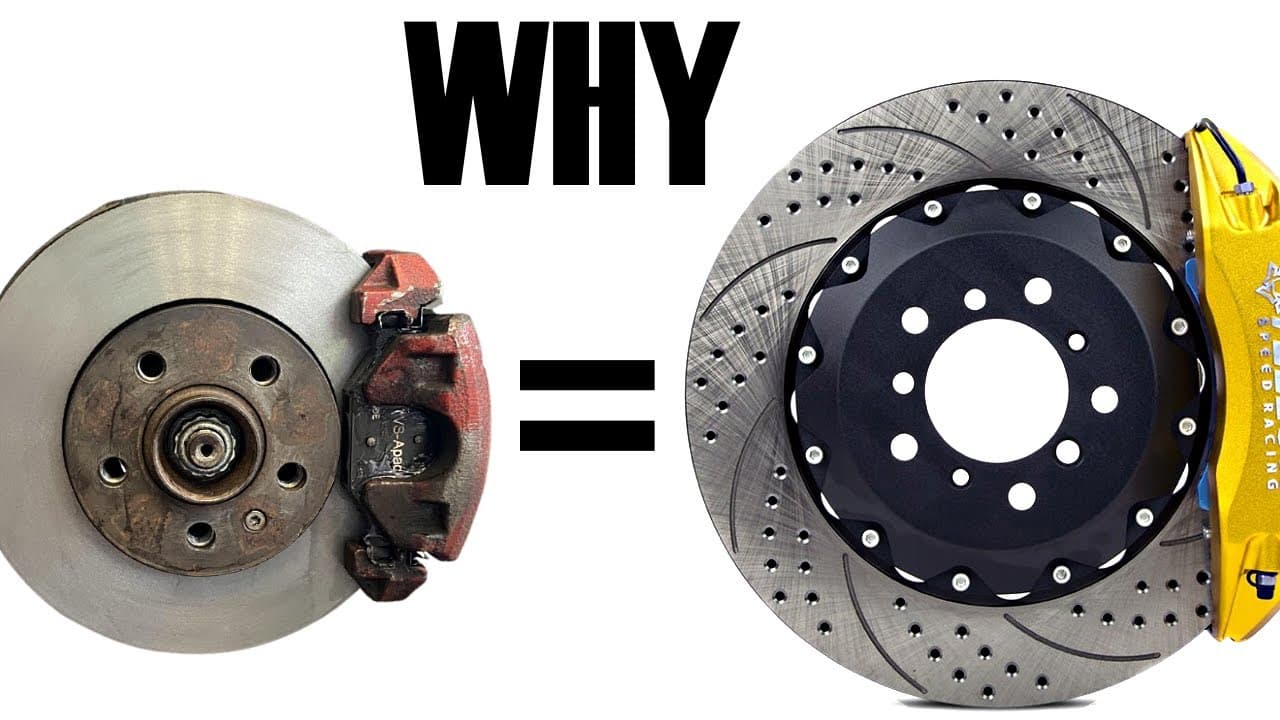
Wider tires improve braking and cornering performance because they can adapt to the road surface, increasing the actual contact area. In contrast, larger brakes do not reduce braking distance since friction is determined by the coefficient of friction and normal force, not surface area. Instead, bigger brakes are primarily used for better heat dissipation to prevent brake fade during high-performance driving.
Transcript
In today's video we'll be explaining a seemingly simple but often confusing conundrum involving vehicular Brakes and Tires. If you have ever considered upgrading your vehicle's brakes and did a bit of research online then you have probably found out that, contrary to intuition, bigger brakes will not reduce your bra... Read More
Key Insights
- Increasing brake size does not decrease braking distance because friction depends on the coefficient of friction and normal force, not surface area.
- Wider tires improve braking and cornering performance due to their elastic nature, allowing for greater actual contact area.
- Brake size is crucial for heat dissipation, preventing brake fade, which occurs when brakes overheat and lose effectiveness.
- Tires can deform and adapt to surfaces, increasing actual contact area and friction, unlike solid brakes.
- Sports and race cars use larger brakes for heat management, not increased friction, as larger brakes dissipate heat more effectively.
- Wider tires provide better grip and traction due to increased contact area and adhesion properties, but can perform poorly in wet conditions.
- Brake ventilation is essential for heat management, as car brakes receive less airflow compared to motorcycle brakes.
- The science of friction and surface contact, tribology, is complex and essential for understanding vehicle performance.
Install to Summarize YouTube Videos and Get Transcripts
Explore YouTube Video Summarizer or Get YouTube Transcript Extractor
Questions & Answers
Q: Why don't bigger brakes reduce braking distance?
Bigger brakes don't reduce braking distance because the frictional force depends on the coefficient of friction and normal force, not the surface area. The formula F = μN shows that friction is not affected by the size of the brake pads or discs, but rather by the material properties and the force pressing the surfaces together.
Q: How do wider tires improve braking and cornering performance?
Wider tires improve braking and cornering performance due to their elastic nature, which allows them to deform and increase the actual contact area with the road. This property enables them to provide greater grip and traction, as the rubber can conform to surface irregularities, enhancing friction and overall performance.
Q: Why are larger brakes important for sports and race cars?
Larger brakes are important for sports and race cars primarily for heat dissipation. During aggressive driving, brakes generate significant heat, and larger brakes have more surface area to dissipate this heat, preventing brake fade. Brake fade occurs when overheating forms a gas layer that reduces friction and braking effectiveness.
Q: What is brake fade, and why is it problematic?
Brake fade is a reduction in braking performance due to overheating. When brakes overheat, a thin layer of gas forms on the surface, reducing friction and the ability to slow down the vehicle effectively. This is problematic, especially during high-speed or aggressive driving, as it can lead to longer stopping distances and reduced control.
Q: How does tire elasticity affect actual contact area and friction?
Tire elasticity allows the rubber to deform and adapt to the surface, increasing the actual contact area and friction. Unlike solid materials, rubber can reach into surface valleys, enhancing grip. As load increases, rubber becomes stiffer, but even a light load can significantly increase contact area, improving friction and performance.
Q: Why do wider tires perform poorly in wet conditions?
Wider tires can perform poorly in wet conditions because the increased contact area means water has to travel a greater distance to be expelled from under the tire. This delay in water evacuation can lead to hydroplaning, where the tire loses contact with the road, reducing grip and increasing the risk of slipping.
Q: What role does heat management play in brake design?
Heat management is crucial in brake design to prevent brake fade. Car brakes are often ventilated to enhance airflow and heat dissipation, as they receive less natural airflow compared to exposed motorcycle brakes. Effective heat management ensures consistent braking performance by preventing overheating and maintaining optimal friction levels.
Q: How does tribology relate to vehicle performance?
Tribology, the study of friction, lubrication, and surface contact, is essential for understanding vehicle performance. It explains the mechanics behind tire deformation and brake function, highlighting how different materials and surface interactions affect grip, traction, and braking efficiency. Understanding tribology helps optimize vehicle components for better performance and safety.
Summary & Key Takeaways
-
The video explains why increasing the size of your vehicle's brakes does not reduce braking distance, while wider tires do improve braking and cornering performance. This is due to the nature of friction, which depends on the coefficient of friction and normal force rather than surface area.
-
Larger brakes are used in sports and race cars primarily for heat dissipation to prevent brake fade. Brake fade occurs when brakes overheat, forming a gas layer that reduces friction and braking performance.
-
Wider tires enhance performance because they are elastic and can adapt to the surface, increasing the actual contact area. However, they may perform worse in wet conditions due to the increased distance water must travel to be expelled from under the tire.
Read in Other Languages (beta)
Share This Summary 📚
Summarize YouTube Videos and Get Video Transcripts with 1-Click
Try YouTube Summary with ChatGPT & Claude or YouTube Transcript Generator
Explore More Summaries from driving 4 answers 📚
Summarize YouTube Videos and Get Video Transcripts with 1-Click
Try YouTube Summary with ChatGPT & Claude or YouTube Transcript Generator