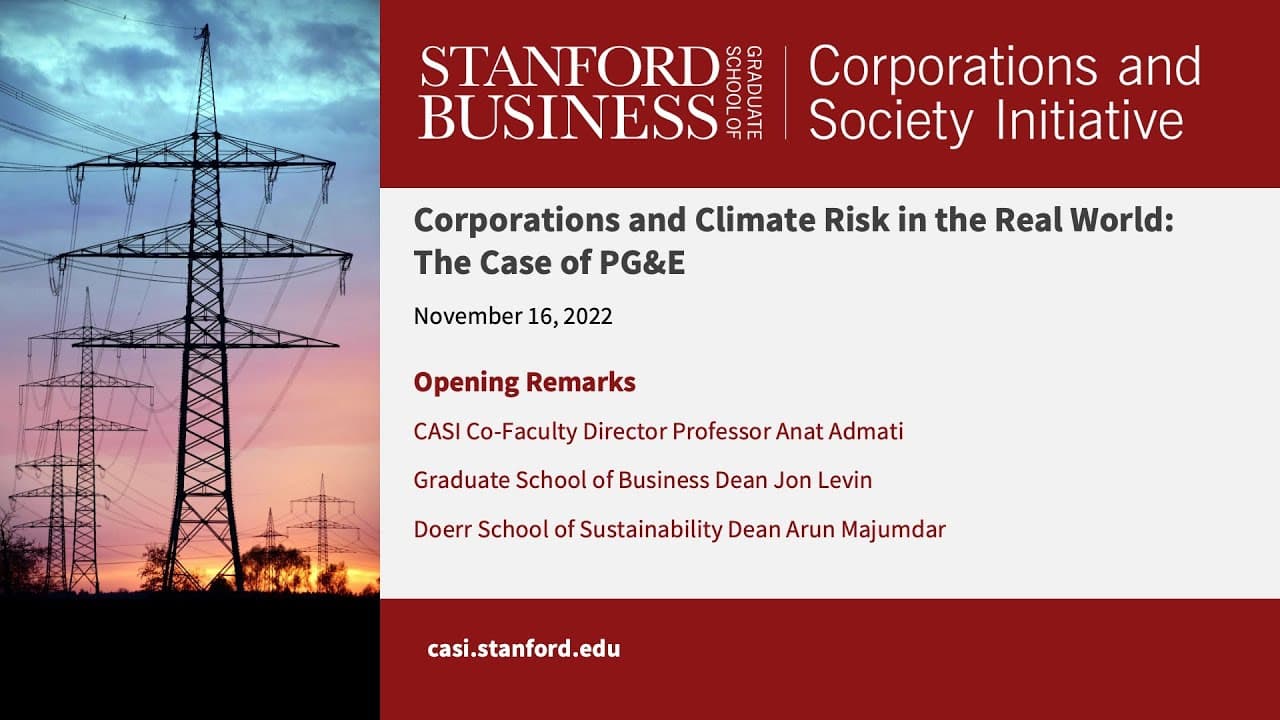
How Does PG&E Navigate Climate Change Risks?
TL;DR
PG&E is at the center of a crucial discussion on how corporations can effectively address climate change risks. Experts emphasize the urgent need for reliable energy solutions while tackling governance challenges and the complexities of infrastructure in light of increasing extreme weather events. This case study of PG&E highlights the broader implications for all organizations facing climate-related challenges.
Transcript
[MUSIC] Good afternoon, my name is Anat R Admati. I'm a professor of finance and economics at this Graduate School of Business, Stanford, where we are right now. And I also got involved symbolically for now at 0% appointment as a professor in New Doerr School of Sustainability here at Stanford. I'm also the faculty director of the Corporations and ... Read More
Key Insights
- ☀️ Climate change presents significant challenges to organizations, including increased risks of wildfires, infrastructure failures, and extreme weather events.
- 😀 Regulated utilities like PG&E face the complex task of balancing regulatory requirements, customer demands, and the need for infrastructure upgrades to address climate change risks.
- 💱 Organizations must prioritize climate change preparedness, evaluate risks, and take immediate action to mitigate and adapt to potential impacts.
Install to Summarize YouTube Videos and Get Transcripts
Explore YouTube Video Summarizer or Get YouTube Transcript Extractor
Questions & Answers
Q: What are some of the specific risks and challenges posed by climate change that PG&E is facing?
PG&E is dealing with the increased threat of wildfires due to extreme weather events and the risk of infrastructure failure during high-demand periods. This puts them in a complex position of balancing regulatory requirements, customer needs, and climate change impacts.
Q: How is PG&E regulated and how does it impact their ability to invest in infrastructure upgrades?
PG&E operates as a regulated utility, following rules and regulations set by the California Utility Commission (CPUC). Their business model is based on return on asset investments, which may sometimes hinder their ability to invest in infrastructure upgrades and adapt to the risks of climate change.
Q: What lessons can be learned from the case of PG&E for other organizations facing climate change risks?
It is essential for organizations to assess their preparedness for climate change, evaluate potential risks within their assets and systems, and have a dedicated team in place to address these risks promptly. The cost of inaction can often be higher than the cost of taking proactive measures.
Q: How does the case of PG&E highlight the need for a systemic approach to addressing climate change impacts?
The challenges faced by PG&E, such as infrastructure failures and extreme weather events, highlight the need for a comprehensive approach that involves regulatory frameworks, infrastructure upgrades, market incentives, effective communication with customers, and collaboration between stakeholders to mitigate and adapt to climate change.
Summary & Key Takeaways
-
The event brings together experts to discuss the impact of climate change, particularly in California, and how to address the risks and challenges it poses.
-
The focus is on the case of PG&E, the electricity provider currently facing governance and responsibility issues related to climate change.
-
Key topics include the history and complexities of PG&E, the role of stakeholders, and the need for action and solutions.
Read in Other Languages (beta)
Share This Summary 📚
Summarize YouTube Videos and Get Video Transcripts with 1-Click
Try YouTube Summary with ChatGPT & Claude or YouTube Transcript Generator
Explore More Summaries from Stanford Graduate School of Business 📚




Summarize YouTube Videos and Get Video Transcripts with 1-Click
Try YouTube Summary with ChatGPT & Claude or YouTube Transcript Generator