5.4.6 R5. Predictive Coding - Video 5: Building Models
TL;DR
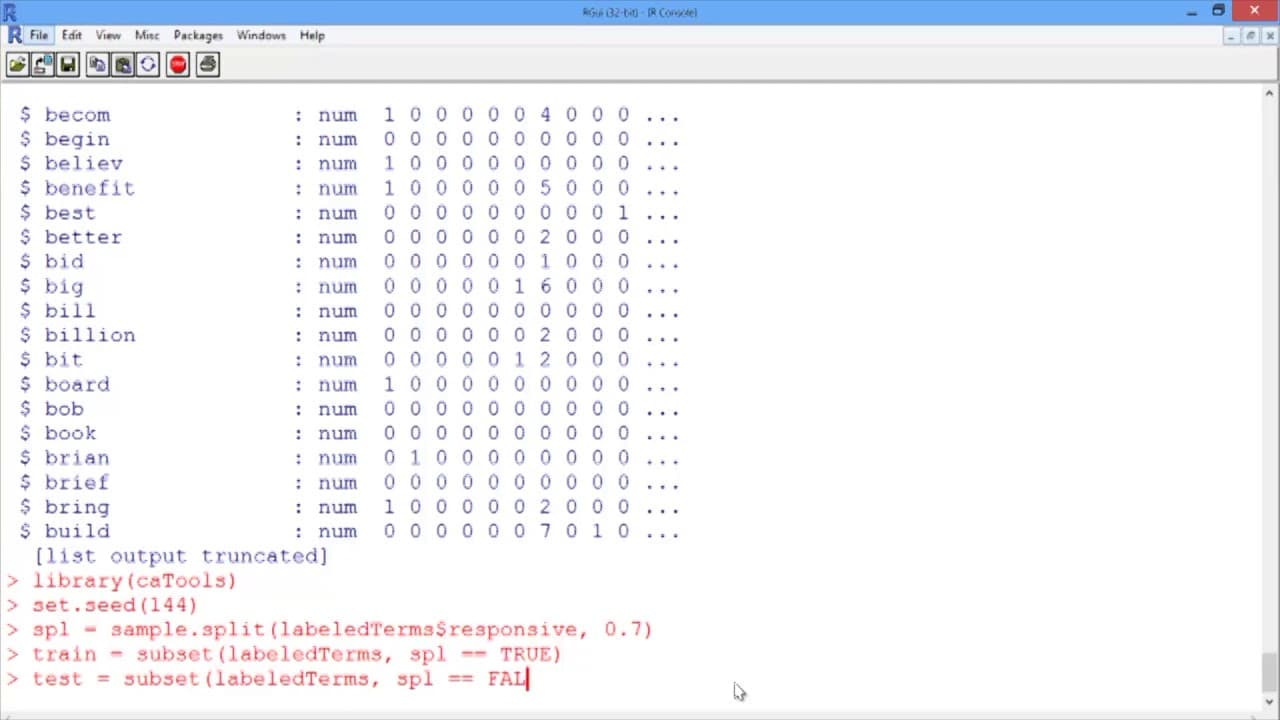
This content discusses how to split data into training and testing sets, and build a classification model using CART to predict responsive emails.
Transcript
At long last, we're ready to split our data into a training and testing set, and to actually build a model. So we'll start by loading the ca tools package, so that we can split our data. So we'll do library(caTools). And then, as usual, we're going to set our random seeds so that everybody has the same results. So use set.seed and we'll pick the nu... Read More
Key Insights
- 😫 Splitting data into training and testing sets is an essential step in building a robust model.
- 🤸 CART models are effective for classification problems and provide interpretable decision trees.
- 💌 Terms like "California" and those related to energy markets play a crucial role in predicting email responsiveness.
- ❓ The CART model reveals potential connections to Enron's involvement in the California energy markets.
- 🌲 The rpart.plot package can be used to visualize and understand the decision tree of a CART model.
- ❓ Random forests can be another suitable modeling technique to consider.
- 😒 The number of terms makes it impractical to manually include them all, necessitating the use of the tilde period notation.
Install to Summarize YouTube Videos and Get Transcripts
Explore YouTube Video Summarizer or Get YouTube Transcript Extractor
Questions & Answers
Q: What is the purpose of splitting the data into training and testing sets?
Splitting the data allows us to train the model on a subset of the data and evaluate its performance on unseen data. This helps in assessing the model's accuracy and generalizability.
Q: Why is the random seed set to a specific number?
Setting the random seed ensures reproducibility. By using the same seed, everyone will get the same random split of the data, leading to consistent results.
Q: Why is a CART model chosen for this classification problem?
CART (Classification and Regression Trees) is suitable for classification problems with categorical outcomes. It creates a decision tree to understand the relationships between predictor variables and the target variable.
Q: What insights can we gain from the plotted CART model?
The top split in the tree, where the term "California" appears, indicates its importance in predicting responsiveness. Other terms related to energy markets, such as "system," "demand," "bid," and "gas," are also significant. The presence of "Jeff" might reference Enron's CEO and his involvement in fraud.
Summary & Key Takeaways
-
The data is split into training and testing sets using the caTools package, with a 70/30 split.
-
A CART model is built to predict whether an email is responsive, based on the frequencies of different terms.
-
The model's decision tree reveals that terms like "California" and terms related to energy bids and scheduling are important predictors of responsiveness.
Read in Other Languages (beta)
Share This Summary 📚
Summarize YouTube Videos and Get Video Transcripts with 1-Click
Try YouTube Summary with ChatGPT & Claude or YouTube Transcript Generator
Explore More Summaries from MIT OpenCourseWare 📚



Summarize YouTube Videos and Get Video Transcripts with 1-Click
Try YouTube Summary with ChatGPT & Claude or YouTube Transcript Generator