L15.5 The Mean Squared Error
TL;DR
The video discusses the performance of an estimator for a random variable in the presence of additive noise, focusing on the mean squared error and conditional variance.
Transcript
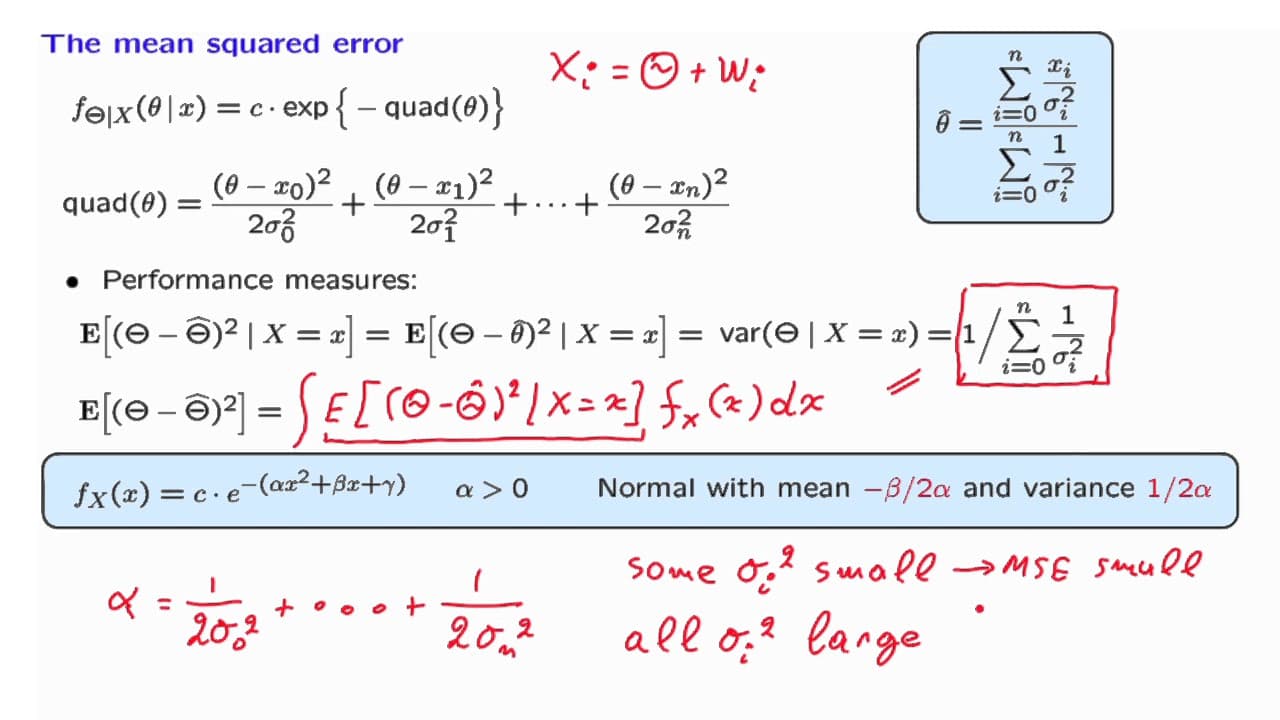
We now continue our discussion of the model in which we obtain several measurements of an unknown random variable Theta in the presence of additive noise, under the same assumptions as before. Theta and Wi are all independent random variables. And they're also normal. We have seen that in this case, the posterior distribution of Theta is a normal d... Read More
Key Insights
- ❓ The posterior distribution of a random variable Theta, under the assumptions of independence and normality, is also a normal distribution.
- 🍉 The variance of the posterior distribution can be derived by examining the coefficients next to the squared terms in the posterior distribution formula.
- ❎ The overall mean squared error, which represents the expected error before making measurements, is equal to the conditional mean squared error because the conditional variance is constant for all values of the observations.
- 🥺 In the special case of all variances being the same, obtaining more observations leads to a decrease in the variance of the posterior distribution and thus, improved estimation performance.
- 🍉 The conditional variance being the same for all values of the observations implies that no particular observation is more informative than another in terms of estimating Theta.
Install to Summarize YouTube Videos and Get Transcripts
Explore YouTube Video Summarizer or Get YouTube Transcript Extractor
Questions & Answers
Q: What is the maximum posterior probability estimate and how is it calculated?
The maximum posterior probability estimate is the mean of the posterior distribution of a random variable Theta. It can be calculated using a specific formula provided in the video.
Q: What is the conditional mean squared error and why is it a reasonable performance measure?
The conditional mean squared error is the error that remains after seeing the observations. It is a reasonable performance measure because it quantifies how well the estimator performs in estimating the random variable Theta.
Q: How does the presence of additive noise affect the uncertainty in estimating Theta?
If the variances of the noise terms are small, the uncertainty in estimating Theta decreases. Conversely, if the noise variances are large, the uncertainty increases, indicating a poor estimation performance.
Q: Is the conditional variance of Theta dependent on the specific value of the observations?
No, the conditional variance of Theta is the same for all values of the observations. This means that no particular value of the observations is more informative or desirable than any other value.
Summary & Key Takeaways
-
The video discusses the posterior distribution of a random variable Theta in the presence of additive noise, which is a normal distribution.
-
The mean of the posterior distribution, also known as the maximum posterior probability estimate, is calculated using a specific formula.
-
The conditional mean squared error, which measures the remaining error after seeing the observations, and the conditional variance of Theta are derived and analyzed.
Read in Other Languages (beta)
Share This Summary 📚
Summarize YouTube Videos and Get Video Transcripts with 1-Click
Try YouTube Summary with ChatGPT & Claude or YouTube Transcript Generator
Explore More Summaries from MIT OpenCourseWare 📚



Summarize YouTube Videos and Get Video Transcripts with 1-Click
Try YouTube Summary with ChatGPT & Claude or YouTube Transcript Generator