Lecture 1.3: James DiCarlo - Neural Mechanisms of Recognition Part 1
TL;DR
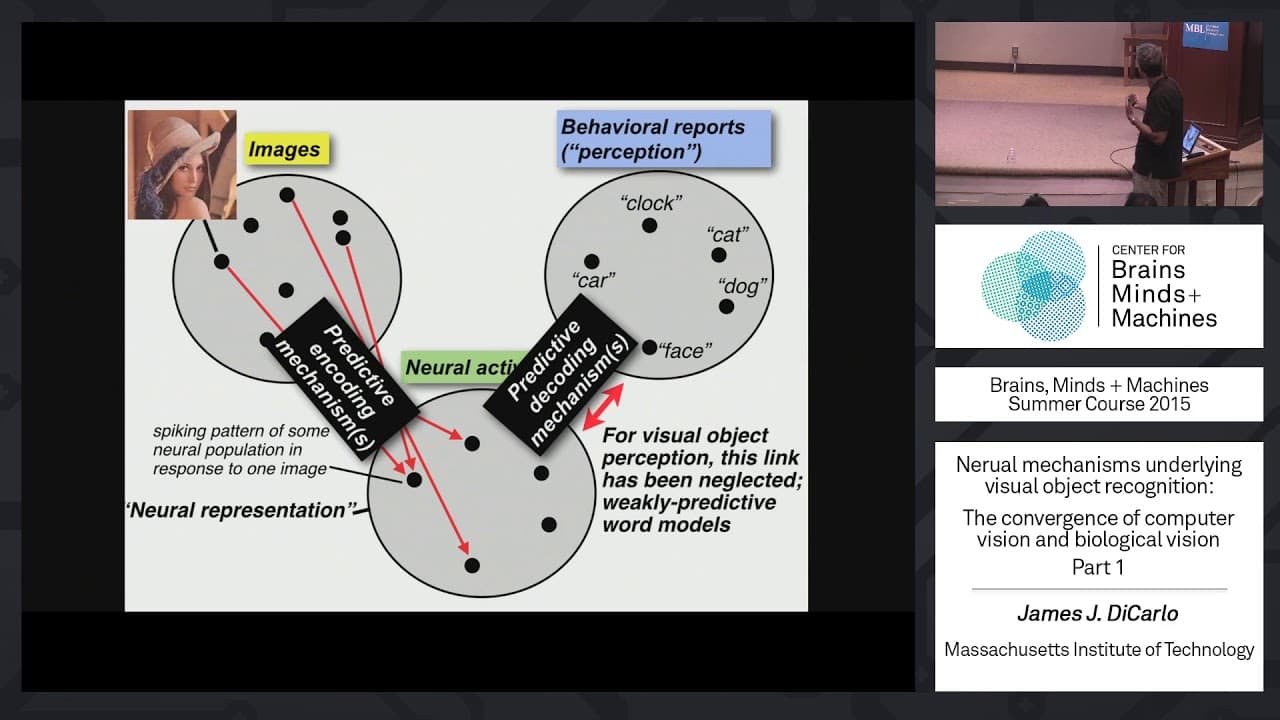
Object recognition in the brain is a complex and challenging problem due to the invariance of objects and their infinite number of possible images.
Transcript
The following content is provided under a Creative Commons license. Your support will help MIT OpenCourseWare continue to offer high quality educational resources for free. To make a donation, or view additional materials from hundreds of MIT courses, visit MIT OpenCourseWare at ocw.mit.edu. JAMES DICARLO: So let me start by first-- I already allud... Read More
Key Insights
- 💁 Object recognition is not just about identifying objects, but also about extracting latent information such as size, position, and pose.
- 😌 The challenge of object recognition lies in dealing with the invariance problem, where objects can produce an infinite number of images under different views and transformations.
- 🧠 Different visual areas in the brain, such as V1, V2, V4, and IT, contribute to object recognition in a stepwise and systematic manner.
Install to Summarize YouTube Videos and Get Transcripts
Explore YouTube Video Summarizer or Get YouTube Transcript Extractor
Questions & Answers
Q: Why is object recognition considered a challenging problem in the brain?
Object recognition is challenging because objects can produce an infinite number of images due to their invariance, and the brain needs to be able to generalize and make predictions based on limited samples.
Q: What is the key insight about the problem of object recognition?
The key insight is that the brain needs to transform the complex and curved image space into a simpler and more explicit representation in order to enable efficient and accurate recognition.
Q: How do different visual areas in the brain contribute to object recognition?
Different visual areas, such as V1, V2, V4, and inferotemporal cortex (IT), have specific roles in object recognition. V1 processes basic visual features, V2 adds more complexity and context, V4 is sensitive to orientation and texture information, and IT is believed to be the encoding basis for explicit object recognition.
Q: How do neuroscientists study object recognition in the brain?
Neuroscientists use techniques such as electrophysiology to record activity from individual neurons, as well as lesion studies and computational models to understand how different brain areas contribute to object recognition.
Summary & Key Takeaways
-
The problem of object recognition is one of the many computational challenges that the brain solves.
-
Vision operationally defines object recognition as the ability to identify objects in images and extract latent information such as size, pose, and position.
-
The invariance problem, which refers to the ability to recognize objects across different views and transformations, makes object recognition difficult.
Read in Other Languages (beta)
Share This Summary 📚
Summarize YouTube Videos and Get Video Transcripts with 1-Click
Try YouTube Summary with ChatGPT & Claude or YouTube Transcript Generator
Explore More Summaries from MIT OpenCourseWare 📚


Summarize YouTube Videos and Get Video Transcripts with 1-Click
Try YouTube Summary with ChatGPT & Claude or YouTube Transcript Generator