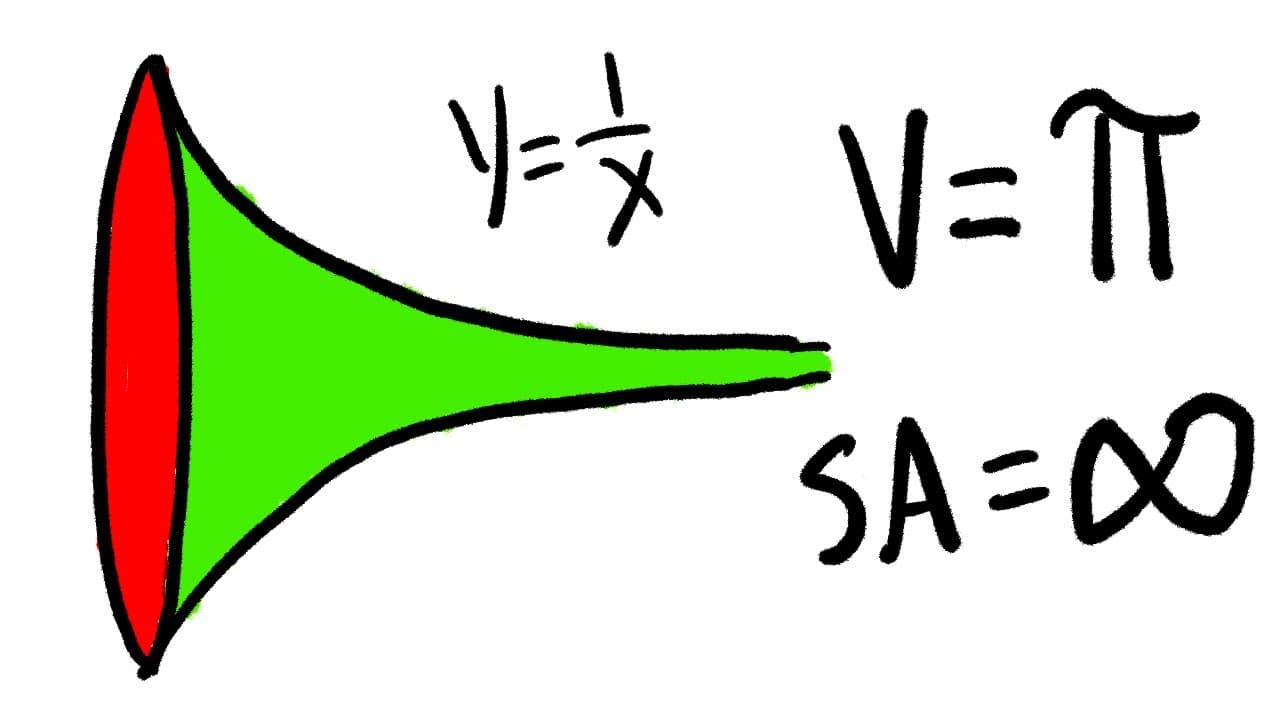
Gabriel's Horn paradox (finite volume but infinite surface area)
TL;DR
This video explains the concept of Gabriel's Horn, demonstrating its finite volume but infinite surface area.
Transcript
is the gabriel's home right here and as you guys can see guests can go check out brenda work for more interesting topic like this one right here anyway let's go over this let me show you guys the definition of gabriel's horn so let me of course write it down first gabriel's 1 and this is how they define it what we're going to do is we're going to c... Read More
Key Insights
- ☺️ Gabriel's Horn is defined as the region under the curve of the function 1/x from x=1 to infinity, rotated around the x-axis.
- 🔇 The volume of Gabriel's Horn can be calculated using the disk method and is found to be finite.
- ❓ The surface area of Gabriel's Horn is determined to be infinite, challenging our understanding of dimensions.
- ☺️ The volume is determined by integrating pi(1/x)^2 with respect to x from 1 to infinity.
- ☺️ The surface area is determined by integrating 2pi(1/x)sqrt(1 + (-1/x^2)) with respect to x from 1 to infinity.
- ❓ The infinite surface area of Gabriel's Horn highlights a counterintuitive concept in mathematics.
- 🛟 Gabriel's Horn serves as an example of how mathematical concepts can defy our intuition.
Install to Summarize YouTube Videos and Get Transcripts
Explore YouTube Video Summarizer or Get YouTube Transcript Extractor
Questions & Answers
Q: What is Gabriel's Horn and how is it defined?
Gabriel's Horn is the region under the curve of the function 1/x from x=1 to infinity, rotated around the x-axis.
Q: How can the volume of Gabriel's Horn be calculated?
The volume can be found using the disk method, by integrating pi(1/x)^2 with respect to x from 1 to infinity.
Q: What is the surface area of Gabriel's Horn?
The surface area is infinite, determined by integrating 2pi(1/x)sqrt(1 + (-1/x^2)) with respect to x from 1 to infinity.
Q: What is the significance of Gabriel's Horn having a finite volume but infinite surface area?
It illustrates a counterintuitive concept in mathematics, challenging our understanding of space and dimensions.
Summary & Key Takeaways
-
Gabriel's Horn is defined as the region under the curve of the function 1/x from x=1 to infinity, rotated around the x-axis.
-
The volume of Gabriel's Horn can be found using the disk method, by integrating pi(1/x)^2 with respect to x from 1 to infinity.
-
The surface area of Gabriel's Horn is infinite, as determined by integrating 2pi(1/x)sqrt(1 + (-1/x^2)) with respect to x from 1 to infinity.
Read in Other Languages (beta)
Share This Summary 📚
Summarize YouTube Videos and Get Video Transcripts with 1-Click
Try YouTube Summary with ChatGPT & Claude or YouTube Transcript Generator
Explore More Summaries from blackpenredpen 📚
Summarize YouTube Videos and Get Video Transcripts with 1-Click
Try YouTube Summary with ChatGPT & Claude or YouTube Transcript Generator