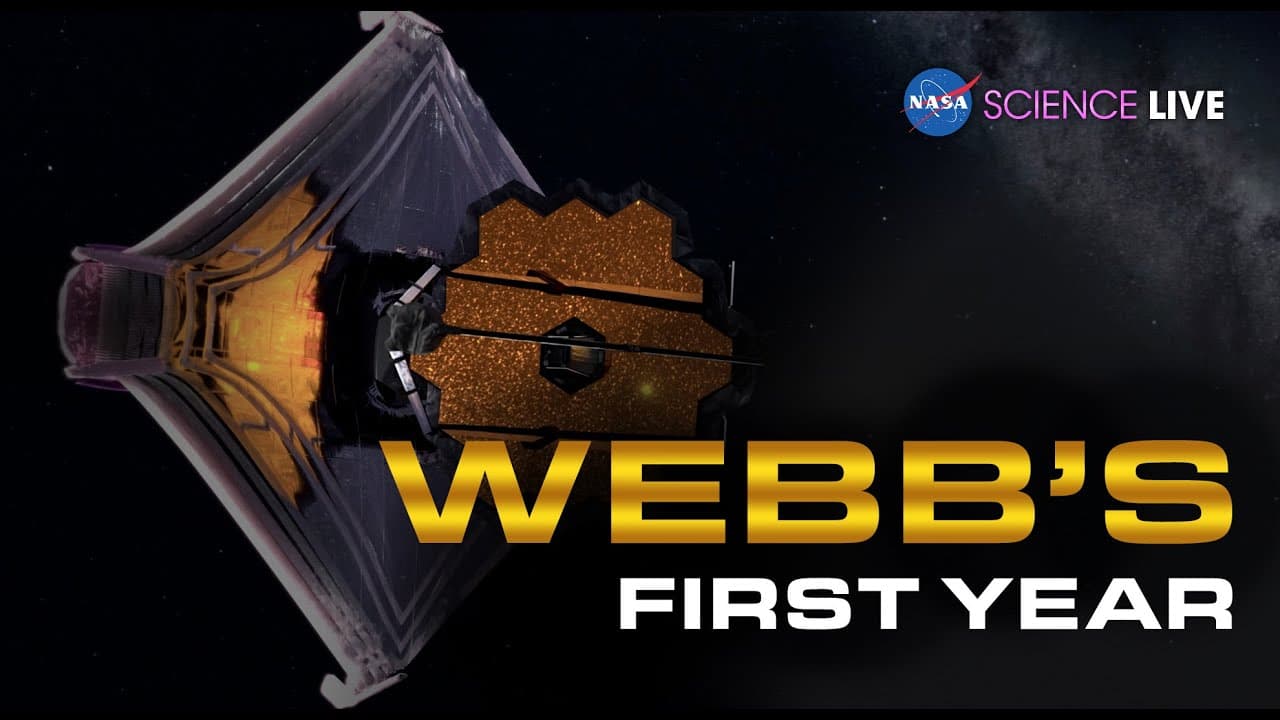
NASA Science Live: Webb's First Year
TL;DR
NASA's James Webb Space Telescope (Webb) celebrates its first year in science, revealing stunning images and shedding light on the formation of stars, galaxies, and exoplanets.
Transcript
foreign foreign foreign thank you foreign welcome to another episode of NASA science live an opportunity for you to interact with NASA experts and have your questions answered in real time I'm your host Tahira Allen and today we're joining you live from NASA's Goddard space flight center in Greenbelt Maryland one year ago today the James Webb Space... Read More
Key Insights
- ❓ Webb has exceeded expectations in its first year, providing incredible images and data on various astronomical objects.
- 🤩 The telescope has enhanced our understanding of star formation, galaxy evolution, and exoplanet atmospheres.
- 🙂 Webb's ability to capture infrared light has revealed hidden structures and features in our own solar system, such as storms on Uranus and Neptune and detailed images of Saturn's rings.
- 👻 The telescope has acted as a time machine, allowing us to peer back billions of years and witness the early stages of galaxy formation and evolution.
- 👶 Webb's data will continue to be analyzed and new discoveries are expected in the coming years.
- 👨🔬 There is potential for citizen scientists to contribute to Webb's research once a citizen science project is developed.
Install to Summarize YouTube Videos and Get Transcripts
Explore YouTube Video Summarizer or Get YouTube Transcript Extractor
Questions & Answers
Q: How does the James Webb Space Telescope capture such detailed images of distant galaxies?
The telescope uses filters to select specific wavelengths of infrared light, which are then assigned visible colors for the images. This process allows scientists to see the details and structures of galaxies that emit infrared light.
Q: What have we learned about exoplanets from Webb's observations?
Webb has revealed the chemical composition of exoplanet atmospheres, analyzing spectroscopic data to identify specific molecules like carbon dioxide and water vapor. This information provides insights into the potential habitability of these planets.
Q: Are there any opportunities for citizen scientists to analyze Webb's data?
Currently, NASA is still working on developing a strategy for citizen science projects with Webb's data. However, all of the telescope's data will eventually become publicly accessible, allowing anyone to explore and analyze the images and spectra.
Q: How far back in time can Webb observe?
Webb can observe galaxies and objects that existed up to 13.5 billion years ago, just a few hundred million years after the Big Bang. This allows scientists to study the early formation and development of galaxies in the universe.
Summary & Key Takeaways
-
Webb has provided detailed images and data of the closest star-forming region to Earth, revealing the birth of baby stars in the Rho Ophiuchi Cloud complex.
-
The telescope has discovered and studied exoplanets, including the TRAPPIST-1 system, shedding light on their atmospheres and potential habitability.
-
Webb has revealed the intimate details of our own solar system, capturing images of planets like Neptune and Saturn, as well as their rings and storms.
-
The telescope has also peered back in time to the early universe, uncovering the formation and evolution of galaxies billions of years ago.
Read in Other Languages (beta)
Share This Summary 📚
Summarize YouTube Videos and Get Video Transcripts with 1-Click
Try YouTube Summary with ChatGPT & Claude or YouTube Transcript Generator
Explore More Summaries from NASA 📚

Summarize YouTube Videos and Get Video Transcripts with 1-Click
Try YouTube Summary with ChatGPT & Claude or YouTube Transcript Generator