26.3 Totally Inelastic Collisions
TL;DR
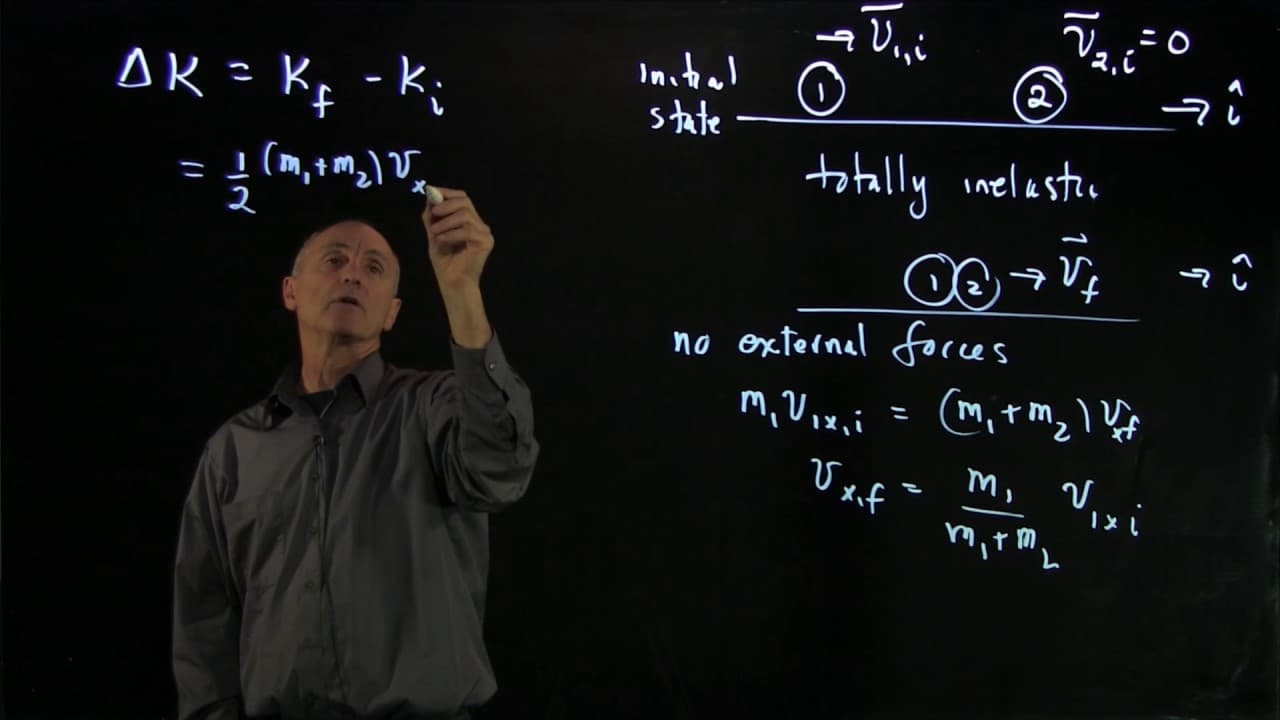
A one-dimensional collision with two particles sticking together results in a loss of kinetic energy due to internal forces and deformations.
Transcript
Let's analyze a one-dimensional collision, where we're in the laboratory reference frame. And we have V1 initial and V2 initial is 0. It's a frictionless surface. But there's a collision here. And now we're going to make this collision totally inelastic. Now what that means is that the two particles stick together. So if this is our initial state--... Read More
Key Insights
- 💋 In a one-dimensional totally inelastic collision, two particles stick together, resulting in a loss of kinetic energy.
- ❓ Internal forces cancel in pairs, and with no external forces, the momentum of the system remains constant.
- 💥 Kinetic energy is not constant in a totally inelastic collision due to irreversible deformations and the conversion of energy into other forms.
- 🥳 The loss of kinetic energy in a totally inelastic collision depends on the mass ratio of the two objects.
- 🥳 The change in kinetic energy can be calculated based on the initial kinetic energy and the mass ratio.
- 🥳 The loss of kinetic energy is proportional to the initial kinetic energy and inversely proportional to the mass ratio.
Install to Summarize YouTube Videos and Get Transcripts
Explore YouTube Video Summarizer or Get YouTube Transcript Extractor
Questions & Answers
Q: What happens in a one-dimensional totally inelastic collision?
In a one-dimensional totally inelastic collision, two particles stick together in the final state due to internal forces. Kinetic energy is lost, as it is converted into other forms of energy.
Q: How does the momentum of the system change in a one-dimensional totally inelastic collision?
The momentum of the system remains constant in a one-dimensional totally inelastic collision. Since there are no external forces, the momentum before the collision is equal to the momentum after the collision.
Q: Why is kinetic energy not constant in a totally inelastic collision?
Kinetic energy is not constant in a totally inelastic collision because internal forces cause irreversible deformations, generating other forms of energy such as heat and noise.
Q: What factors influence the loss of kinetic energy in a totally inelastic collision?
The loss of kinetic energy in a totally inelastic collision depends on the initial kinetic energy and the mass ratio of the two objects. The greater the mass ratio, the greater the loss of kinetic energy.
Summary & Key Takeaways
-
A one-dimensional collision occurs on a frictionless surface, with two particles sticking together in the final state.
-
Internal forces cancel in pairs, and with no external forces, the momentum of the system is constant.
-
In a totally inelastic collision, kinetic energy is not constant and is lost due to irreversible deformations and other forms of energy.
Read in Other Languages (beta)
Share This Summary 📚
Summarize YouTube Videos and Get Video Transcripts with 1-Click
Try YouTube Summary with ChatGPT & Claude or YouTube Transcript Generator
Explore More Summaries from MIT OpenCourseWare 📚



Summarize YouTube Videos and Get Video Transcripts with 1-Click
Try YouTube Summary with ChatGPT & Claude or YouTube Transcript Generator