Infinite fractions and the most irrational number
TL;DR
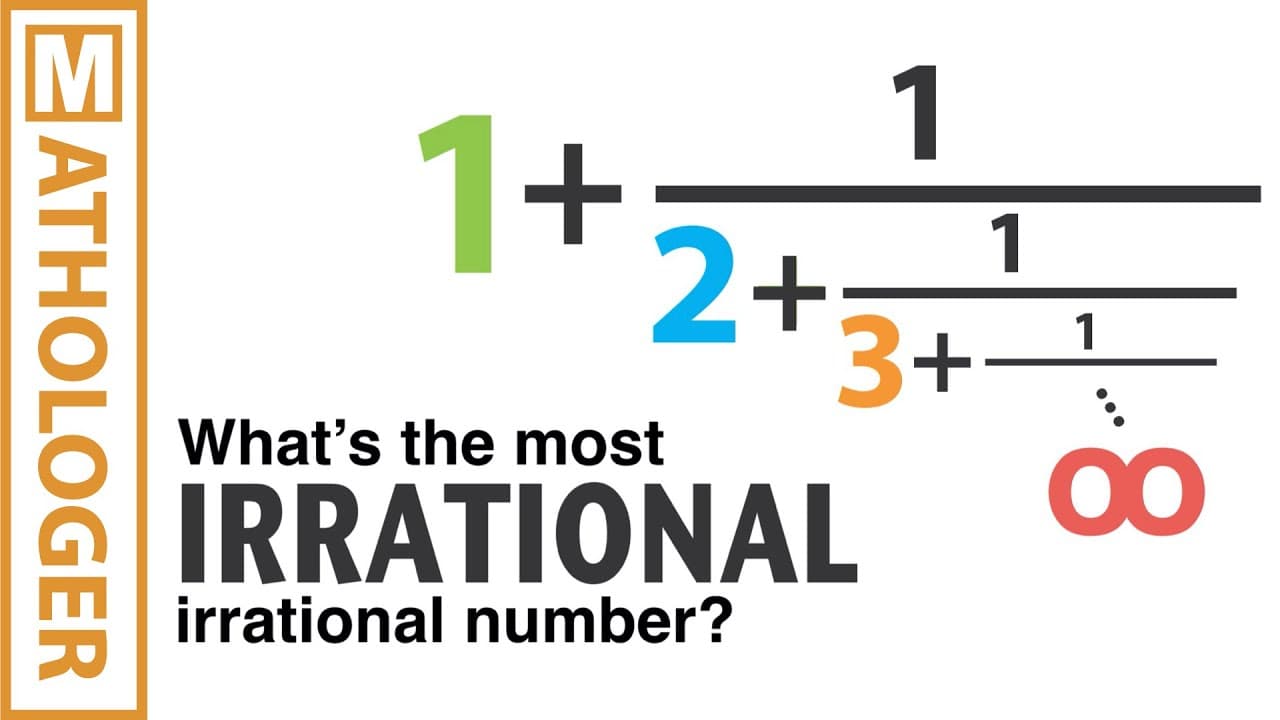
Infinite fractions are powerful tools for understanding the irrationality of numbers, and through continued fractions, we can explore the most irrational numbers.
Transcript
[Subtitles contributed by: Zacháry Dorris] You are watching a Mathologer video, and that probably means you're familiar with infinite sums, but did you ever encounter infinite fractions? Not many people have. Now infinite fractions are incredibly powerful tools for uncovering structure and patterns hidden in real numbers. And they are particularly ... Read More
Key Insights
- 🔨 Infinite fractions, particularly continued fractions, are effective tools for studying the irrationality of numbers.
- 🤑 Simple continued fractions have all ones as numerators and provide periodic representations of square roots.
- #️⃣ The continued fraction expansions of numbers like e do not exhibit repetition and are harder to approximate with fractions.
- 👋 Continued fractions provide the best rational approximations to real numbers.
- 🥳 The golden ratio (Φ) is the most irrational number as it is the hardest to approximate with fractions.
Install to Summarize YouTube Videos and Get Transcripts
Explore YouTube Video Summarizer or Get YouTube Transcript Extractor
Questions & Answers
Q: What are infinite fractions, and why are they useful in uncovering patterns in numbers?
Infinite fractions are representations of numbers where the denominators continue indefinitely. They are useful in discovering the structure and patterns hidden in real numbers, especially in relation to their irrationality.
Q: Can any number be represented as an infinite fraction?
Yes, any number can be expressed as an infinite fraction. This is done through continued fractions, where the integer part is separated from the rest, and the process of rewriting and evaluating the fraction continues indefinitely.
Q: How can continued fractions be used to prove the irrationality of numbers?
By observing the continued fraction expansion, it is possible to determine whether a number is rational or irrational. If the continued fraction expands forever, the number is irrational. This is a proof of irrationality for numbers like √2, Φ, and e.
Q: What is the significance of comparing the approximations of two numbers using continued fractions?
Comparing the approximations of two numbers using continued fractions reveals which number is more irrational. The number that is harder to approximate with fractions, as seen through the partial fractions, is considered more irrational.
Summary & Key Takeaways
-
Infinite fractions, particularly continued fractions, reveal hidden patterns and structure in real numbers.
-
Every number can be represented as an infinite fraction, and simple continued fractions have all ones as numerators.
-
Square roots lead to periodic continued fractions, while numbers like e have non-repeating continued fractions.
Read in Other Languages (beta)
Share This Summary 📚
Summarize YouTube Videos and Get Video Transcripts with 1-Click
Try YouTube Summary with ChatGPT & Claude or YouTube Transcript Generator
Explore More Summaries from Mathologer 📚



Summarize YouTube Videos and Get Video Transcripts with 1-Click
Try YouTube Summary with ChatGPT & Claude or YouTube Transcript Generator