5.2.12 An Introduction to Text Analytics - Video 7: Predicting Sentiment
TL;DR
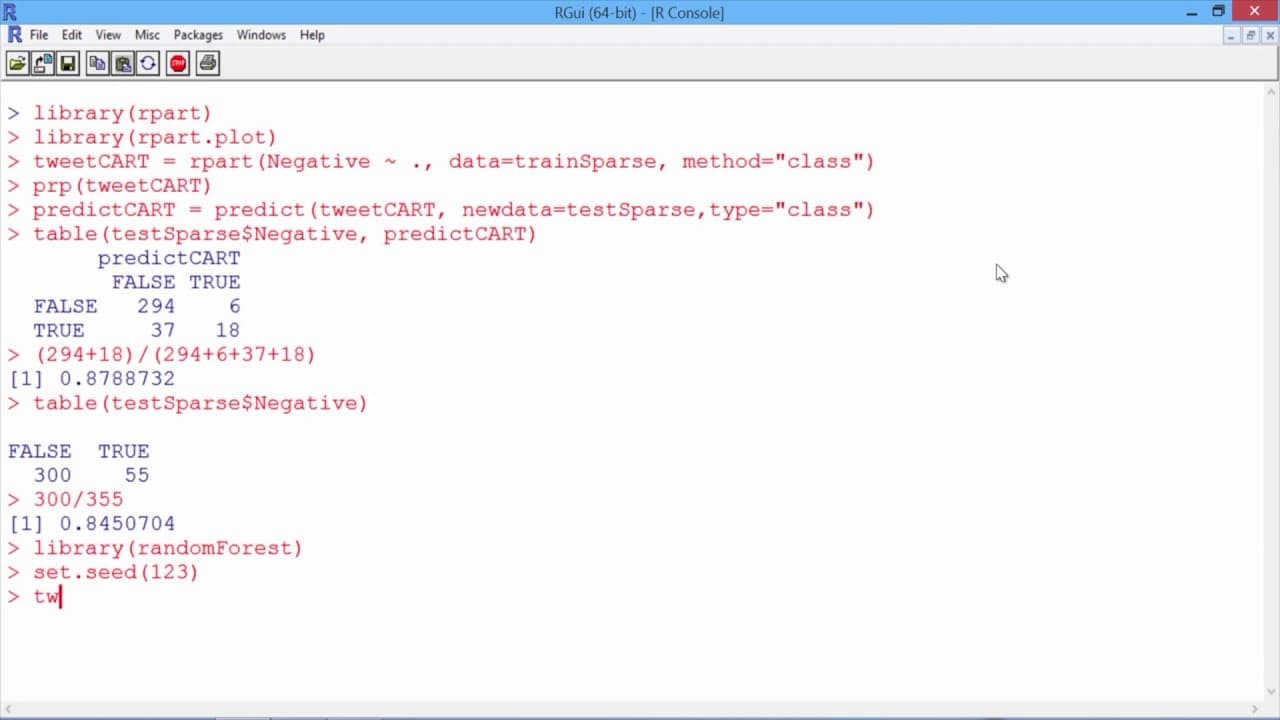
Using the bag-of-words approach, CART and random forest models were built to predict sentiment in tweets, achieving accuracies of 0.88 and 0.885, respectively.
Transcript
Now that we've prepared our data set, let's use CART to build a predictive model. First, we need to load the necessary packages in our R Console by typing library(rpart), and then library(rpart.plot). Now let's build our model. We'll call it tweetCART, and we'll use the rpart function to predict Negative using all of the other variables as our inde... Read More
Key Insights
- 🥖 The bag-of-words approach was used to predict sentiment in tweets.
- ❓ The CART model had an accuracy of 0.88, while the random forest model had an accuracy of 0.885.
- 💄 The interpretability of the CART model makes it more preferred over the random forest model.
- 🏛️ Building a random forest model for text analytics problems with a large number of independent variables takes significantly longer than building a CART model.
- 😵 Cross-validation could be used to improve the accuracy of the CART model.
Install to Summarize YouTube Videos and Get Transcripts
Explore YouTube Video Summarizer or Get YouTube Transcript Extractor
Questions & Answers
Q: How was the CART model built?
The CART model was built using the rpart package in R, with the "Negative" variable as the dependent variable, and all other variables as independent variables. The model used the words "freak," "hate," and "wtf" as predictors for negative sentiment.
Q: How was the accuracy of the CART model calculated?
The accuracy of the CART model was calculated by creating a confusion matrix using the actual outcomes and the model's predictions on the test set. The accuracy was computed by summing up the correctly predicted cases and dividing by the total number of observations in the table.
Q: How does the accuracy of the CART model compare to the baseline model?
The accuracy of the CART model (0.88) was higher than that of the baseline model (0.845) which always predicted non-negative sentiment. This suggests that the CART model performs better in predicting sentiment.
Q: How was the random forest model built and evaluated?
The random forest model was built using the randomForest package in R, with the same variables as the CART model. The accuracy was computed by creating a confusion matrix using the actual outcomes and the model's predictions on the test set.
Summary & Key Takeaways
-
CART model: A classification model was built using the rpart package in R, with "freak," "hate," and "wtf" as negative sentiment predictors.
-
Confusion matrix: The model achieved an accuracy of 0.88 when making predictions on the test set.
-
Baseline model: A simple baseline model that always predicts non-negative sentiment had an accuracy of 0.845.
-
Random forest model: Another model was built using the randomForest package, achieving an accuracy of 0.885.
-
Model comparison: While the random forest model had a slightly higher accuracy, the interpretability of the CART model made it more preferred.
Read in Other Languages (beta)
Share This Summary 📚
Summarize YouTube Videos and Get Video Transcripts with 1-Click
Try YouTube Summary with ChatGPT & Claude or YouTube Transcript Generator
Explore More Summaries from MIT OpenCourseWare 📚


Summarize YouTube Videos and Get Video Transcripts with 1-Click
Try YouTube Summary with ChatGPT & Claude or YouTube Transcript Generator