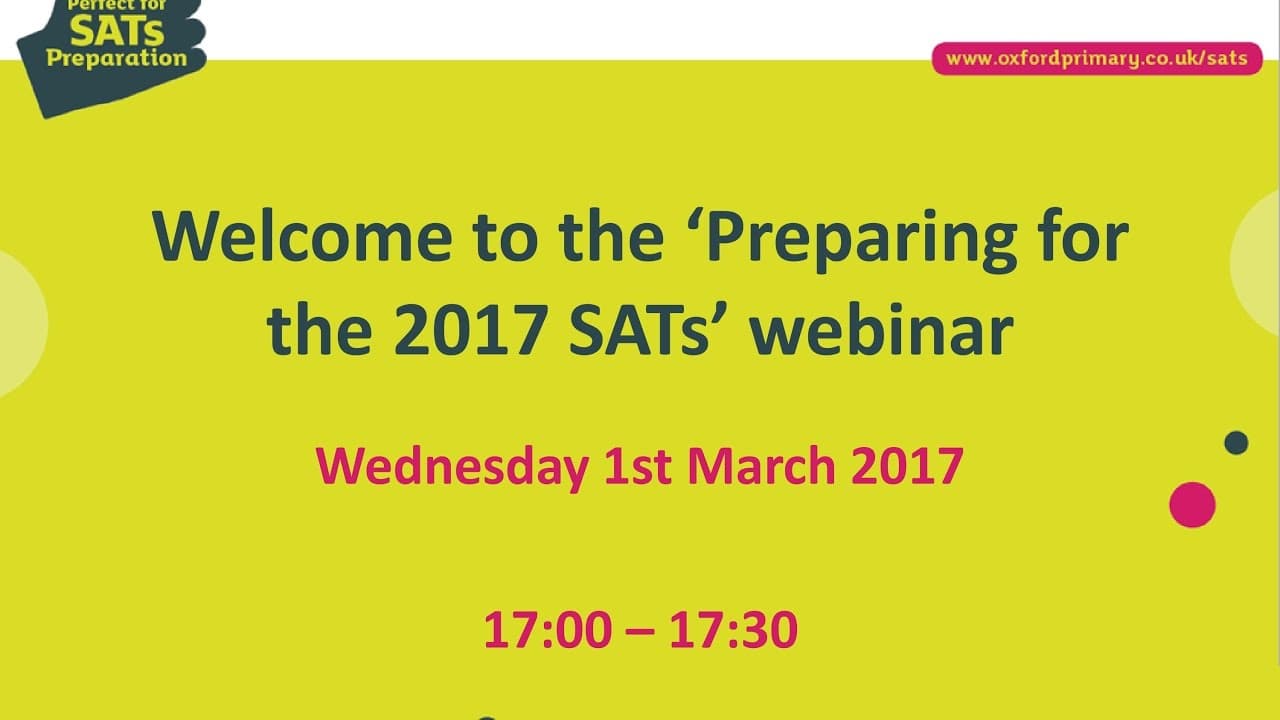
Preparing for the 2017 SATs Webinar
TL;DR
This webinar discusses strategies for preparing children for the challenging SATs exam, with a focus on developing comprehension, reasoning, spelling, and grammar skills.
Transcript
good afternoon everyone welcome to today's webinar on preparing for SATs 2017 I'm Martin nuclear chat and I'm excited to have with me Nicola romaine and Louise Pennington from Oxford University Press they are PD leads here with us today let me tell you lives with about them and please add anything you wish Louise is a PD leader for maps at Oxford U... Read More
Key Insights
- 🧑🏫 Explicitly teaching vocabulary and comprehension strategies is crucial for effective reading.
- 🫠 Fluency in reading aloud helps in developing reading comprehension and confidence.
- 🧑🎓 Empowering students to take ownership of their spelling skills improves their independent spelling proficiency.
- ✋ Using discussion, high-quality texts, manipulatives, and metacognition enhances grammar teaching and comprehension.
- ⌛ Mathematical reasoning skills require time, practice, manipulatives, and a supportive classroom environment.
- 🤔 Metacognitive strategies and problem-solving in small groups promote mathematical reasoning and thinking.
- 👪 Parents should maintain a balanced approach, explore online resources, and support reading at home for SATs preparation.
Install to Summarize YouTube Videos and Get Transcripts
Explore YouTube Video Summarizer or Get YouTube Transcript Extractor
Questions & Answers
Q: How can we prepare children for the challenging memory in English comprehension?
To develop effective comprehension, children need a broad vocabulary and the ability to understand and spell words. It is important to explicitly teach vocabulary across the curriculum and teach spelling in a way that helps children understand the meaning of words. Whole-school approaches and practical strategies like choosing rich vocabulary texts and discussing unfamiliar words can also help.
Q: How can we help children improve their inference and deduction skills in reading?
Inference and deduction skills are higher-order reading skills that require critical thinking. Teachers should explicitly teach these strategies through discussions, structured activities, and modeling. Providing opportunities for children to activate prior knowledge, discuss texts, summarize, predict, and make connections with other texts can also enhance their inference and deduction skills.
Q: How can teachers support children in developing fluency in reading aloud?
It is important to provide regular opportunities for children to read aloud and to model effective reading. Teachers should set up reading partnerships, engage in speed reading exercises, and provide texts that are accessible to children. By listening to and hearing written words, children can improve their reading fluency, comprehension, and confidence.
Q: What strategies can be used to improve students' independent spelling skills?
Empowering students to take ownership of their spelling proficiency is key. Teachers can encourage collaborative work, provide spelling journals, teach different spelling strategies, and support peer learning. Teachers should also assess spelling in writing and provide meaningful contexts to reinforce learning.
Q: How can grammar teaching be made more lively and engaging?
Using discussion, high-quality texts, manipulatives, drama, and metacognition can make grammar teaching more lively. Teachers should model thinking and problem-solving, integrate grammar learning into writing and other subjects, and provide opportunities for students to discuss and question concepts. Creating a safe environment for challenging ideas and mistakes is also important.
Q: Why do students find mathematical reasoning more difficult than arithmetic?
Mathematical reasoning requires skills that are not traditionally taught explicitly. It takes time to develop reasoning skills, and teachers often focus more on procedural aspects. The format and higher expectations of recent SATs papers may have also contributed to students finding reasoning more challenging. Teachers should devote more time to reasoning, normalize being stuck, and provide manipulatives and metacognitive strategies to support students.
Q: How can mathematical reasoning skills be developed before the SATs?
Teachers can create a supportive classroom environment by promoting discussion, questioning, and problem-solving in small groups. Using manipulatives, providing writing scaffolds, and modeling thinking are effective strategies. Teachers should also focus on learning and teaching reasoning as a routine, apply metacognitive techniques, and celebrate metacognition and thinking.
Q: What tips can be given to parents for supporting SATs preparation at home?
Parents should maintain a balanced routine, ensure enough sleep, and keep SATs preparation normal and fun. They can explore online resources and apps, access the Oxford owl website for activities and questions, and familiarize themselves with the tips and strategies provided by education experts. Supporting reading at home is also important.
Summary & Key Takeaways
-
The webinar emphasizes the importance of explicitly teaching vocabulary to develop effective comprehension skills.
-
It suggests using discussion and structured activities to teach inference and deduction.
-
The presenters emphasize the need for fluency in reading aloud and provide strategies for developing this skill.
-
The webinar highlights the importance of empowering students to take ownership of their spelling proficiency.
-
It recommends using discussion, high-quality texts, manipulatives, and metacognition to improve grammar teaching.
-
The presenters discuss the challenge of developing mathematical reasoning skills and suggest strategies such as group work and metacognition.
-
The webinar also offers tips for parents on maintaining a balanced approach to SATs preparation.
Read in Other Languages (beta)
Share This Summary 📚
Summarize YouTube Videos and Get Video Transcripts with 1-Click
Try YouTube Summary with ChatGPT & Claude or YouTube Transcript Generator
Explore More Summaries from Oxford Education 📚

Summarize YouTube Videos and Get Video Transcripts with 1-Click
Try YouTube Summary with ChatGPT & Claude or YouTube Transcript Generator