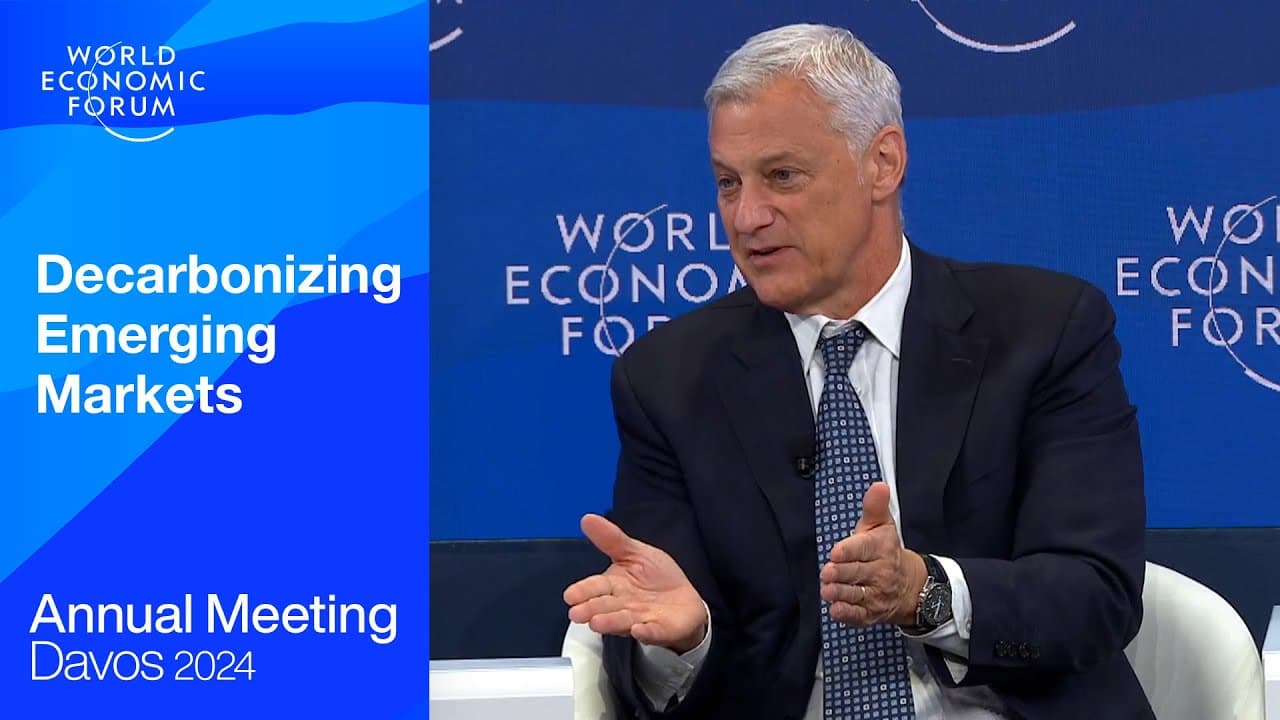
Decarbonizing Emerging Markets | Davos 2024 | World Economic Forum
TL;DR
Many emerging economies face a funding gap of $2 trillion annually to achieve a carbon-neutral future, with only a fraction of the required capital being mobilized. Innovative funding solutions and robust policy frameworks are essential to bridge this gap.
Transcript
good afternoon thank you thank you for for being with us now the goal is to decarbonize keep one and a half alive for emerging economies it means mobilizing about2 trillion dollar annually through 2030 but currently only 20% of what's needed is being mobilized so there is a funding Gap and according to the IMF the private Capital can fill about 80%... Read More
Key Insights
- 🚨 Financing the energy transition in emerging economies requires about $2 trillion annually, with only a fraction of that amount currently being mobilized.
- ✋ The Energy Transition Accelerator, focused on jurisdictional approaches and high-integrity carbon markets, aims to bridge the financing gap for clean energy projects.
- 💚 MDBs are committed to increasing their contributions, supporting policy reforms, and mobilizing public and private sector financing to drive green transitions in all countries.
- 🖐️ Philanthropies can play a crucial role in catalyzing innovation, supporting ambitious projects, and investing in people-centered solutions.
- 💚 Banks can mobilize private capital by developing innovative financing solutions, collaborating with public sectors, and standardizing green investment structures.
Install to Summarize YouTube Videos and Get Transcripts
Explore YouTube Video Summarizer or Get YouTube Transcript Extractor
Questions & Answers
Q: How does the Energy Transition Accelerator aim to address the financing gap for the energy transition in emerging economies?
The ETA focuses on jurisdictional approaches and high-integrity carbon market solutions to mobilize finance for clean energy projects. By working with governments and utilities, it ensures resourcing for transmission, storage, and new renewables, thus accelerating the energy transition.
Q: What are the key outcomes for MDBs at COP 28, and how do they guide the reform agenda?
MDBs have committed to increasing their contributions to climate change and supporting green transitions in all countries. They aim to double renewable energy and enhance energy efficiency. They also prioritize cutting methane emissions and work on greening the energy and manufacturing sector through partnerships with countries.
Q: How can banks play a bigger role in mobilizing private capital for climate investments?
Banks can leverage their expertise and networks to develop innovative financing solutions. This can include providing guarantees, addressing political and market risks, and supporting local banking institutions to promote green investments. Collaboration between public and private sectors is crucial to unlocking private capital.
Q: How can philanthropies and private sectors work together to maximize their impact and capitalize on innovative partnerships?
Philanthropies can catalyze innovation and support higher ambitions by investing in technical assistance, transparency funds, and business planning for new products. Private sectors can contribute by developing sustainable financing models, supporting policy reforms, and standardizing structures for green investments. Collaboration and radical partnerships are key to problem-solving together.
Summary & Key Takeaways
-
The Energy Transition Accelerator (ETA) aims to address the financing gap for the energy transition. By focusing on jurisdictional approaches and high-integrity carbon market solutions, the ETA aims to mobilize finance and accelerate the transition to clean energy.
-
MDBs (Multilateral Development Banks) have committed to increasing their contributions to climate change and supporting green transitions in all countries. They are working on policy frameworks, providing technical assistance, and leveraging public and private sector financing to drive renewable energy projects.
-
Philanthropies play a crucial role in catalyzing innovation, supporting higher ambition, and addressing investment gaps. They can offer funding for policy reforms, technical assistance, and supporting projects with social and environmental benefits.
-
Banks can play a bigger role in mobilizing private capital by using more innovative financing solutions, such as guarantees and concessional financing. Collaboration between public and private sectors is essential to deploy capital at scale and address climate risks effectively.
Read in Other Languages (beta)
Share This Summary 📚
Summarize YouTube Videos and Get Video Transcripts with 1-Click
Try YouTube Summary with ChatGPT & Claude or YouTube Transcript Generator
Explore More Summaries from World Economic Forum 📚
Summarize YouTube Videos and Get Video Transcripts with 1-Click
Try YouTube Summary with ChatGPT & Claude or YouTube Transcript Generator