Mastering Chaos - A Netflix Guide to Microservices
TL;DR
Josh Evans discusses Netflix's journey and strategies in mastering microservices.
Transcript
all right wow full room I'm just going to jump right in about 15 years ago my stepmother and we'll call her Francis for the sake of this conversation became ill she had aches through her whole body she had weakness she had difficulty standing and by the time they got her to the hospital she had paralysis in her arms and legs and it ... Read More
Key Insights
- Josh Evans shares a personal story about how his stepmother's illness highlighted the complexity and resilience of systems, drawing parallels to microservices.
- Netflix's transition from a monolithic architecture to microservices enabled better scalability and operational efficiency.
- Microservices at Netflix are likened to biological systems, where each service functions like an organ, contributing to the overall health of the ecosystem.
- Netflix employs various strategies, including circuit breakers and chaos engineering, to manage the complexity and ensure the reliability of its microservices.
- The introduction of new technologies and languages at Netflix required careful consideration of organizational structure and operational support.
- Netflix's approach to microservices includes a focus on automation and continuous improvement to handle operational drift and maintain system performance.
- The company emphasizes the importance of understanding the cost of variance and prioritizing support for impactful architectural decisions.
- Netflix's delivery platform, Spinnaker, integrates best practices to ensure efficient and reliable deployment of microservices.
Install to Summarize YouTube Videos and Get Transcripts
Explore YouTube Video Summarizer or Get YouTube Transcript Extractor
Questions & Answers
Q: What personal story does Josh Evans share at the beginning of the talk?
Josh Evans shares a personal story about his stepmother, Francis, who suffered from Guillain-Barré Syndrome. This experience highlighted the complexity and resilience of biological systems, which he later relates to the challenges and intricacies of managing microservices at Netflix.
Q: How did Netflix transition from monolithic to microservices architecture?
Netflix transitioned from a monolithic architecture, characterized by a single codebase and database, to a microservices architecture to improve scalability and operational efficiency. This shift allowed Netflix to better manage dependencies, scale services horizontally, and partition workloads effectively.
Q: What analogy does Josh Evans use to describe microservices?
Josh Evans uses the analogy of biological systems to describe microservices. He likens microservices to organs in an organism, where each service plays a specific role in maintaining the overall health and functionality of the system, similar to how organs contribute to the body's health.
Q: What techniques does Netflix use to ensure the reliability of its microservices?
Netflix employs techniques such as circuit breakers, fault injection testing, and chaos engineering to ensure the reliability of its microservices. These strategies help manage the complexity of distributed systems and ensure that services can handle unexpected failures or traffic spikes effectively.
Q: How does Netflix handle the introduction of new technologies within its microservices architecture?
Netflix carefully considers the organizational impact and support requirements when introducing new technologies, such as Docker and Node.js, within its microservices architecture. The company focuses on automation and continuous improvement to manage operational drift and maintain system performance while supporting new technologies.
Q: What is the significance of the paved road concept at Netflix?
The paved road concept at Netflix refers to a set of best-of-breed technologies and practices that are integrated and automated to provide a seamless and efficient development experience for engineers. By following the paved road, developers can achieve higher agility and reliability in deploying microservices.
Q: What challenges did Netflix face with its initial API and service architecture?
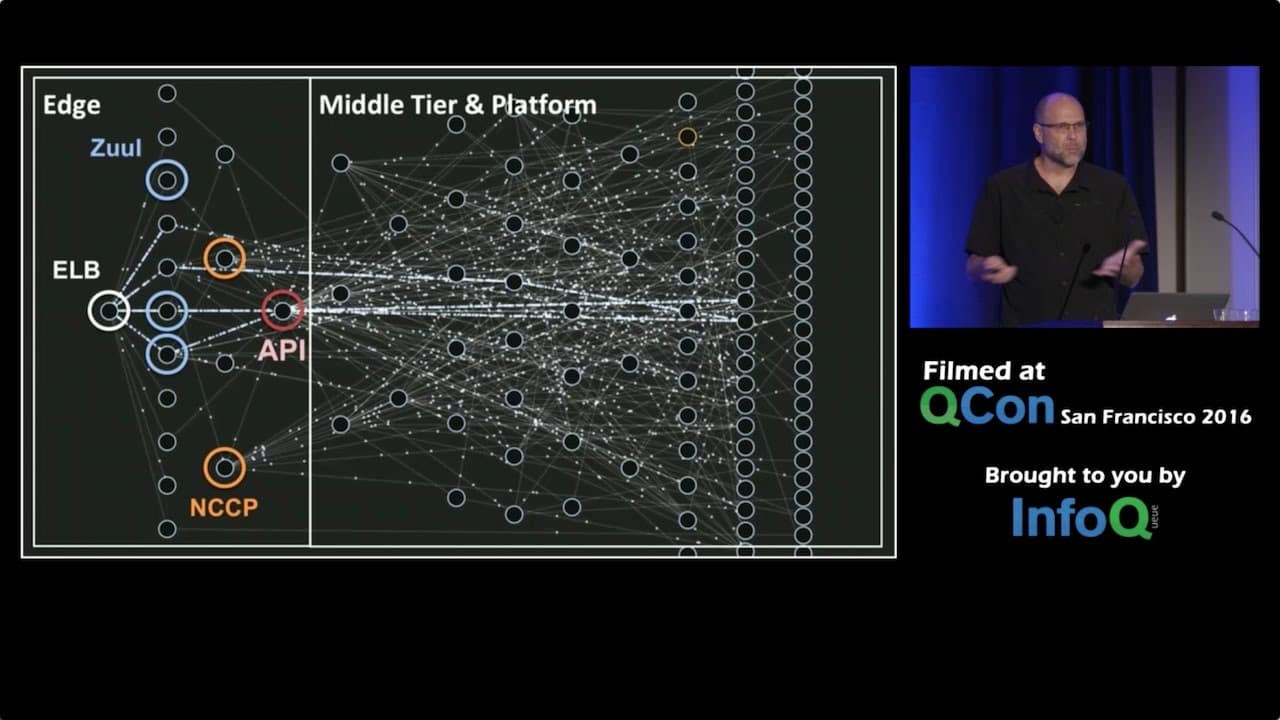
Netflix faced challenges with its initial API and service architecture due to fragmentation and differing protocols between the Netflix API and the nccp service. This led to inefficiencies and difficulties for client developers who had to navigate between different contexts and systems.
Q: How does Netflix's delivery platform, Spinnaker, enhance microservices deployment?
Netflix's delivery platform, Spinnaker, enhances microservices deployment by integrating best practices and automating the delivery process. It supports automated Canary analysis, staged deployments, and other reliability measures, allowing Netflix to achieve high velocity and confidence in deploying changes to production.
Summary & Key Takeaways
-
Josh Evans discusses the evolution of Netflix's architecture from monolithic systems to a microservices approach, highlighting the benefits and challenges encountered. He draws parallels between biological systems and microservices, emphasizing the importance of resilience and adaptability in both contexts.
-
Netflix's strategies for managing microservices include the use of circuit breakers, chaos engineering, and fault injection testing. These techniques help ensure system reliability and performance, even under unexpected conditions or failures.
-
The introduction of new technologies, such as Docker and Node.js, at Netflix required careful consideration of organizational impact and support structures. The company prioritizes automation and continuous learning to manage operational drift and maintain system performance.
Read in Other Languages (beta)
Share This Summary 📚
Summarize YouTube Videos and Get Video Transcripts with 1-Click
Try YouTube Summary with ChatGPT & Claude or YouTube Transcript Generator
Explore More Summaries from InfoQ 📚

Summarize YouTube Videos and Get Video Transcripts with 1-Click
Try YouTube Summary with ChatGPT & Claude or YouTube Transcript Generator