A new way to monitor vital signs (that can see through walls) | Dina Katabi
TL;DR
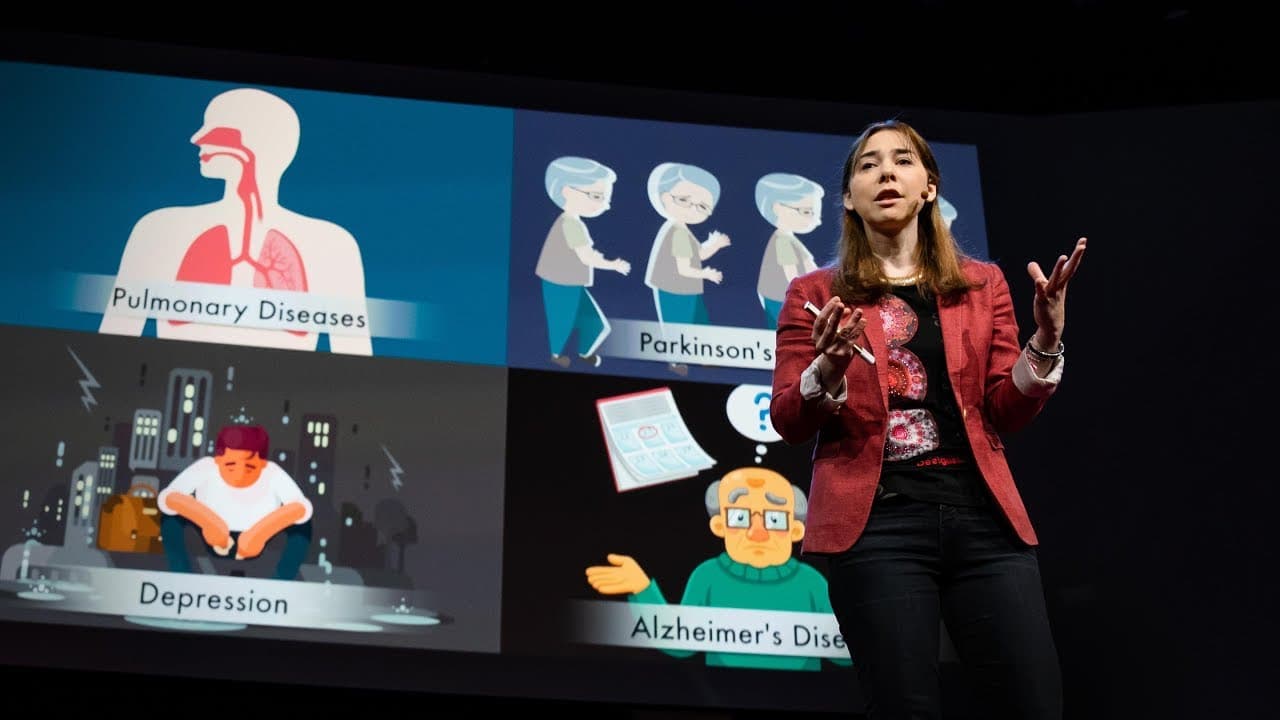
In this TED Talk, Dina Katabi discusses how she and her team have developed a device that can monitor physiological signals, such as breathing and heartbeats, using wireless signals, without the need for wearables or invasive procedures.
Transcript
When I was a kid, I was, like many of you in this room, very much fascinated by Star Wars, and what fascinated me the most is this notion of the Force, this energy that connects all people and all objects and allows you to feel people that you can't even see. And I remember many nights, I would be sitting at home, just, like, concentrating and focu... Read More
Key Insights
- 🚀 The speaker was inspired by the concept of the Force from Star Wars, which led to the development of a device that can sense and track people using wireless signals.
- 🔮 Wireless signals can be used to track movements of individuals without the need for wearables or physical contact.
- 🔍 The device operates similarly to radar, utilizing sensitive radios and machine learning algorithms to interpret complex reflections of signals in indoor environments.
- 💡 The combination of advanced radio technology and machine learning has made it possible to capture and interpret various physiological signals, including sleep stages, breathing patterns, and heartbeats.
- 🏥 The device has potential applications in healthcare, allowing for passive monitoring of patients with chronic diseases and enabling early detection of emergencies to avoid hospitalization.
- 📚 The ethical framework for the technology includes measures to prevent misuse, ensuring consent and security protocols are in place.
- 🌍 The speaker envisions a future where devices like this can be installed in the homes of chronic disease patients to passively monitor their health and alert doctors to potential emergencies.
- 💪 This technology has the potential to revolutionize healthcare and improve our understanding of chronic diseases, ultimately saving lives.
Install to Summarize YouTube Videos and Get Transcripts
Explore YouTube Video Summarizer or Get YouTube Transcript Extractor
Questions & Answers
Q: Why was the speaker fascinated by Star Wars as a child?
The speaker was fascinated by Star Wars as a child because of the notion of the Force, which is an energy that connects all people and objects.
Q: How did the speaker connect their childhood fascination with Star Wars to their scientific work?
The speaker connected their childhood fascination with Star Wars to their scientific work by realizing that wireless signals, like Wi-Fi and cellular systems, could be compared to the Force. They believed that by building a device that could sense and interpret these signals, they could "feel" people they couldn't see.
Q: What were some of the results of the speaker's early work on building a device to monitor people using wireless signals?
The speaker showed early results of their device's capabilities by accurately tracking a person's movements purely based on how their body interacted with surrounding wireless signals. They demonstrated that the device could monitor someone's breathing, detect their heartbeats, and even measure their sleep stages without any wearables or physical contact.
Q: How could this device potentially revolutionize healthcare?
The device could revolutionize healthcare by allowing for passive monitoring of patients with chronic diseases in their own homes. By detecting changes in physiological signals, the device could alert doctors to potential emergencies before they occur, potentially avoiding hospitalization. This could greatly improve the understanding and management of chronic diseases and potentially save lives.
Summary & Key Takeaways
-
The speaker was fascinated by the idea of the Force in Star Wars as a child, and later realized that wireless signals could be like the Force, allowing us to sense people and track their movements.
-
The combination of sensitive radios and machine learning has led to the development of a device that can monitor physiological signals like sleep, breathing, and heartbeats without wearables or invasive procedures.
-
This technology has the potential to revolutionize healthcare by monitoring chronic disease patients at home and detecting changes in their health before emergencies occur, leading to earlier interventions and potentially avoiding hospitalization.
Read in Other Languages (beta)
Share This Summary 📚
Summarize YouTube Videos and Get Video Transcripts with 1-Click
Try YouTube Summary with ChatGPT & Claude or YouTube Transcript Generator
Explore More Summaries from TED 📚

Summarize YouTube Videos and Get Video Transcripts with 1-Click
Try YouTube Summary with ChatGPT & Claude or YouTube Transcript Generator