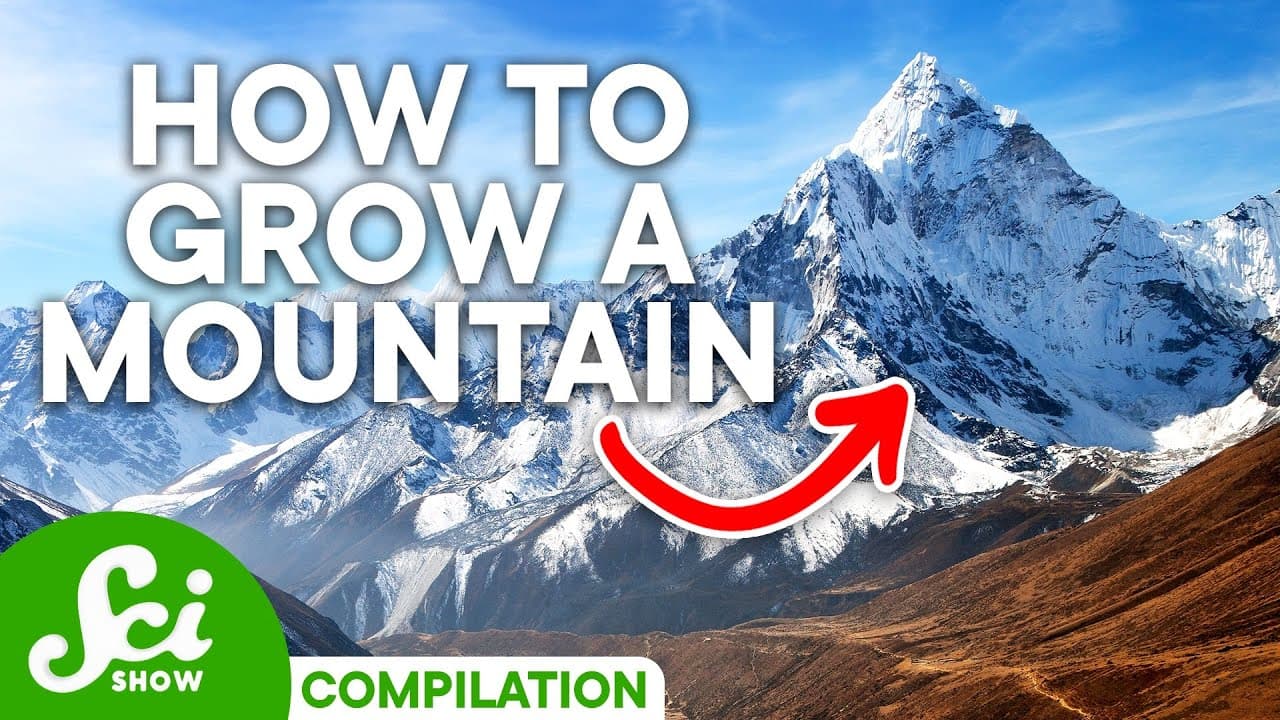
The Amazing Life Cycle of Mountains | SciShow Compilation
TL;DR
Mountains form through the collision of tectonic plates, resulting in crustal shortening and thickening. However, the growth of mountains is limited by gravity and glacial erosion. Some mountains are formed by volcanic activity. Rainfall and erosion also play a role in shaping mountains.
Transcript
mountains are some of the biggest things around but something that big takes a lot of energy to create and not all mountains are made the same way but once a mountain forms that's far from the end of the story sometimes it keeps growing so here's how they go from a regular old piece of earth to the tallest peak at least for now starting with the ba... Read More
Key Insights
- 💥 The formation of mountains is primarily driven by the collision of tectonic plates, which results in crustal shortening and thickening.
- 🚵 Gravity plays a role in limiting the growth of mountains, causing the underlying crust to bend and sag under the weight of the mountains.
- 💨 Glacial erosion poses a significant threat to mountain growth, as glaciers can carve away at the summit of mountains faster than they can grow.
- 💁 Volcanic activity can contribute to the formation of mountains, as successive eruptions deposit layers of lava, building up the volcano over time.
- 🚵 Rainfall and erosion play a crucial role in shaping mountains, as erosion removes material from mountains, shaping their slopes and valleys.
- 💗 Plateau formation occurs when mountains can no longer grow upward and instead expand outward due to the pressure of tectonic forces.
- 🍽️ The process of plate tectonics is essential for mountain formation, as tectonic plates colliding can push up the edges of the plates, leading to mountain formation.
Install to Summarize YouTube Videos and Get Transcripts
Explore YouTube Video Summarizer or Get YouTube Transcript Extractor
Questions & Answers
Q: How are mountains formed?
Mountains are formed through the collision of tectonic plates, which leads to crustal shortening and thickening. This process pushes parts of the plate kilometers into the air, forming mountains.
Q: What limits the growth of mountains?
Gravity limits the growth of mountains. The mass of the mountains causes the underlying crust to bend and sag, which can lower the peaks. Additionally, if mountains grow tall enough, their weight can overpower the tectonic forces pushing them upward, causing uplift to stop.
Q: How does glacial erosion affect mountain growth?
Glacial erosion can prevent mountains from growing taller. Once a peak reaches a certain height, glaciers begin to form, and they slowly carve away at the summit. Mountains tend to top out at about 1500 meters above the local snow line due to glacial erosion.
Q: What role does rainfall play in shaping mountains?
Rainfall contributes to the erosion of mountains. Rainwater, along with other erosional agents like wind and ice, removes material from mountains, shaping their slopes and valleys.
Q: Can volcanic activity create mountains?
Yes, volcanic activity can contribute to the formation of mountains. Shield volcanoes, like Mauna Kea in Hawaii, are formed through successive eruptions that deposit layers of lava, leading to the growth of the volcano and the depressions of the sea floor beneath it.
Q: How do mountains expand into plateaus?
When mountains can no longer grow upward, they expand outward into plateaus. Under the pressure of tectonic forces, the slopes on either side of the central peaks of mountains rise, causing the mountains to spread out.
Q: How does the process of plate tectonics impact mountain formation?
Plate tectonics is the driving force behind mountain formation. When tectonic plates collide, the edges of the plates can be pushed up, resulting in the formation of mountains.
Q: What are some factors that can prevent the formation of mountains?
Factors such as insufficient tectonic forces, lack of volcanic activity, erosion, and weathering can prevent the formation of mountains. Additionally, the absence of plate tectonics, as seen on Mars, can also hinder mountain formation.
Summary & Key Takeaways
-
Mountains are formed through the collision of tectonic plates, leading to crustal shortening and thickening.
-
Gravity limits the growth of mountains, causing the underlying crust to bend and sag, which can result in the expansion of plateaus.
-
Glacial erosion can prevent mountains from growing taller, as glaciers carve away at their summits.
-
Volcanic activity can also contribute to the formation of mountains.
-
Rainfall and erosion play a vital role in shaping mountains, as erosion removes material from mountains and can make them lighter and taller.
Read in Other Languages (beta)
Share This Summary 📚
Summarize YouTube Videos and Get Video Transcripts with 1-Click
Try YouTube Summary with ChatGPT & Claude or YouTube Transcript Generator
Explore More Summaries from SciShow 📚


Summarize YouTube Videos and Get Video Transcripts with 1-Click
Try YouTube Summary with ChatGPT & Claude or YouTube Transcript Generator