Line Graph | Cost of Fruits | DI | Reasoning | Part - 17 | Bharath Kumar
TL;DR
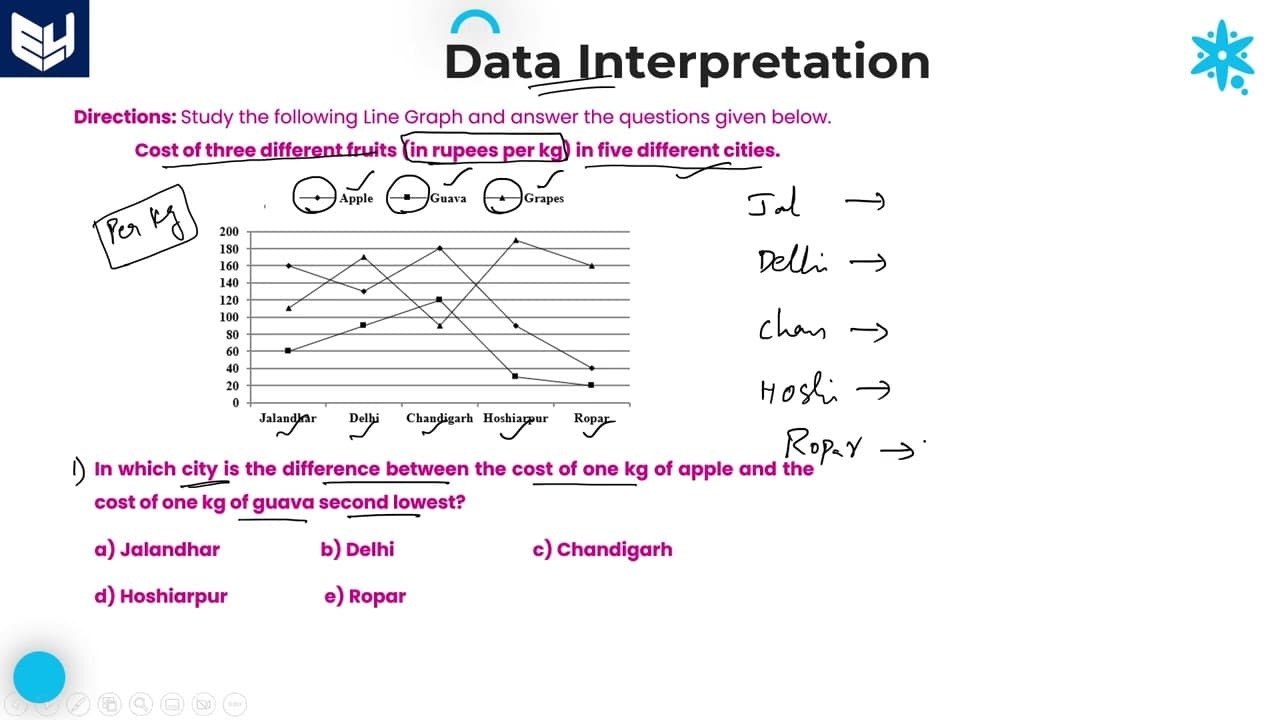
This content guides solving questions based on line graph data regarding fruit prices in various cities.
Transcript
hi everyone welcome to the session in this session I am continuing line graph data interpretation first of all we need to read the information carefully and then according to the given information we need to solve the questions right first of all see the information which is provided in this line graph data interpretation here the information is ab... Read More
Key Insights
- 🫥 Each fruit's costing is clearly distinguished by shape on the line graph, aiding quick visual reference during calculations.
- 🏙️ Proper understanding of price differentials across cities provides insights into market trends and comparisons.
- 🈹 The content reinforces mathematical concepts related to percentages, discounts, and total calculations in everyday scenarios.
- 🏃 The exercise illustrates the methodical approach to interpreting graphical data, which can be applied in various analytical contexts.
- 🏃 Successful completion of the exercises showcases the practical application of theoretical knowledge in real-life decision-making.
- 👀 The session serves as a foundation for mastering data interpretation, crucial for anyone looking to excel in analytical readings.
- ❓ By solving multiple problems, learners can develop confidence in their problem-solving abilities and analytical skills.
Install to Summarize YouTube Videos and Get Transcripts
Explore YouTube Video Summarizer or Get YouTube Transcript Extractor
Questions & Answers
Q: What is the significance of understanding line graph data interpretation in this session?
Understanding line graph data interpretation is essential as it allows individuals to analyze trends, compare different data points, and make informed decisions based on visualized data. This session helps learners grasp these skills, which are crucial in real-world applications, such as economics or market analysis.
Q: How do you find the second-lowest difference between the costs of apples and guavas in different cities?
To find the second-lowest difference, you take the cost of apples per kg and subtract the cost of guavas per kg for each city, then sort these differences. The second lowest value, in this case, was calculated for Delhi, where the difference was 40, highlighting the analytical process involved.
Q: What was the total cost for Ram when he purchased apples and guavas in Delhi?
Ram's total cost was calculated by taking the price of apples (130 per kg) and guavas (90 per kg), multiplying it by the quantity he purchased (3 kg of apples and 2 kg of guavas), resulting in a total of 570 rupees. This detailed calculation demonstrates the importance of applying mathematical operations correctly.
Q: How do you calculate the percentage of guava's cost in Jalandhar compared to the cost of 2 kgs of grapes in Chandigarh?
To calculate this percentage, take the cost of guavas (60) as the numerator and the cost of 2 kgs of grapes (180) as the denominator, then multiply by 100 to find the approximate percentage, which is about 34%. This process illustrates effective percentage calculations.
Q: What was the discount Ravinder received on grapes, and how did it affect the total cost?
Ravinder received a 4% discount on grapes which originally cost 190 rupees per kg. The discount amounted to 7.6 rupees per kg, reducing the price to 182.4 rupees per kg. After calculating for 45 kgs, his total payment became 8,208 rupees, emphasizing the impact of discounts on final costs.
Q: Can you explain the final calculation of the ratio between the cost of apples from Roper and grapes from Chandigarh?
The ratio is calculated by comparing the costs directly: apples from Roper are 40 rupees per kg and grapes from Chandigarh are 90 rupees per kg. Simplifying this ratio gives 4:9. Such calculations are essential for comparing unit costs effectively.
Summary & Key Takeaways
-
The session covers the interpretation of a line graph concerning the prices of apples, guavas, and grapes across five cities, emphasizing the importance of reading the information carefully.
-
Detailed explanations are provided for specific questions about calculating the price differences, percentages, and totals based on the fruit costs in each city, helping learners understand how to approach similar problems.
-
The instructor walks through the calculations transparently, clarifying any confusion regarding the methods to determine costs, discounts, and ratios, therefore enhancing comprehension in data interpretation.
Read in Other Languages (beta)
Share This Summary 📚
Summarize YouTube Videos and Get Video Transcripts with 1-Click
Try YouTube Summary with ChatGPT & Claude or YouTube Transcript Generator