Turing Machine | TM | Language | TOC | Lec-89 | Bhanu Priya
TL;DR
Turing machines accept complex languages and perform computable functions using transition diagrams and tables.
Transcript
hi students now coming to the next topic in this subject theory of competitions we are discussing about the charring machine right so now let's see what is the language accepted by the Turing machine when you can say that the language is accepted by the Turing machine okay so in this video I will just give an introduction of this language accepted ... Read More
Key Insights
- 😫 A Turing machine accepts languages through a specific set of rules and states, facilitating the understanding of complex computations.
- 🤟 The concept of recursively enumerable languages expands the scope of languages that Turing machines can understand beyond simple structures.
- 🎰 Transition diagrams and tables are critical tools for visualizing and implementing the operational processes of Turing machines.
- 🤟 Each transition in a Turing machine is both a state and an action, emphasizing the dynamic nature of computation.
- ⚧️ The blank symbol in a Turing machine signifies the end of processing, indicating that the input has been fully read and evaluated.
- 🥺 Turing machines exemplify how computation can be abstractly modeled, leading to advancements in algorithm design and complexity analysis.
- ⚾ They demonstrate the fundamental principles of how machines can perform calculations based on symbolic input rather than numerical data alone.
Install to Summarize YouTube Videos and Get Transcripts
Explore YouTube Video Summarizer or Get YouTube Transcript Extractor
Questions & Answers
Q: What is the significance of the Turing machine in computational theory?
The Turing machine is pivotal in computational theory as it provides a model for understanding what can be computed. It can simulate any algorithm and defines the limits of what is computationally feasible. This concept is foundational in computer science, influencing areas like complexity theory and formal languages.
Q: How does a Turing machine distinguish between different types of languages?
A Turing machine distinguishes between types of languages through its design, specifically its ability to accept recursively enumerable languages, which can have infinite elements, and decidable languages, where a definitive yes/no answer can be provided. This allows it to process a wide variety of language patterns.
Q: Can you explain the role of transition functions in a Turing machine?
Transition functions define how a Turing machine moves between states based on the input symbols it reads. Each function specifies the current state, the input symbol, the new state to transition to, and any changes to the tape. This process mimics how algorithms operate in a controlled manner.
Q: What practical applications do Turing machines have today?
Although Turing machines are theoretical constructs, they underpin modern computing systems and algorithms. They are used for analyzing computational problems, teaching programming concept foundations, and understanding the capabilities and limits of computers, essential in fields such as software development and artificial intelligence.
Summary & Key Takeaways
-
The Turing machine is a theoretical model that accepts both recursively enumerable languages and computable functions, playing a crucial role in understanding computation.
-
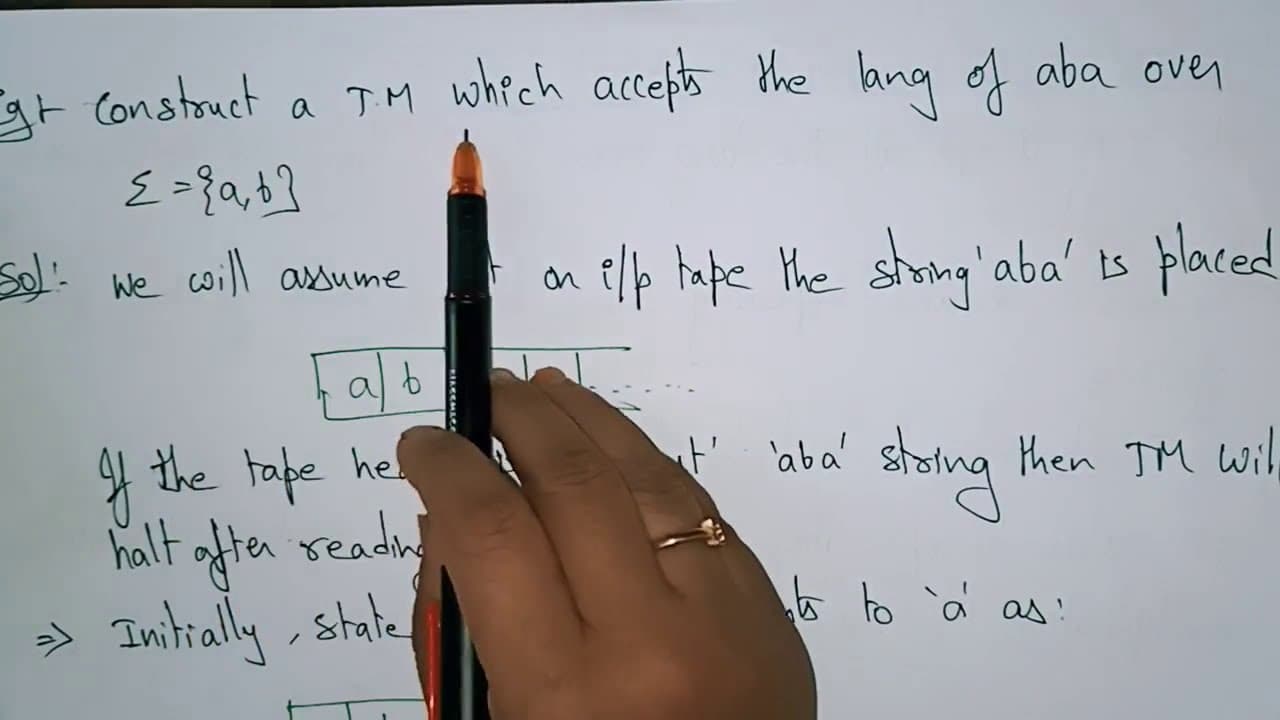
An example demonstrates how to construct a Turing machine for the language represented by the strings consisting of a's and b's, illustrating the use of transition diagrams and tables.
-
The transition function is highlighted, showing how the machine transitions between states while reading symbols on an input tape, ultimately reaching a halt state when a blank symbol is encountered.
Read in Other Languages (beta)
Share This Summary 📚
Summarize YouTube Videos and Get Video Transcripts with 1-Click
Try YouTube Summary with ChatGPT & Claude or YouTube Transcript Generator