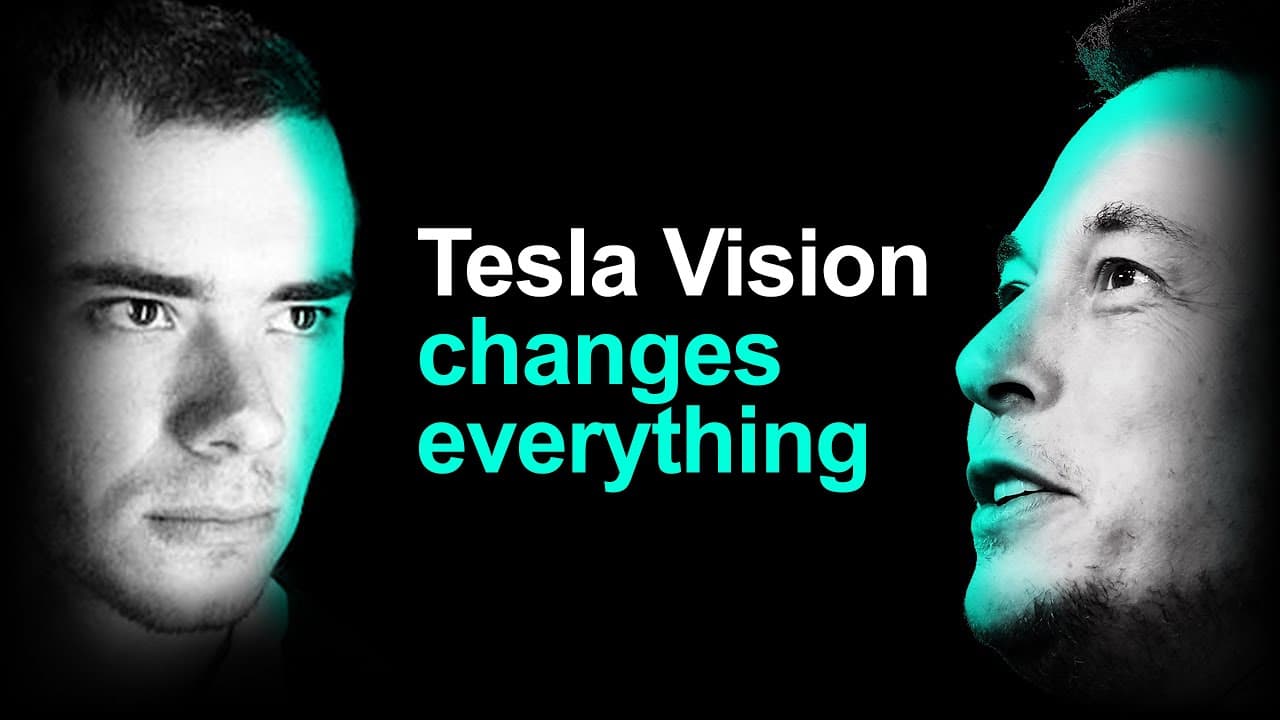
Tesla Vision: INSANE Real World AI (deep dive: NERDS only)
TL;DR
Tesla is developing Tesla Vision, an advanced AI system, with the goal of achieving full autonomy in its vehicles and revolutionizing transportation.
Transcript
and so having seen all this we've actually released this we've accumulated about 15 million miles so far um and 1.7 million of those have been on autopilot and so far there have been no crashes now of course we're running at a massive scale here and so we do expect some crashes at some point uh the legacy stack has a crash roughly every five millio... Read More
Key Insights
- 🛀 Tesla's focus on vision-based autonomy rather than relying on radar is showing promising results, with improved detection and tracking of objects.
- 🦔 The development of a synthetic visual cortex demonstrates Tesla's cutting-edge approach to artificial intelligence.
- 🏛️ The company's commitment to building a powerful computing infrastructure highlights the importance of data processing and neural network training in achieving full autonomy.
- 😤 Tesla's recruitment efforts indicate its dedication to assembling a talented team to further advance its AI capabilities.
- ❓ The success of Tesla's autonomous driving program has the potential to revolutionize transportation and make a significant economic impact.
- 😫 Tesla's progress in autonomous driving and AI development sets it apart from other companies in the industry.
- 🤳 The deployment of full self-driving capabilities to Tesla's customer vehicles shows the company's confidence in its autonomous technology.
Install to Summarize YouTube Videos and Get Transcripts
Explore YouTube Video Summarizer or Get YouTube Transcript Extractor
Questions & Answers
Q: How many miles has Tesla accumulated so far, and how many of those miles were on autopilot?
Tesla has accumulated 15 million miles in total, with 1.7 million miles driven on autopilot.
Q: Has Tesla experienced any crashes during its autonomous driving program?
So far, Tesla has not experienced any crashes during its autonomous driving program, despite running at a massive scale.
Q: How does Tesla's vision stack compare to the legacy radar system?
Tesla's vision stack has shown significant improvements compared to the legacy radar system, providing a smoother and more accurate detection of objects and their velocities.
Q: What is the significance of Tesla's supercomputer cluster?
Tesla's supercomputer cluster, which is one of the world's most powerful, allows for the efficient training of neural networks and processing of the massive amount of data collected by Tesla's vehicles.
Summary & Key Takeaways
-
Tesla has accumulated 15 million miles of driving data, with 1.7 million miles on autopilot, and has experienced no crashes so far.
-
The vision stack in Tesla's autonomous system has shown significant improvements compared to the legacy radar system.
-
Tesla's neural network architecture is based on the synthetic visual cortex, allowing for efficient processing of visual information.
-
The company has built a powerful supercomputer cluster, currently one of the world's most powerful, for training neural networks.
-
Tesla is using auto-labeling to source training data and is actively recruiting talent to further develop its AI capabilities.
Read in Other Languages (beta)
Share This Summary 📚
Summarize YouTube Videos and Get Video Transcripts with 1-Click
Try YouTube Summary with ChatGPT & Claude or YouTube Transcript Generator
Explore More Summaries from Solving The Money Problem 📚



Summarize YouTube Videos and Get Video Transcripts with 1-Click
Try YouTube Summary with ChatGPT & Claude or YouTube Transcript Generator