Military Force as a Tool of Foreign Policy
TL;DR
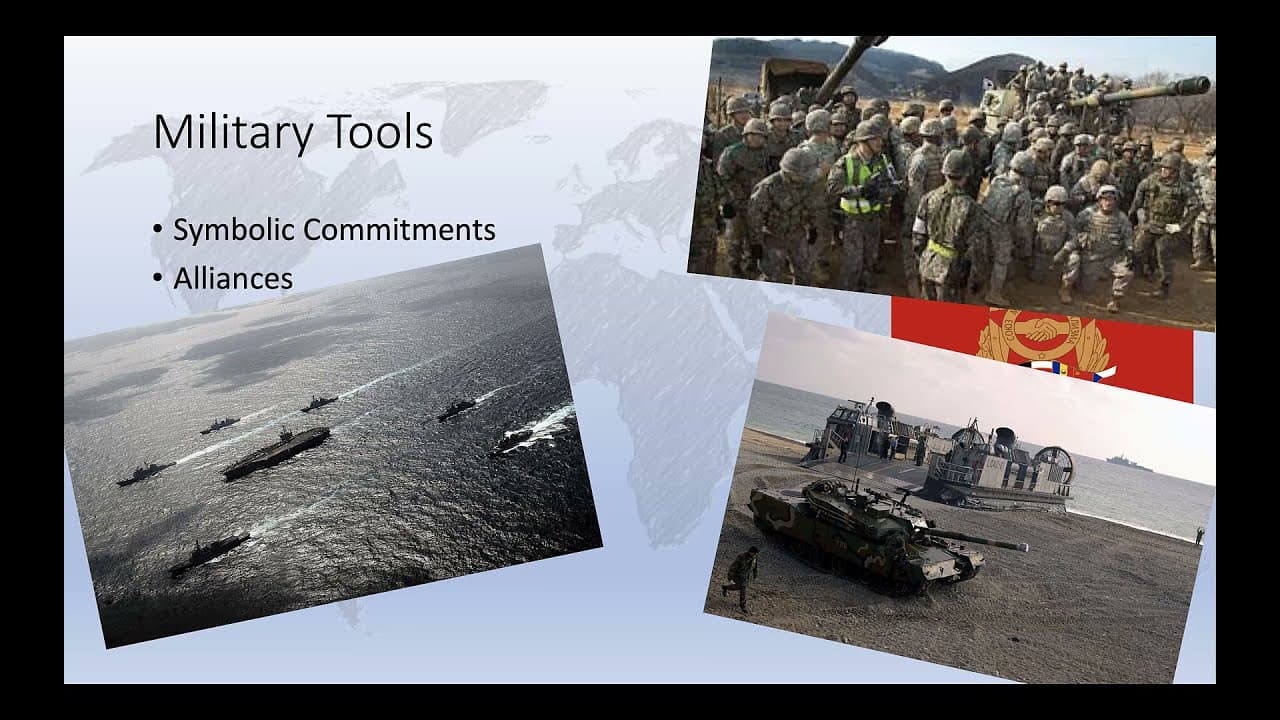
Military force can be used as a tool of foreign policy to achieve goals, through actions such as symbolic commitments, troop deployments, formal alliances, threats, targeted strikes, and conventional warfare.
Transcript
Hey everyone. Noah Zerbe here. This is one of a series of short videos looking at instruments of foreign policy. That is, when a government wants to achieve a foreign policy goal, what tools are available to it to achieve that goal? In this video we're going to look at the use of force or the military as a tool of foreign policy. Other vi... Read More
Key Insights
- 😒 The use of force as a tool of foreign policy falls on the coercive end of the spectrum of foreign policy instruments.
- 🎖️ Military force can be used symbolically, through troop deployments, formal alliances, threats, targeted strikes, and conventional warfare.
- 🎖️ Political leaders sometimes use the military in ways that are ill-suited for its mission, and military deployments can carry political costs.
- 🤙 Bluffs with military responses may be effective until they are called or develop a reputation for bluffing.
- 🌍 The international community has debated the legality and ethics of targeted strikes, particularly when they result in civilian casualties.
- 🏣 Military forces can also be used for peacekeeping, post-conflict stabilization, and unconventional warfare.
- 🙈 Conventional warfare is seen as a last resort due to the high costs involved.
Install to Summarize YouTube Videos and Get Transcripts
Explore YouTube Video Summarizer or Get YouTube Transcript Extractor
Questions & Answers
Q: What are some examples of symbolic commitments through the use of military force?
Symbolic commitments through the use of military force can include air patrols, sovereignty exercises, and freedom of navigation operations.
Q: How do troop deployments in other countries serve foreign policy goals?
Troop deployments in other countries can express support for governments and deter potential attackers from engaging in conflict due to the potential military confrontation with the deploying country.
Q: What is the purpose of formal alliances or mutual defense agreements?
Formal alliances or mutual defense agreements, such as NATO, provide collective defense against common threats and reinforce commitments to each other's defense.
Q: How does the threat of military response achieve foreign policy goals?
Threats of military response, known as deterrence, dissuade adversaries from taking aggressive actions by raising the potential cost of such actions.
Summary & Key Takeaways
-
The use of force or the threat of force can be a symbolic commitment or an expression of priorities without immediate intention of using force.
-
Troop deployments in other countries can express support for governments and caution opponents about the cost of attacking.
-
Formal alliances or mutual defense agreements, like NATO, can provide common defense against potential threats.
Read in Other Languages (beta)
Share This Summary 📚
Summarize YouTube Videos and Get Video Transcripts with 1-Click
Try YouTube Summary with ChatGPT & Claude or YouTube Transcript Generator
Explore More Summaries from Noah Zerbe 📚






Summarize YouTube Videos and Get Video Transcripts with 1-Click
Try YouTube Summary with ChatGPT & Claude or YouTube Transcript Generator