7.2 Relativistic Doppler Effect
TL;DR
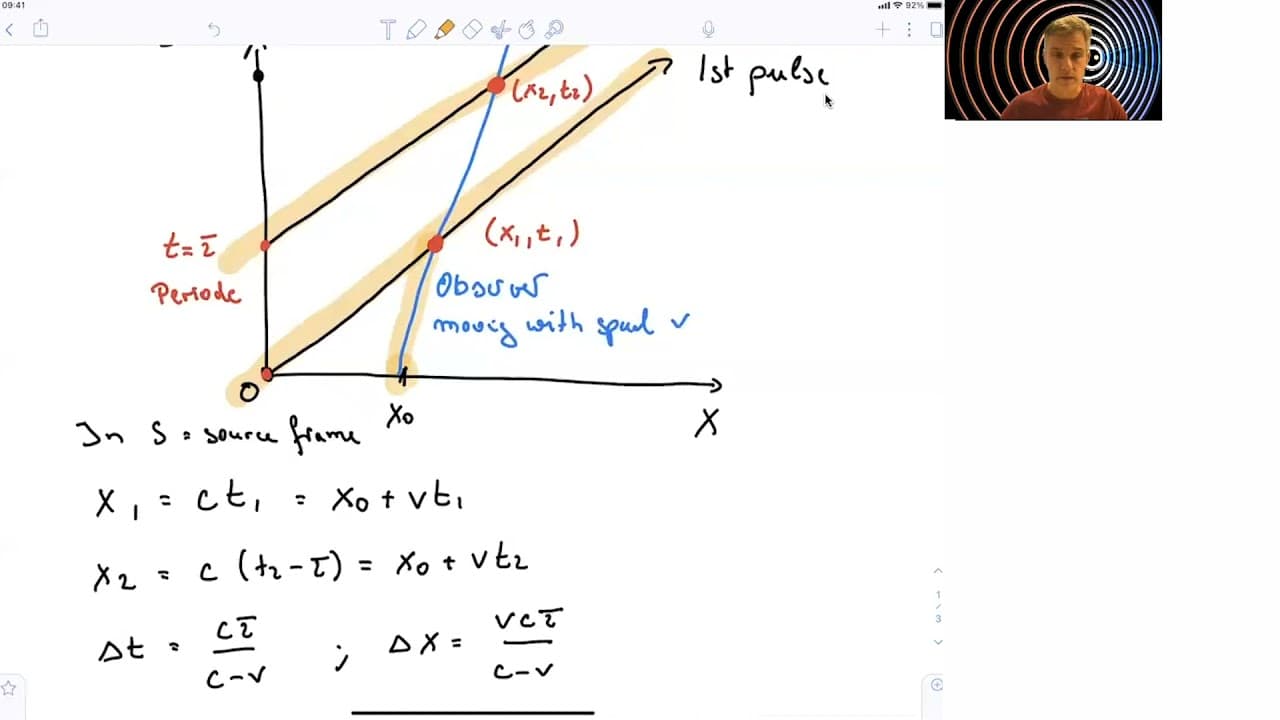
The video explains the concept of the relativistic Doppler effect using space-time diagrams and discusses how it is observed by an observer in motion relative to the source.
Transcript
MARKUS KLUTE: Welcome back to 8.20, Special Relativity. In this section, we're going to talk about the relativistic Doppler effect. And we make good use of our space-time diagrams, which we discussed earlier. So the situation is as follows-- to simplify this, we have a source which is emitting pulses. So the waves are pulses. Every now and then the... Read More
Key Insights
- 👋 The relativistic Doppler effect describes how the frequency and wavelength of a wave change due to relative motion in special relativity.
- 👾 Space-time diagrams help visualize the motion of the source and observer in understanding the relativistic Doppler effect.
- 👋 Lorentz transformation is used to calculate the period and frequency of the wave in the observer's frame.
Install to Summarize YouTube Videos and Get Transcripts
Explore YouTube Video Summarizer or Get YouTube Transcript Extractor
Questions & Answers
Q: What is the relativistic Doppler effect?
The relativistic Doppler effect refers to the change in frequency and wavelength of a wave due to relative motion between the source and the observer in special relativity. It differs from the classical Doppler effect because it takes into account the effects of time dilation and length contraction.
Q: How does the observer's motion affect the perception of the wave?
When the observer is moving towards the source, the perceived frequency and wavelength of the wave increase. Conversely, when the observer is moving away from the source, the perceived frequency and wavelength decrease. The relativistic Doppler effect accounts for these changes in the observer's frame of reference.
Q: How is the period of the wave calculated in the observer's frame?
The period in the observer's frame is calculated using Lorentz transformation. It is given by 1 plus beta over 1 minus beta square root of that times the original period. Here, beta represents the velocity of the source relative to the speed of light, and gamma is the Lorentz factor.
Q: What is the relationship between frequency and period in the observer's frame?
The frequency in the observer's frame is the inverse of the period. It is given by 1 minus beta over 1 plus beta square root of that times the original frequency. This shows that the relativistic Doppler effect affects both the period and frequency of the wave.
Summary & Key Takeaways
-
The video focuses on the relativistic Doppler effect and uses space-time diagrams to illustrate the concept.
-
It introduces a source emitting pulses and discusses the distance between these pulses, known as the period.
-
The video explains how an observer in motion relative to the source perceives the waves and applies Lorentz transformation to calculate the period and frequency.
Read in Other Languages (beta)
Share This Summary 📚
Summarize YouTube Videos and Get Video Transcripts with 1-Click
Try YouTube Summary with ChatGPT & Claude or YouTube Transcript Generator
Explore More Summaries from MIT OpenCourseWare 📚



Summarize YouTube Videos and Get Video Transcripts with 1-Click
Try YouTube Summary with ChatGPT & Claude or YouTube Transcript Generator