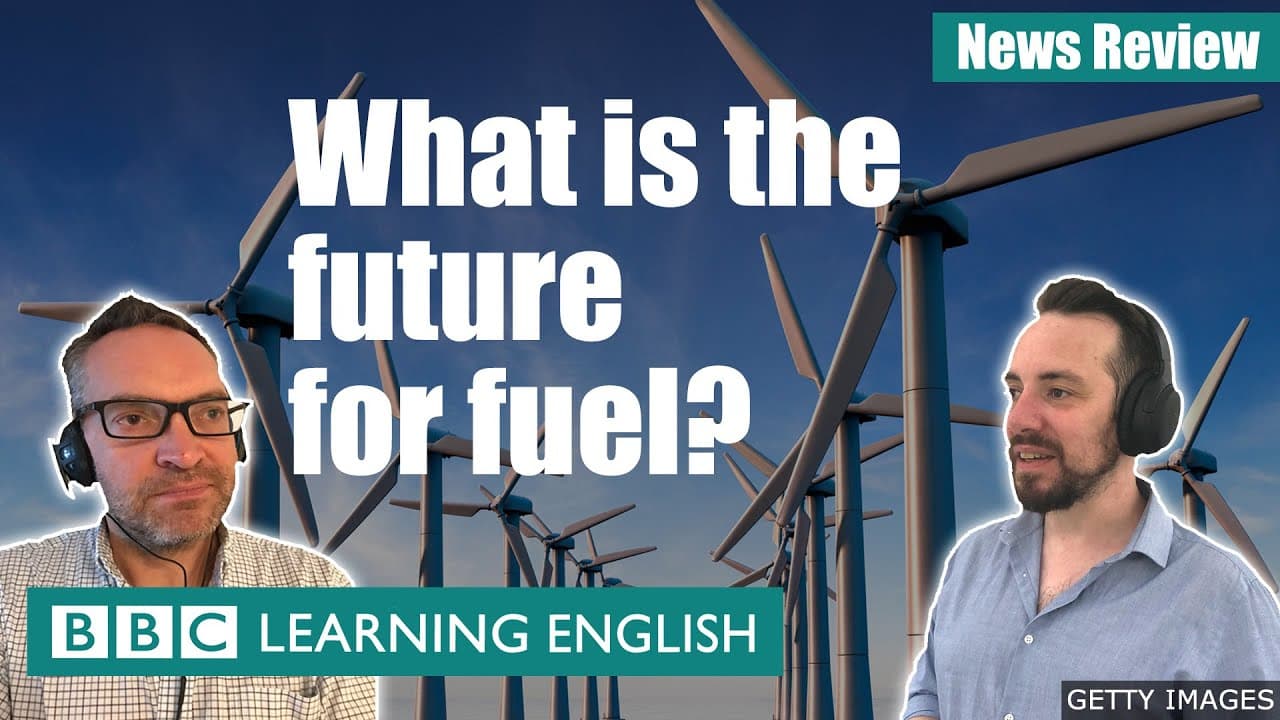
What is the future for fuel?: BBC News Review
TL;DR
War in Ukraine prompts shift to renewable energy.
Transcript
What is the future for fuel? The war in Ukraine has made many people question their reliance on oil and gas, and there have been calls for the transition to alternative and renewable energy sources to be speeded up. Hello, I'm Rob. Welcome to News Review from BBC Learning English. And to talk more about this story and the vocabulary behind the head... Read More
Key Insights
- The war in Ukraine has intensified the urgency for countries, especially in Europe, to reduce dependence on Russian oil and gas.
- The EU's REPowerEU Plan aims to eliminate reliance on Russian fossil fuels by 2030, with a significant reduction targeted within a year.
- Renewable energy projects in the UK are being accelerated to mitigate the impact of the Ukraine conflict on energy supplies.
- The term 're-energise' is used to describe giving new energy or life to something, applicable to both situations and people.
- The word 'mitigate' is a formal term used to describe the reduction of negative effects, commonly applied in business and environmental contexts.
- The expression 'seeing sense' refers to understanding or agreeing with something logical, often used when someone's behavior is considered foolish.
- Common sense is described as logical behavior that most people understand, though it is humorously noted that it is not always common.
- The discussion includes vocabulary related to energy transition, emphasizing the importance of understanding these terms in the current global context.
Install to Summarize YouTube Videos and Get Transcripts
Explore YouTube Video Summarizer or Get YouTube Transcript Extractor
Questions & Answers
Q: What prompted the urgency for renewable energy transition?
The war in Ukraine has made many countries, particularly in Europe, question their heavy reliance on Russian oil and gas. This geopolitical tension has accelerated calls for a shift towards alternative and renewable energy sources to ensure energy security and independence.
Q: What is the REPowerEU Plan?
The REPowerEU Plan is an initiative by the European Union to reduce and eventually eliminate dependence on Russian fossil fuels by 2030. The plan outlines strategies to cut reliance on these energy sources by two-thirds within a year, focusing on increasing renewable energy adoption.
Q: How is the UK responding to the energy crisis?
The UK is accelerating its renewable energy projects to mitigate the impact of the Ukraine conflict on its energy supplies. This involves speeding up the implementation of alternative energy solutions to reduce dependence on fossil fuels and enhance energy security.
Q: What does 're-energise' mean in this context?
In the context of the energy discussion, 're-energise' refers to giving new energy or life to a situation or project. It is used to describe efforts to revive interest or momentum in renewable energy initiatives, as well as the revitalization of individuals or groups involved in these efforts.
Q: How is the word 'mitigate' used in the energy discussion?
The word 'mitigate' is used to describe efforts to lessen the negative effects of reliance on fossil fuels. In the context of the energy crisis, it involves reducing the impact of geopolitical tensions on energy supplies by adopting renewable energy sources and implementing strategic policies.
Q: What does 'seeing sense' imply in the discussion?
The phrase 'seeing sense' implies understanding or agreeing with a logical course of action. In the energy discussion, it refers to the recognition of the need for renewable energy adoption and the shift towards sustainable energy practices as a sensible and necessary response to current challenges.
Q: What is the significance of 'common sense' in energy policy?
Common sense in energy policy refers to adopting logical and widely accepted practices that ensure efficient and sustainable energy use. It highlights the importance of practical decision-making in energy consumption and policy, emphasizing actions that are generally understood as beneficial for long-term energy security.
Q: How are vocabulary terms relevant to the energy transition?
Understanding vocabulary terms like 're-energise', 'mitigate', and 'seeing sense' is crucial for comprehending discussions around energy transition. These terms encapsulate key concepts and actions necessary for addressing the challenges posed by reliance on fossil fuels and the shift towards renewable energy solutions.
Summary & Key Takeaways
-
The war in Ukraine has highlighted the need for a transition to renewable energy, as countries seek to reduce reliance on Russian oil and gas. The EU's REPowerEU Plan aims to cut this dependency significantly by 2030.
-
Key vocabulary terms such as 're-energise', 'mitigate', and 'seeing sense' are explained, with examples provided to illustrate their usage in the context of energy and environmental discussions.
-
The discussion emphasizes the importance of understanding and adopting renewable energy solutions, as well as the need for logical and common-sense approaches to energy consumption and policy-making.
Read in Other Languages (beta)
Share This Summary 📚
Summarize YouTube Videos and Get Video Transcripts with 1-Click
Try YouTube Summary with ChatGPT & Claude or YouTube Transcript Generator
Explore More Summaries from BBC Learning English 📚
Summarize YouTube Videos and Get Video Transcripts with 1-Click
Try YouTube Summary with ChatGPT & Claude or YouTube Transcript Generator