L14.7 Continuous Parameter, Continuous Observation
TL;DR
This content discusses the use of continuous random variables and various estimators, such as the maximum a posteriori probability estimator and the least mean squares estimator, and their performance measured by mean squared error.
Transcript
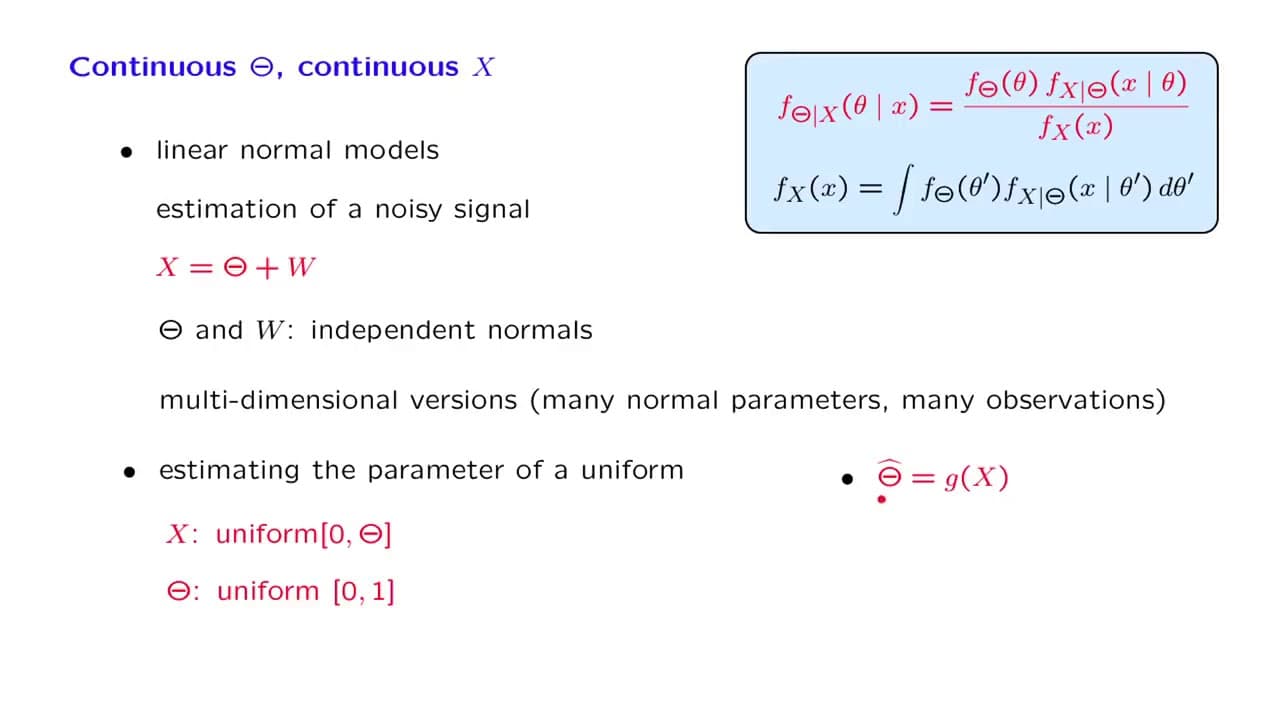
In the next variation we consider, all random variables are continuous. For this case, we do have a Bayes rule, once more. And we have worked [out] quite a few examples. So there's no point, again, in going through a detailed example. Let us just discuss some of the issues. One question is when do these models arise? One particular class of models ... Read More
Key Insights
- ❓ Continuous random variables are often modeled using linear normal models in which variables are combined linearly and follow a normal distribution.
- ❎ Estimators for continuous random variables include the maximum a posteriori probability estimator and the least mean squares estimator.
- ❎ The performance of an estimator is typically evaluated using the mean squared error, measuring the average squared distance between the estimated value and the true value of the variable.
- 📡 Linear normal models are widely used in signal processing applications for recovering noisy continuous signals.
- 🧡 Another example scenario involves estimating the parameter of a uniform distribution when the range itself is random and unknown.
- ❎ The maximum a posteriori probability estimator selects the value that maximizes the conditional density, while the least mean squares estimator calculates the expected value of the variable given the observed data.
- 😥 The mean squared error can be measured conditionally, considering specific observed data, or unconditionally, averaging over all potential data points.
Install to Summarize YouTube Videos and Get Transcripts
Explore YouTube Video Summarizer or Get YouTube Transcript Extractor
Questions & Answers
Q: What are some applications of linear normal models in continuous random variables?
Linear normal models are commonly used in signal processing, where a noisy continuous signal corrupted by independent noise needs to be recovered.
Q: What is the main difference between the maximum a posteriori probability estimator and the least mean squares estimator?
The maximum a posteriori probability estimator selects the value of the variable that maximizes the conditional density, while the least mean squares estimator computes the expected value of the variable given the observed data.
Q: How is the performance of an estimator measured?
The performance of an estimator is measured by the mean squared error, which calculates the average squared distance between the estimated value and the true value of the variable.
Q: What is the difference between conditional mean squared error and unconditional mean squared error?
The conditional mean squared error measures the mean squared error of an estimator given a specific set of observed data, while the unconditional mean squared error averages over all possible data points, providing an overall measure of the estimator's performance.
Summary & Key Takeaways
-
Continuous random variables can be modeled using linear normal models, where the variables are combined in a linear function and follow a normal distribution.
-
Estimating the true value of a continuous random variable involves using estimators like the maximum a posteriori probability estimator and the least mean squares estimator.
-
The performance of an estimator is measured by the mean squared error, which quantifies the average squared distance between the estimated value and the true value of the variable.
Read in Other Languages (beta)
Share This Summary 📚
Summarize YouTube Videos and Get Video Transcripts with 1-Click
Try YouTube Summary with ChatGPT & Claude or YouTube Transcript Generator
Explore More Summaries from MIT OpenCourseWare 📚



Summarize YouTube Videos and Get Video Transcripts with 1-Click
Try YouTube Summary with ChatGPT & Claude or YouTube Transcript Generator