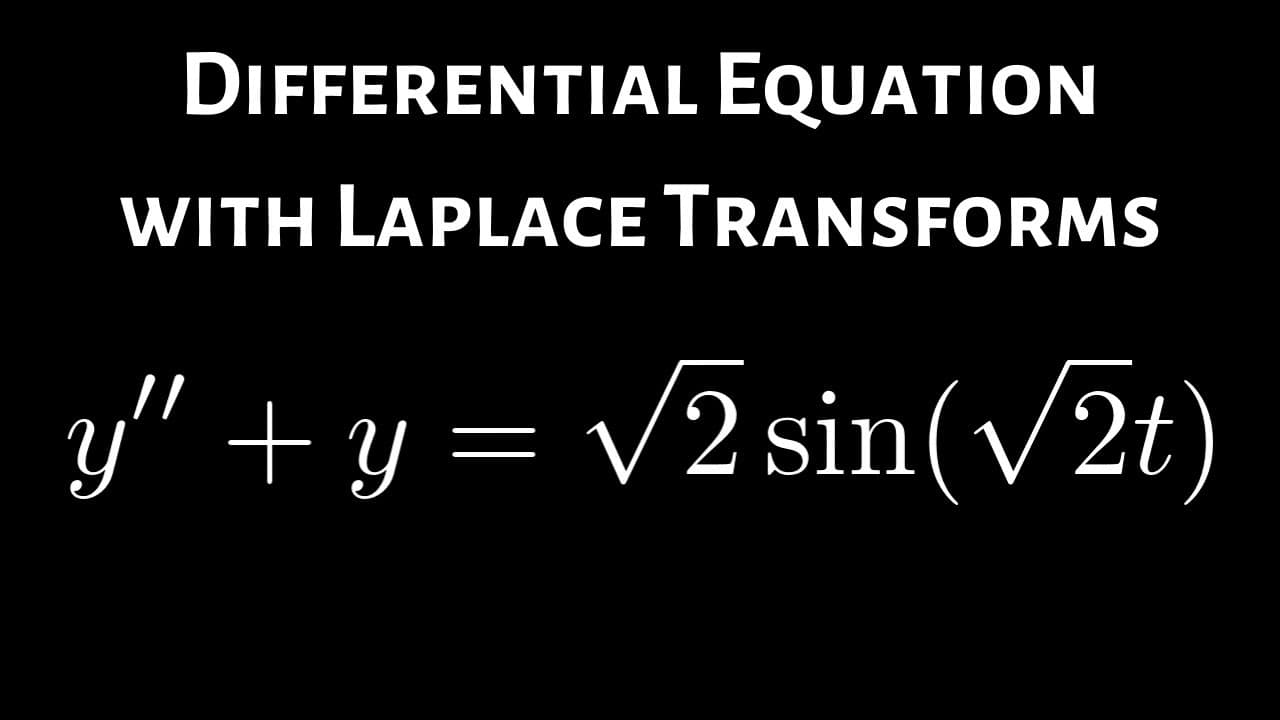
How to Solve an Initial Value Problem using Laplace Transforms y'' + y = sqrt(2)sin(sqrt(2)t)
TL;DR
Learn how to solve a differential equation using Laplace transforms, including applying the Laplace transform, using formulas, and solving for the inverse Laplace transform.
Transcript
in this video we're going to solve this differential equation using Laplace transforms so in the method of Laplace transforms the first thing you do is you take the Laplace of both sides of the DE so let's go ahead and do that start off by taking the Laplace of Y double prime plus y and that's equal to the Laplace of all of this the Laplace of the ... Read More
Key Insights
- 🙃 The Laplace transform can be applied to both sides of a differential equation to simplify the equation.
- ❓ Formulas for Laplace transforms and inverse Laplace transforms are used to find the transform of a given function and solve for the unknown function.
- 🍳 Partial fractions are useful for breaking down complicated fractions and determining coefficients in Laplace transforms.
- 🆘 Initial conditions are used early in the problem to help solve for the unknown function.
- ❓ Memorization tricks can be helpful in remembering the formulas for Laplace transforms and inverse Laplace transforms.
Install to Summarize YouTube Videos and Get Transcripts
Explore YouTube Video Summarizer or Get YouTube Transcript Extractor
Questions & Answers
Q: What is the first step in solving a differential equation using Laplace transforms?
The first step is to apply the Laplace transform to both sides of the differential equation, taking into account linearity to simplify the equation.
Q: How do you use the formulas for Laplace transforms to solve for unknown functions?
The formulas for Laplace transforms of derivatives and the inverse Laplace transform are used to find the Laplace transform and inverse Laplace transform of a given function, allowing for the solution of the differential equation.
Q: What is the purpose of using initial conditions in Laplace transform methods?
Initial conditions are used early in the problem to help solve for the unknown function. They are incorporated into the formulas for derivatives and the inverse Laplace transform.
Q: How do you use partial fractions to solve for coefficients in Laplace transforms?
Partial fractions are used to break down complicated fractions, allowing for the determination of coefficients. By equating coefficients on both sides of the equation, the values of the coefficients can be solved.
Summary & Key Takeaways
-
The video demonstrates the process of solving a differential equation using Laplace transforms.
-
The Laplace transform is applied to both sides of the differential equation, using linearity to simplify the equation.
-
Formulas for the Laplace transforms of derivatives and the inverse Laplace transform are used to solve for the unknown function.
Read in Other Languages (beta)
Share This Summary 📚
Summarize YouTube Videos and Get Video Transcripts with 1-Click
Try YouTube Summary with ChatGPT & Claude or YouTube Transcript Generator
Explore More Summaries from The Math Sorcerer 📚

Summarize YouTube Videos and Get Video Transcripts with 1-Click
Try YouTube Summary with ChatGPT & Claude or YouTube Transcript Generator