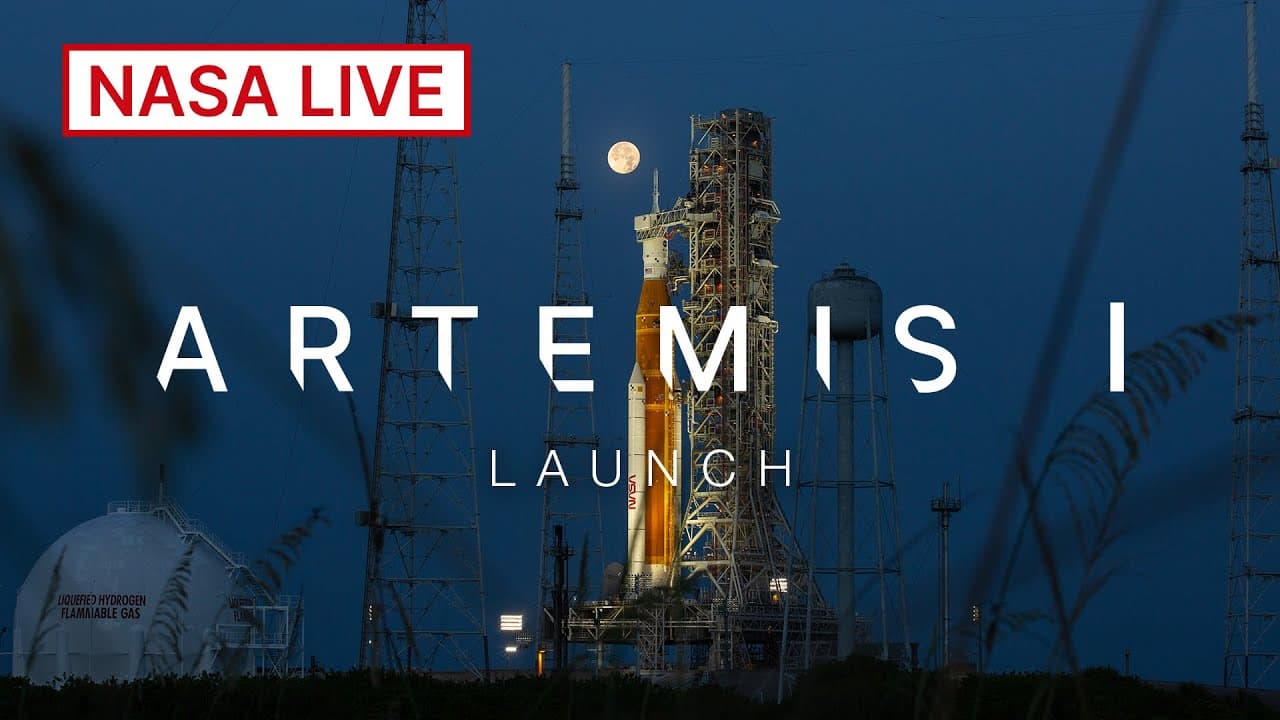
Artemis I Launch to the Moon (Official NASA Broadcast) - Nov. 16, 2022
TL;DR
NASA astronaut Kayla Veran discusses the importance of NASA's Artemis mission, which aims to explore the Moon for the benefit of all and establish a sustainable presence. The mission involves launching the world's most powerful rocket, the Space Launch System (SLS), and an uncrewed Orion spacecraft to test systems and pave the way for future crewed missions.
Transcript
foreign you are looking at the world's most rocket and Orion spacecraft live on Launchpad 39b Artemis 1 embodies the hard work of thousands across the world determined to explore for the benefit of all welcome and thank you for joining us live at Kennedy Space Center where the energy here is palpable as we attempt to make history today I'm Megan Cr... Read More
Key Insights
- 🌍 The Artemis mission is a global partnership involving NASA, ESA, and various industries across Europe, contributing to the development of the Orion spacecraft, Gateway, and other critical components.
- 👩🚀 Artemis aims to land the first woman and person of color on the Moon, highlighting the importance of diversity and representation in space exploration.
- 🐕🦺 ESA's contributions to the Artemis program include the development of the service module, communication system, habitation module, and logistics capabilities.
- 👾 NASA and its partners are committed to sustainable lunar exploration and utilizing the Moon as a stepping stone for further space exploration, including crewed missions to Mars.
Install to Summarize YouTube Videos and Get Transcripts
Explore YouTube Video Summarizer or Get YouTube Transcript Extractor
Questions & Answers
Q: Why is NASA returning to the Moon with the Artemis mission?
NASA is returning to the Moon to learn more about its formation, study our solar system and Earth's history, and test technologies and systems for future deep space missions, including a mission to Mars.
Q: What must be demonstrated with the Artemis 1 mission before sending astronauts on board for future missions?
Artemis 1 is the first integrated test flight of the SLS rocket and Orion spacecraft. It aims to demonstrate the performance of these systems, including the heat shield's ability to endure re-entry, and gather data essential for future crewed missions.
Q: How many astronauts can the Orion capsule carry?
The Orion capsule can carry up to four astronauts on future crewed missions, providing more habitable volume than the Apollo spacecraft and enabling longer-duration exploration missions.
Q: Can scientists from various backgrounds, such as microbiologists, become astronauts?
Yes, NASA welcomes scientists from diverse academic backgrounds, including microbiologists. As long as they have a STEM degree and meet other requirements, they can apply to become astronauts and contribute to NASA's mission of exploration and discovery.
Summary & Key Takeaways
-
NASA astronaut Kayla Veran discusses the significance of NASA's Artemis mission, which aims to learn more about the Moon and establish a sustainable presence for further exploration.
-
The Artemis 1 mission involves launching the SLS rocket and an uncrewed Orion spacecraft to perform a test flight, marking the first step before sending astronauts on future missions.
-
The mission will test the performance of the rocket and the spacecraft systems, including the heat shield, and gather valuable data for future crewed missions.
Read in Other Languages (beta)
Share This Summary 📚
Summarize YouTube Videos and Get Video Transcripts with 1-Click
Try YouTube Summary with ChatGPT & Claude or YouTube Transcript Generator
Explore More Summaries from NASA 📚

Summarize YouTube Videos and Get Video Transcripts with 1-Click
Try YouTube Summary with ChatGPT & Claude or YouTube Transcript Generator