How Can Analytics Predict Supreme Court Outcomes?
TL;DR
Analytics can predict the outcomes of Supreme Court cases more accurately than expert panels by using statistical models like classification and regression trees. This method, tested by a group of political scientists in 2002, proved that data-driven approaches can outperform traditional expert intuition in forecasting legal decisions.
Transcript
In this lecture, we'll see how analytics can be used to predict the outcomes of cases in the United States Supreme Court. This seems like a very unconventional use of analytics, but in 2002 a group of political science and law academics decided to test if a model can do better than a group of experts at predicting the decisions of the Supreme Court... Read More
Key Insights
- 👥 Analytics and statistical models can predict Supreme Court decisions more accurately than a group of experts.
- 🇺🇸 The federal court system in the United States is divided into district courts, circuit courts, and the Supreme Court.
- 💼 Notable Supreme Court decisions include Wickard v. Filburn (1942), Roe v. Wade (1973), the Bush v. Gore case (2000), and the Patient Protection and Affordable Care Act case (2012).
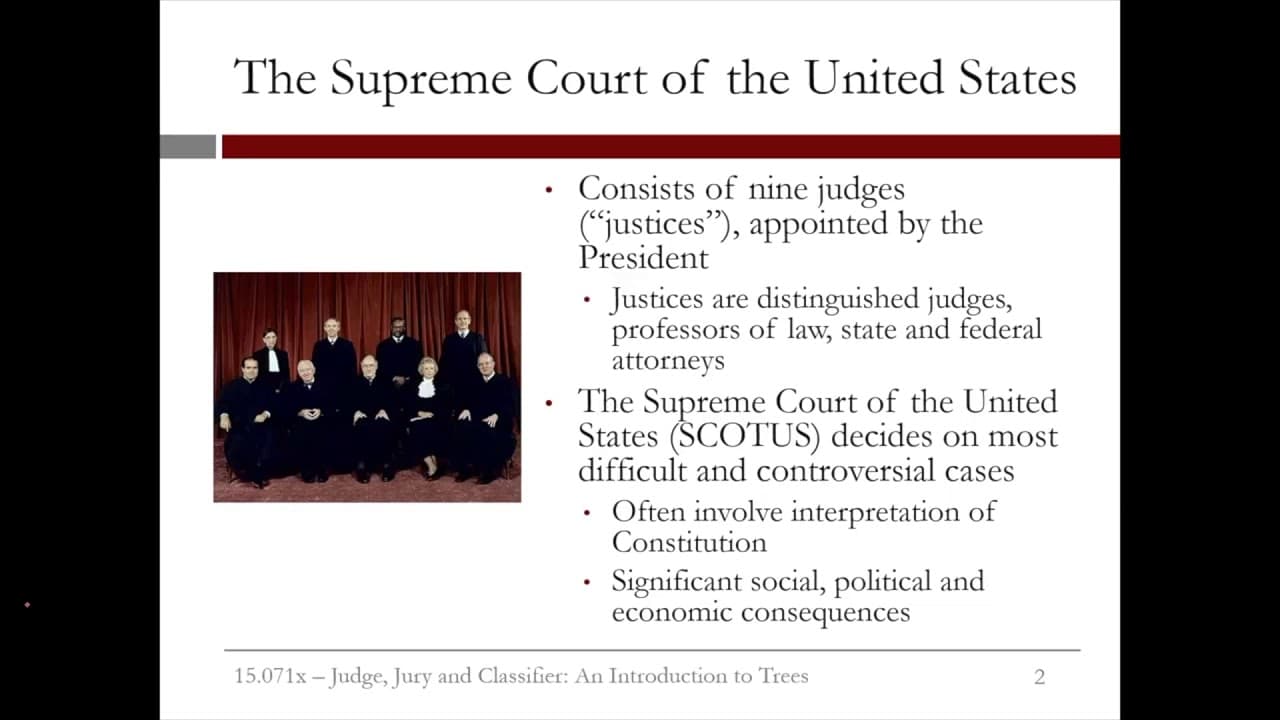
- 😥 Supreme Court justices are appointed by the President based on their qualifications and expertise.
- 🧑🌾 Cases decided by the Supreme Court often have far-reaching implications for society, politics, and the economy.
- 🎚️ The Supreme Court's role includes interpreting the Constitution and resolving disputes at the federal level.
- 🇺🇸 The Supreme Court's decisions are final and have a significant impact on the legal landscape of the United States.
Install to Summarize YouTube Videos and Get Transcripts
Explore YouTube Video Summarizer or Get YouTube Transcript Extractor
Questions & Answers
Q: What were the criteria for selecting the Supreme Court justices?
Supreme Court justices are usually chosen based on their judicial experience, law professorship, or state or federal attorney background.
Q: What types of cases does the Supreme Court decide?
The Supreme Court deals with complex and controversial cases, often involving constitutional interpretation and significant social, political, and economic consequences.
Q: What was the outcome of the 2000 presidential election case?
The Supreme Court ruled that all ballots in Florida needed to be recounted, but due to time constraints, President Bush was declared the winner.
Q: How did the Supreme Court handle the Patient Protection and Affordable Care Act case?
The Supreme Court upheld the requirement for most Americans to have health insurance, supporting the legality of the Patient Protection and Affordable Care Act.
Summary & Key Takeaways
-
In 2002, a group of academics tested if a statistical model can predict Supreme Court decisions better than a panel of experts.
-
The United States legal system operates at the state and federal levels, with the Supreme Court being the highest level.
-
Notable Supreme Court decisions include Wickard v. Filburn (1942), Roe v. Wade (1973), the Bush v. Gore case (2000), and the Patient Protection and Affordable Care Act case (2012).
Read in Other Languages (beta)
Share This Summary 📚
Summarize YouTube Videos and Get Video Transcripts with 1-Click
Try YouTube Summary with ChatGPT & Claude or YouTube Transcript Generator
Explore More Summaries from MIT OpenCourseWare 📚



Summarize YouTube Videos and Get Video Transcripts with 1-Click
Try YouTube Summary with ChatGPT & Claude or YouTube Transcript Generator