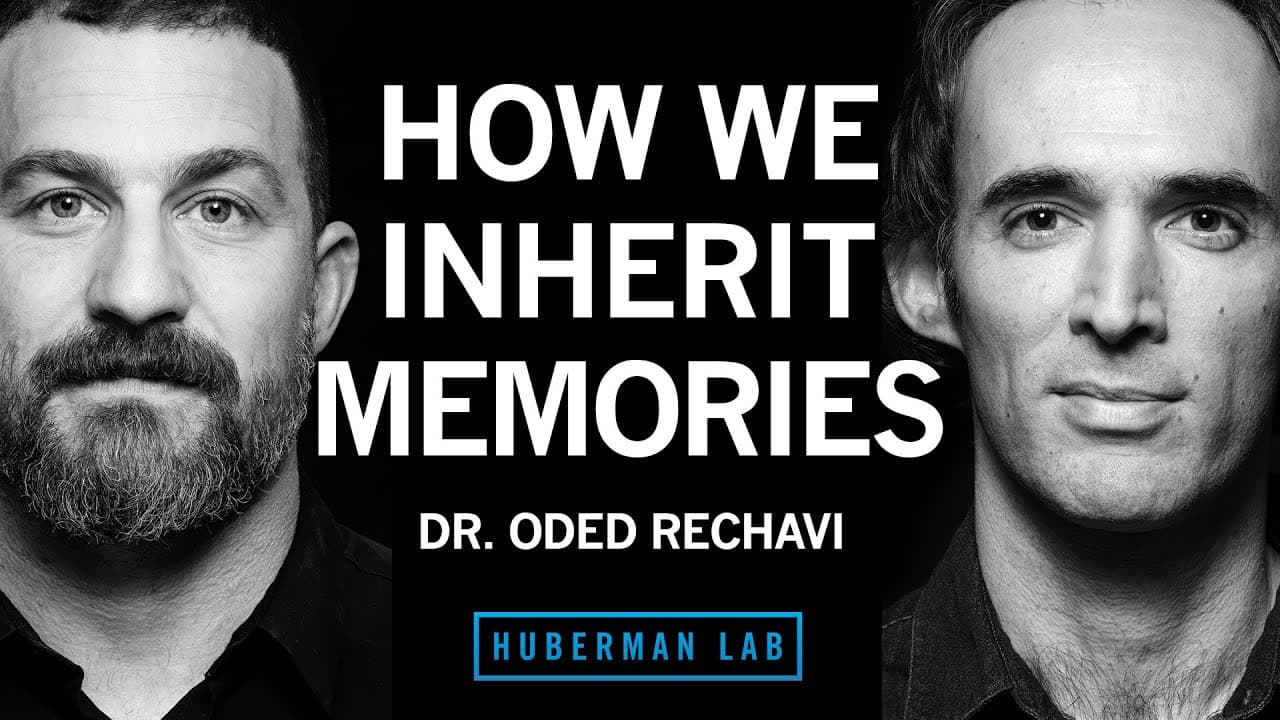
Dr. Oded Rechavi: Genes & the Inheritance of Memories Across Generations | Huberman Lab Podcast
TL;DR
Memories and traits acquired by parents can be passed on through generations, but the mechanisms behind this process are still not fully understood.
Transcript
Andrew Huberman: [OPENING THEME MUSIC] Welcome to the Huberman Lab podcast, where we discuss science and science-based tools for everyday life. I'm Andrew Huberman, and I'm a Professor of Neurobiology and Ophthalmology at Stanford School of Medicine. Today, my guest is Dr. Oded Rechavi. Dr. Oded Rechavi is a Professor of Neurobiology at Tel Aviv Un... Read More
Key Insights
- 🧬 Evidence suggests that memories and traits can be passed from one generation to the next, both genetically and through epigenetic modifications. This challenges the traditional understanding of inheritance.
- 🧬 The separation of soma (somatic cells) from the germline (germ cells) is an important barrier that limits the transmission of acquired traits.
- 🧬 Epigenetic reprogramming, where chemical modifications to DNA and proteins are largely erased between generations, is another barrier to the inheritance of acquired traits.
- 🤔 The specific molecules responsible for transmitting traits across generations, such as RNA, are still not fully understood in humans, but studies suggest their involvement.
- 💡 There are examples of environmental factors, such as famine or nicotine exposure, leading to changes in future generations, potentially through epigenetic modifications.
- 🌱 Nature vs. nurture: It is important to distinguish between genetic factors and environmental influences when discussing the inheritance of traits. Both play a role, and the mechanisms involved are complex.
- 🥦 Caloric restriction and overeating have been shown to have effects on lifespan and health in different organisms, suggesting a connection between metabolism and inheritance.
- ❓Further research is needed to fully understand the mechanisms and implications of inheritance of acquired traits and the role of epigenetics in these processes.
Install to Summarize YouTube Videos and Get Transcripts
Explore YouTube Video Summarizer or Get YouTube Transcript Extractor
Questions & Answers
Q: Can memories and learned behaviors be passed down through generations?
The transmission of memories and learned behaviors across generations is still a topic of debate and ongoing research. While there is evidence in some organisms that experiences can leave a lasting impact on future generations, the exact mechanisms and extent of this transmission are still not fully understood. Epigenetic modifications, such as DNA methylation and histone modifications, are possible candidates for how this transmission occurs, but further studies are needed to confirm and understand these processes in humans.
Q: What are the barriers to the inheritance of acquired traits?
There are two main barriers to the inheritance of acquired traits. The first is the separation of the soma (non-germline cells) from the germline cells, which are responsible for passing genetic information to the next generation. The second barrier is epigenetic reprogramming, which involves the removal of most chemical modifications to DNA and proteins during the transition between generations. These barriers ensure that acquired traits in somatic cells do not directly affect the germline cells and subsequent generations, but there are exceptions to these barriers.
Q: Can environmental factors influence the heritable material?
Environmental factors can potentially influence the heritable material, but the extent and mechanisms of this influence are still not fully understood. Studies have shown that experiences such as starvation or exposure to certain drugs can have effects on future generations, but disentangling the genetic and epigenetic contributions to these effects is challenging. It is important to note that the term "epigenetic" is often misused, and not all environmental influences require epigenetic mechanisms to be transmitted to future generations.
Q: Can acquired traits be inherited through RNA molecules?
The role of RNA molecules in the inheritance of acquired traits is still an area of active research. Some studies have suggested that RNA molecules, through their chemical modifications or transfer between generations, could play a role in transmitting information from one generation to the next. However, more research is needed to fully understand the mechanisms and extent of RNA-mediated inheritance. It is important to note that the majority of research in this area has been conducted in non-human organisms such as worms, and it is not yet clear how applicable these findings are to humans.
Summary & Key Takeaways
-
Genetic inheritance is well-known, but there is evidence that traits acquired through experiences can also be passed on to future generations.
-
The concept of Lamarckian evolution, which suggests the inheritance of acquired traits, was controversial and became associated with pseudoscience due to historical events.
-
There are two main barriers to the inheritance of acquired traits: the separation of the soma from the germline, and epigenetic reprogramming.
-
Epigenetic modifications, such as DNA methylation and histone modifications, can potentially transmit information across generations.
-
While the evidence for epigenetic inheritance in humans is still unclear, studies have shown examples in other organisms, such as worms and rodents.
Read in Other Languages (beta)
Share This Summary 📚
Summarize YouTube Videos and Get Video Transcripts with 1-Click
Try YouTube Summary with ChatGPT & Claude or YouTube Transcript Generator
Explore More Summaries from Andrew Huberman 📚
Summarize YouTube Videos and Get Video Transcripts with 1-Click
Try YouTube Summary with ChatGPT & Claude or YouTube Transcript Generator