20.2.3 Buses
TL;DR
The traditional bus architecture for modular systems allowed for easy expansion, but faced limitations as system speeds increased.
Transcript
If we want our system to be modular and expandable, how should its design accommodate components that the user might add at a later time? For many years the approach was to provide a way to plug additional printed circuit boards into the main "motherboard" that holds the CPU, memory, and the initial collection of I/O components. The socket on the m... Read More
Key Insights
- 👨💼 Modular systems initially employed bus architecture for easy expansion.
- 👨💼 The system bus facilitated communication by connecting the CPU and add-in cards.
- 🐎 Increasing system speeds posed challenges such as timing issues, electrical noise, and signal corruption.
- 🚄 Traditional bus architecture proved suitable for lower transaction rates but required significant improvements for high-speed communication.
- 😥 Point-to-point connections and serial communication emerged as alternatives for high-speed communication.
- 🚄 Timing and synchronization became critical in high-speed systems to avoid signal distortions.
- 👨💼 Reflection and impedance discontinuities caused additional challenges in bus architecture.
Install to Summarize YouTube Videos and Get Transcripts
Explore YouTube Video Summarizer or Get YouTube Transcript Extractor
Questions & Answers
Q: What is the purpose of the system bus in a modular system?
The system bus serves as a collection of wires that enable data transfer using a pre-determined communication protocol. It connects the CPU to add-in cards, allowing for communication between components.
Q: How does a bus transaction work?
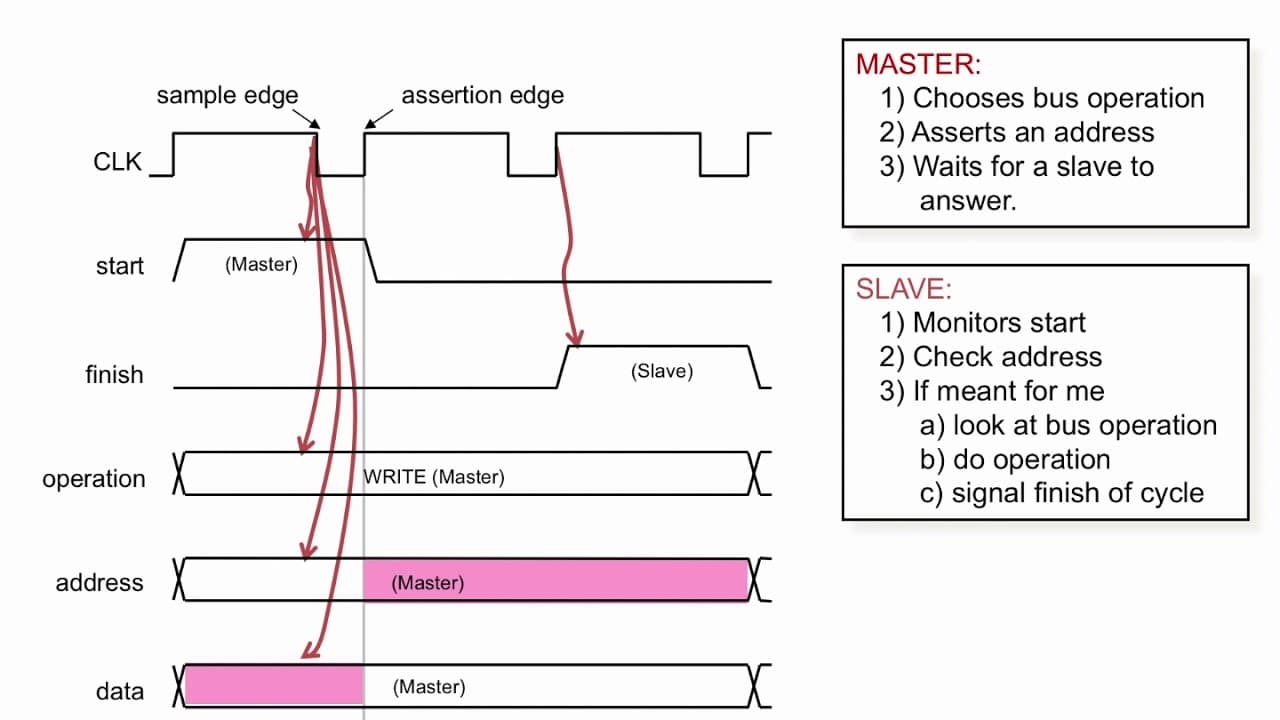
A bus transaction involves a bus master initiating the transaction by setting the bus lines to indicate the desired operation, recipient address, and data (for write operations). The bus slave, watching for its address, performs the requested operation and may return information to the master.
Q: What challenges arise with increasing system speeds in bus architecture?
Faster system speeds lead to shorter transaction times, causing issues such as insufficient time for signaling, conflicts between drivers, electrical noise from impedance discontinuities, and signal corruption due to echoes.
Q: How is high-speed communication addressed in modern systems?
High-speed communication requires a different approach than traditional bus architecture. New methods, such as point-to-point connections and serial communication, are utilized to overcome the limitations of bus architecture.
Summary & Key Takeaways
-
The traditional approach to accommodate add-in components in a modular system was through plugging additional printed circuit boards into the motherboard.
-
The system bus, consisting of various signals, facilitated communication between the CPU and add-in cards.
-
As system speeds increased, the limitations of bus architecture became apparent, including timing issues, electrical noise, and signal corruption.
Read in Other Languages (beta)
Share This Summary 📚
Summarize YouTube Videos and Get Video Transcripts with 1-Click
Try YouTube Summary with ChatGPT & Claude or YouTube Transcript Generator
Explore More Summaries from MIT OpenCourseWare 📚



Summarize YouTube Videos and Get Video Transcripts with 1-Click
Try YouTube Summary with ChatGPT & Claude or YouTube Transcript Generator