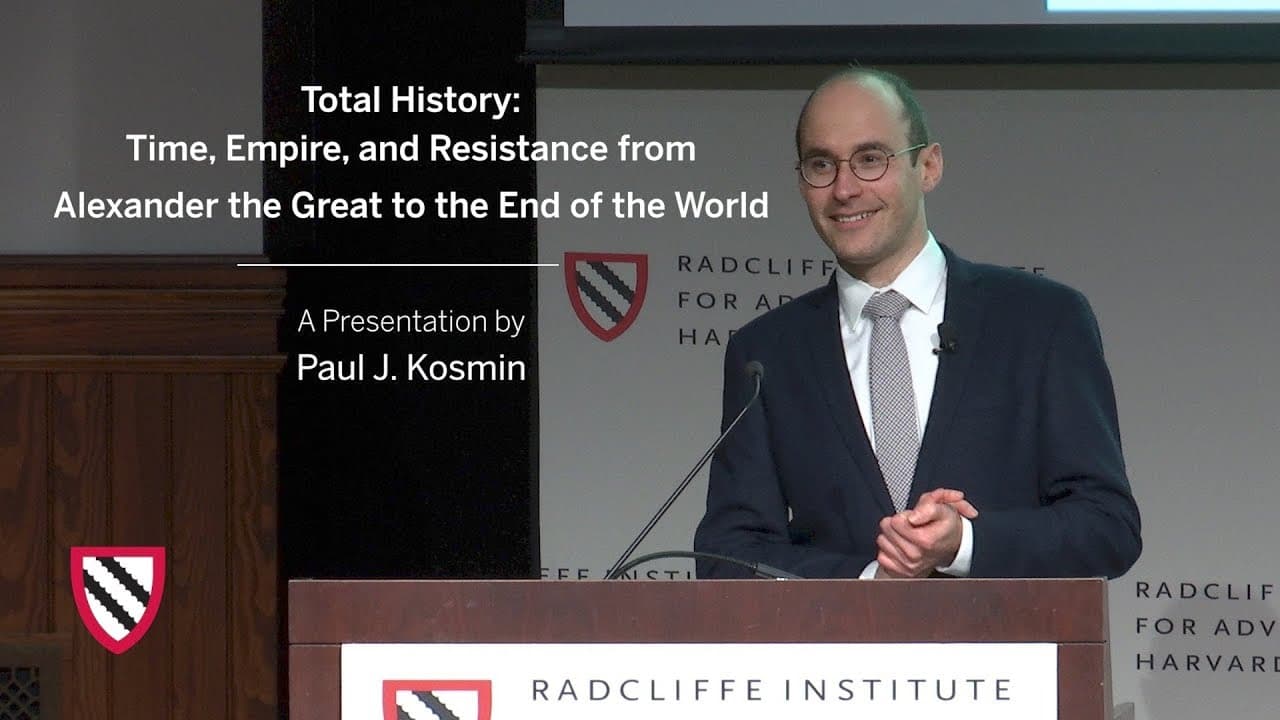
Total History: Alexander the Great to the End of the World | Paul J. Kosmin || Radcliffe Institute
TL;DR
The introduction of the Seleucid Era, the world's first continuous and irreversible tally of counted years, in the Hellenistic East provoked fantasies of finitude and resistance against the open-endedness of the Seleucid Empire.
Transcript
[MUSIC PLAYING] - From around the eighth to the late fourth centuries BCE, the Greek world consisted of around 1000 city-states concentrated in the southern Balkan Peninsula and the Aegean and spread over the coastlands of the Mediterranean and Black Seas. In these centuries, the Archaic and Classical periods that have been canonized as Greek civil... Read More
Key Insights
- 🥺 The introduction of the Seleucid Era marked the emergence of the world's first continuous and irreversible tally of counted years, leading to the standardization of temporal measurement.
- 💋 The Seleucid Empire, with its linguistic and cultural diversity, marked a shift from the city-state democracy to territorial monarchy.
- 👶 The Seleucid Era brought about new forms of statecraft and bureaucratic practices, such as the institutionalization of timekeeping and the development of archives and market trade.
- ⌛ The emergence of apocalyptic theologies in the Seleucid Empire can be seen as a reaction to the open-endedness and institutionalization of time, offering a sense of closure and divine sovereignty over time.
Install to Summarize YouTube Videos and Get Transcripts
Explore YouTube Video Summarizer or Get YouTube Transcript Extractor
Questions & Answers
Q: What characterized the Greek world in the 8th to 4th centuries BCE?
The Greek world consisted of around 1000 city-states with a close relationship with the sea, a focus on local autonomy, and complex interactions with non-Greek imperial states.
Q: How did Alexander the Great's conquest change Greek civilization?
Alexander's conquest expanded Greek civilization to Central Asia, North Africa, and northern India.
Q: What happened to Alexander the Great's empire after his death?
Alexander's empire broke into three kingdoms ruled by lines of kings descending from his generals, including the Seleucid Empire.
Q: What was unique about the Seleucid Empire?
The Seleucid Empire was characterized by its linguistic, religious, and social diversity, and its imperial elite were Greek and Macedonian descendants ruling over territories outside of Greece and Macedonia.
Summary & Key Takeaways
-
The Greek world in the 8th to 4th centuries BCE consisted of around 1000 city-states with a close relationship with the sea, a focus on local autonomy, and complex interactions with non-Greek imperial states.
-
Alexander the Great's conquest in 334 BCE expanded Greek civilization to Central Asia, North Africa, and northern India.
-
After Alexander's death, his empire broke into three kingdoms, including the Seleucid Empire, characterized by its linguistic, religious, and social diversity.
-
The era system introduced by the Seleucid Empire became the first continuous and irreversible tally of counted years, leading to the emergence of new forms of timekeeping and a sense of historical agency.
Read in Other Languages (beta)
Share This Summary 📚
Summarize YouTube Videos and Get Video Transcripts with 1-Click
Try YouTube Summary with ChatGPT & Claude or YouTube Transcript Generator
Explore More Summaries from Harvard University 📚






Summarize YouTube Videos and Get Video Transcripts with 1-Click
Try YouTube Summary with ChatGPT & Claude or YouTube Transcript Generator