Dice problems | Probability | Aptitude | Part-09 | Pratik Shrivastava
TL;DR
Probability concepts related to dice rolling for exams are explained in detail.
Transcript
hello friends welcome back our today's topic is probability as we know probability is one of the very important topic for all kind of exams let it be Bank SEC railway UPA CC set or placement trainings in all the exams question from probability will be asked and you can expect more than three to four questions in the SVI pu exam so let's start with ... Read More
Key Insights
- 🤣 Probability fundamentals entail understanding basic outcomes; rolling one die has six distinct results, a cornerstone for further calculations.
- 🤣 Rolling multiple dice leads to an exponential increase in total outcomes, significant for strategic problem-solving in probability-focused scenarios.
- ❓ Understanding how to differentiate between favorable outcomes and total possible outcomes is crucial for calculating accurate probabilities.
- 👾 Real-life applications of probability in examinations can involve scenarios like betting games, decision-making under uncertainty, and predicting outcomes based on observed patterns.
- 🤗 Combining theoretical knowledge with hands-on examples makes probability concepts clearer and easier to grasp.
- 🛟 The importance of probabilities extends beyond academics, offering insights into risk assessment and statistical reasoning applicable in everyday life.
- 🧑🎓 Developing proficiency with these concepts is essential for students aiming for competitive examinations where probability questions are commonly featured.
Install to Summarize YouTube Videos and Get Transcripts
Explore YouTube Video Summarizer or Get YouTube Transcript Extractor
Questions & Answers
Q: What is the total number of outcomes when rolling one die?
When rolling one die, there are six possible outcomes represented by the numbers one through six. This represents the basic probability framework, where each number has an equal chance of being rolled, thus ensuring that students understand the foundational principle of outcomes straightaway.
Q: How do you calculate the probability of rolling two dice?
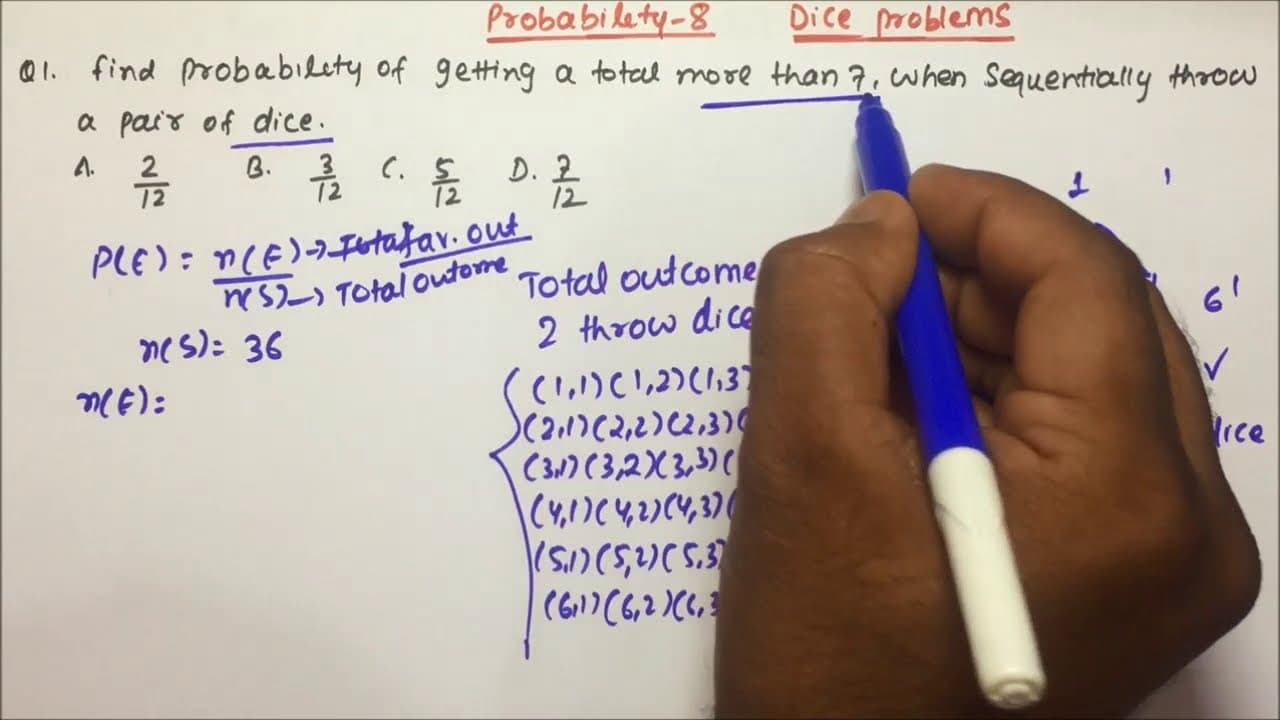
To compute the probability when rolling two dice, the total outcomes become 6 squared, which equals 36. This means that there are 36 different combinations possible, showcasing how the outcomes increase exponentially as more dice are added, thus emphasizing the multiplicative nature of probability.
Q: Can you explain how to find the probability of getting a total greater than seven with two dice?
To find the probability of rolling a total greater than seven with two dice, first identify the favorable outcomes. After listing combinations that result in scores above seven (15 favorable outcomes), the probability becomes 15 divided by the total outcomes (36), simplifying to 5/12 or approximately 41.67%, illustrating how to effectively analyze and compute probabilities.
Q: What is the probability of rolling an even number with one die?
When rolling one die, the favorable outcomes for an even number are 2, 4, and 6, resulting in three favorable outcomes. Since total outcomes remain six, the probability is calculated as 3/6, which simplifies to 1/2 or 50%, showing students the simplicity of even-odd calculations on a single trial.
Summary & Key Takeaways
-
The video introduces the fundamental concepts of probability, particularly focusing on outcomes associated with rolling dice, which is essential for various competitive exams.
-
It illustrates how to calculate total outcomes when rolling one, two, or three dice, with examples provided to reinforce learning through patterns in combinations.
-
Key probability calculations are demonstrated, including determining the probability of obtaining even numbers and totals greater than seven from rolling one or two dice.
Read in Other Languages (beta)
Share This Summary 📚
Summarize YouTube Videos and Get Video Transcripts with 1-Click
Try YouTube Summary with ChatGPT & Claude or YouTube Transcript Generator