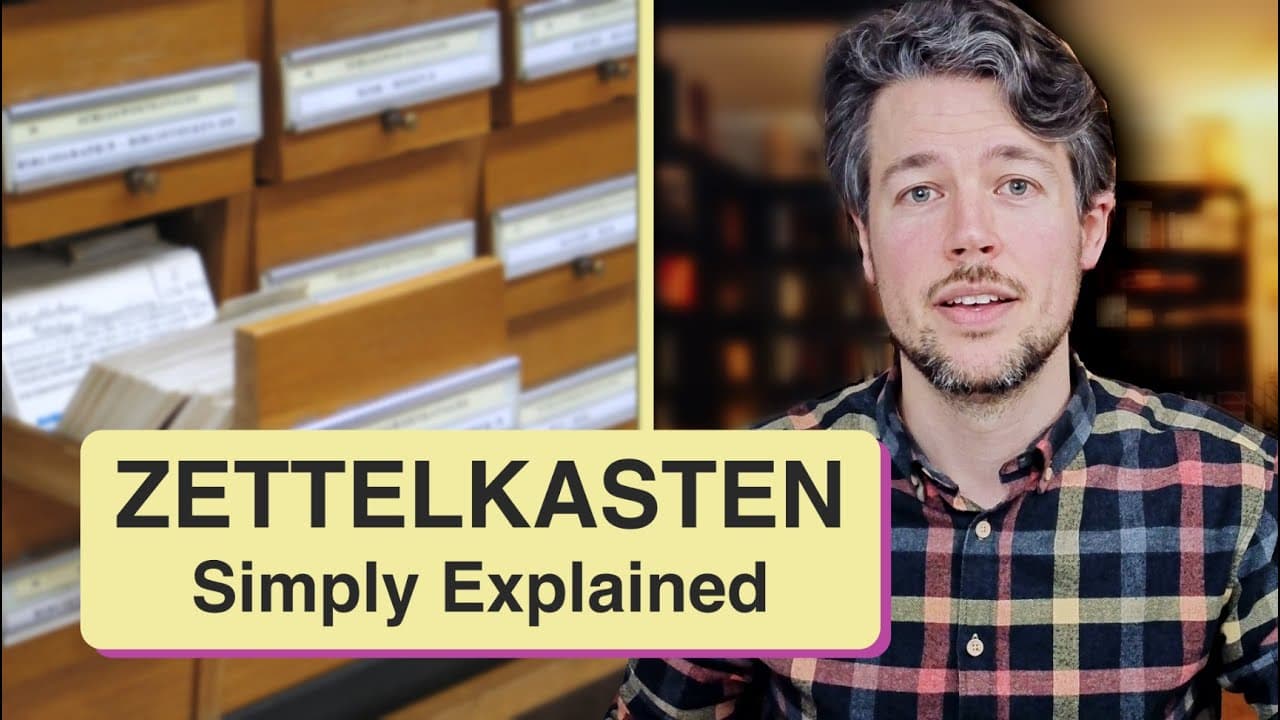
Zettelkasten Method For Beginners · Simply Explained
TL;DR
The Zettelkasten method is a note-taking and knowledge management system that allows for retrieval of thoughts and building meaningful connections in a digital environment.
Transcript
Imagine you have a place where you can store all your notes and insights in such a way that it helps you to a deeper understanding of the topics that interest you. And even more: A place where your own work on these topics emerges almost by itself. That is the promise of the Zettelkasten, a second brain that in some ways functions better... Read More
Key Insights
- 🧠 The Zettelkasten method, popularized by the book "How to Take Smart Notes" by Sönke Ahrens, is a knowledge management system that helps users collect and organize their thoughts, leading to increased productivity.
- 📝 The method was originally developed by German sociologist Niklas Luhmann, known for his incredible productivity, who used slip boxes filled with notes to retrieve and connect ideas for his work.
- 💻 With the digital revival of the Zettelkasten method, anyone can now create their own digital slip box using apps like Logseq, Obsidian, and Roam Research.
- ✍️ The Zettelkasten method involves three main steps: taking media notes to record insights from readings or other forms of media, taking bibliographical notes to capture information about the source, and transforming these notes into permanent notes that are linked with existing knowledge.
- 🔗 By regularly reviewing and connecting their media notes with their existing knowledge, users can create meaningful connections and generate new trains of thought.
- 🗂️ It is important to be selective with the information included in permanent notes, focusing on relevance and creating as many links as possible without overwhelming the note with irrelevant details.
- 🔑 The Zettelkasten method is especially useful for individuals who engage in a lot of reading and research and want to develop their own framework of thoughts.
- 📚 The method is not meant for any kind of note, such as contacts or journal entries, and it is important to maintain order within the digital knowledge base, which can often contain more information than Luhmann's physical slip boxes.
Install to Summarize YouTube Videos and Get Transcripts
Explore YouTube Video Summarizer or Get YouTube Transcript Extractor
Questions & Answers
Q: How did Niklas Luhmann's Zettelkasten method contribute to his productivity as a writer?
Niklas Luhmann's Zettelkasten method allowed him to collect and retrieve thoughts, make meaningful connections, and build a large knowledge base, which contributed to his incredible productivity as a writer. It provided a foundation for his work and facilitated easy access to relevant information.
Q: What are the main steps involved in implementing the Zettelkasten method?
The main steps of the Zettelkasten method include taking notes as you read, rewriting and transferring those notes into your Zettelkasten, and transforming them into permanent notes by finding connections to your existing knowledge base. This process helps in building a comprehensive and organized repository of information.
Q: How can the Zettelkasten method be adapted to a digital environment?
In a digital environment, the Zettelkasten method can be implemented using various note-taking apps such as Logseq, Obsidian, and Roam Research. These apps provide a platform for creating and organizing digital Zettelkastens, allowing for easy access and retrieval of information.
Q: Who is the Zettelkasten method suitable for?
The Zettelkasten method is suitable for individuals who read, research, and want to build their own framework of thoughts. It is beneficial for knowledge management and facilitating a deeper understanding of topics of interest. However, it is not meant for organizing all types of notes, such as contacts or personal journals.
Summary & Key Takeaways
-
The Zettelkasten method originated from Niklas Luhmann, a German sociologist known for his productivity and unique note-taking system.
-
The method involves taking notes as you read, transforming them into permanent notes, and finding meaningful connections between new and existing notes.
-
The goal is to build a knowledge base that aids in understanding and retrieval of information.
Read in Other Languages (beta)
Share This Summary 📚
Summarize YouTube Videos and Get Video Transcripts with 1-Click
Try YouTube Summary with ChatGPT & Claude or YouTube Transcript Generator