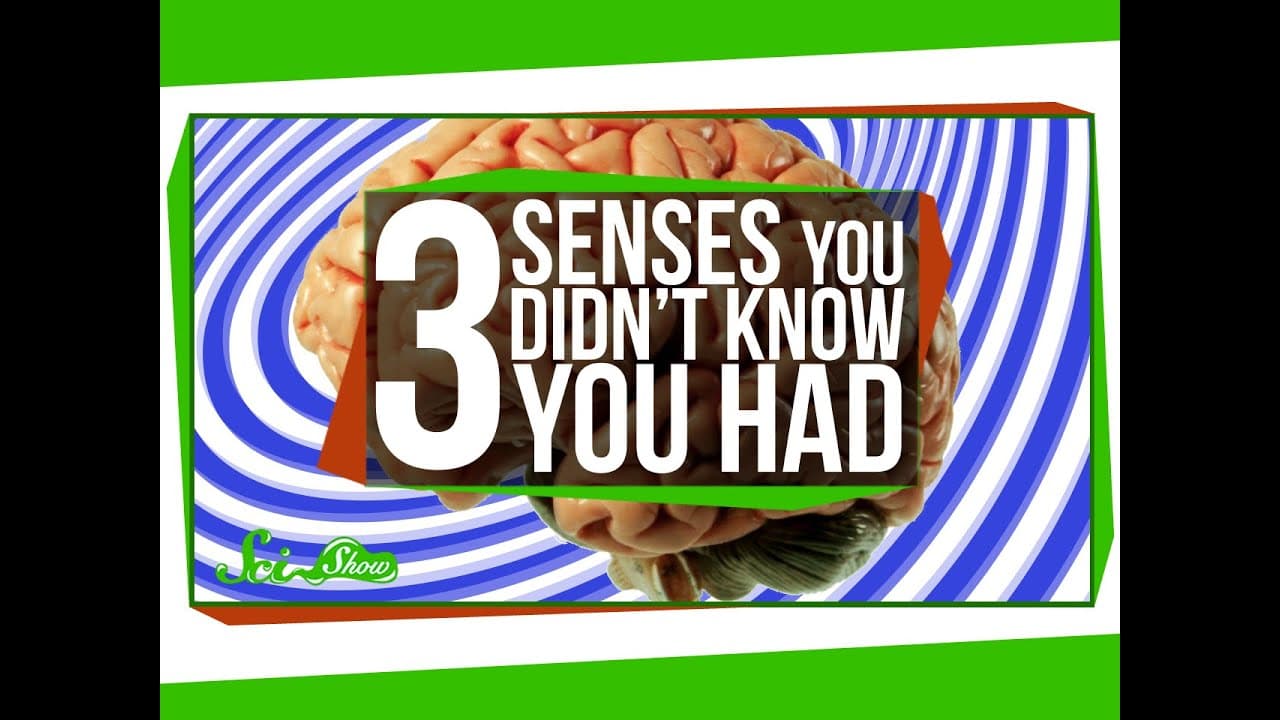
3 Senses You Didn’t Know You Had
TL;DR
Scientists have discovered three additional senses: thermoception, which helps us sense temperature; proprioception, which allows us to perceive the position of our body; and equilibrioception, our sense of balance.
Transcript
At some point, you've probably learned about the five senses: sight, sound, smell, taste, and touch. But these five don't explain all of our sensations. How can we tell how hot or cold we are, or keep ourselves balanced? Now, scientists are beginning to add more senses to that classic list. Here are three of them. It's probably no surprise that sen... Read More
Key Insights
- 🆘 Thermoception helps us maintain body temperature and avoid tissue damage.
- 🥵 TRP channels, such as TRPV1 and TRPM8, play a role in sensing heat and cold, respectively.
- 💪 Proprioception involves specialized receptors in the skin, joints, and muscles, providing information about movement and limb positions to the brain.
- 💁 The cerebellum is responsible for coordinating balance, posture, and voluntary movement based on proprioceptive information.
- 😂 Equilibrioception relies on the inner ear's vestibular system, which includes semicircular canals and otolith organs.
- 🤕 Hair cells in the vestibular system send signals about head movements to the brain stem.
- ⚖️ Issues with the vestibular system can result in balance problems, such as vertigo.
Install to Summarize YouTube Videos and Get Transcripts
Explore YouTube Video Summarizer or Get YouTube Transcript Extractor
Questions & Answers
Q: How do TRP channels help us sense temperature?
TRP channels in the Transient Receptor Protein channel family react to different stimuli, including changes in temperature. When the environment gets warmer or colder, these channels are more likely to open, triggering a response in nociceptors (pain-sensing nerves) and sending signals to the brain about temperature sensations.
Q: What is proprioception and how does it work?
Proprioception refers to our ability to perceive the positioning and movements of our body. Receptors like muscle spindles, Golgi tendon organs, and cutaneous mechanoreceptors provide information about muscle length, speed, tension, and pressure to the brain, primarily the cerebellum, which coordinates balance, posture, and voluntary movement.
Q: How does equilibrioception contribute to our sense of balance?
Equilibrioception relies on the inner ear's vestibular system, which consists of semicircular canals and otolith organs. Hair cells in these structures detect head movements and send signals to the brain stem, which then coordinates responses in the eyes, joints, and muscles to maintain balance and navigate the environment.
Q: What happens when there are issues with the vestibular system?
Problems with the vestibular system can lead to balance issues. For example, loose stones in the otolith organs can cause vertigo, while disruption of normal fluid movement in the semicircular canals can put unexpected pressure on hair cells, resulting in dizziness when the head moves.
Summary & Key Takeaways
-
Thermoception, or the ability to sense temperature, is crucial for maintaining body temperature and avoiding tissue damage. Transient Receptor Protein (TRP) channels play a role in sensing temperature, with channels like TRPV1 activated by heat and TRPM8 by cold.
-
Proprioception enables us to know the position of our body in space. Specialized receptors in the skin, joints, and muscles provide the brain with information about movement and limb positions, coordinated by the cerebellum.
-
Equilibrioception, or our sense of balance, relies on the inner ear and the vestibular system, which includes semicircular canals and otolith organs. Hair cells in these structures send signals to the brain about head movements, allowing proper coordination of eyes, joints, and muscles.
Read in Other Languages (beta)
Share This Summary 📚
Summarize YouTube Videos and Get Video Transcripts with 1-Click
Try YouTube Summary with ChatGPT & Claude or YouTube Transcript Generator
Explore More Summaries from SciShow 📚

Summarize YouTube Videos and Get Video Transcripts with 1-Click
Try YouTube Summary with ChatGPT & Claude or YouTube Transcript Generator