Do plants have consciousness? | Annaka Harris and Lex Fridman
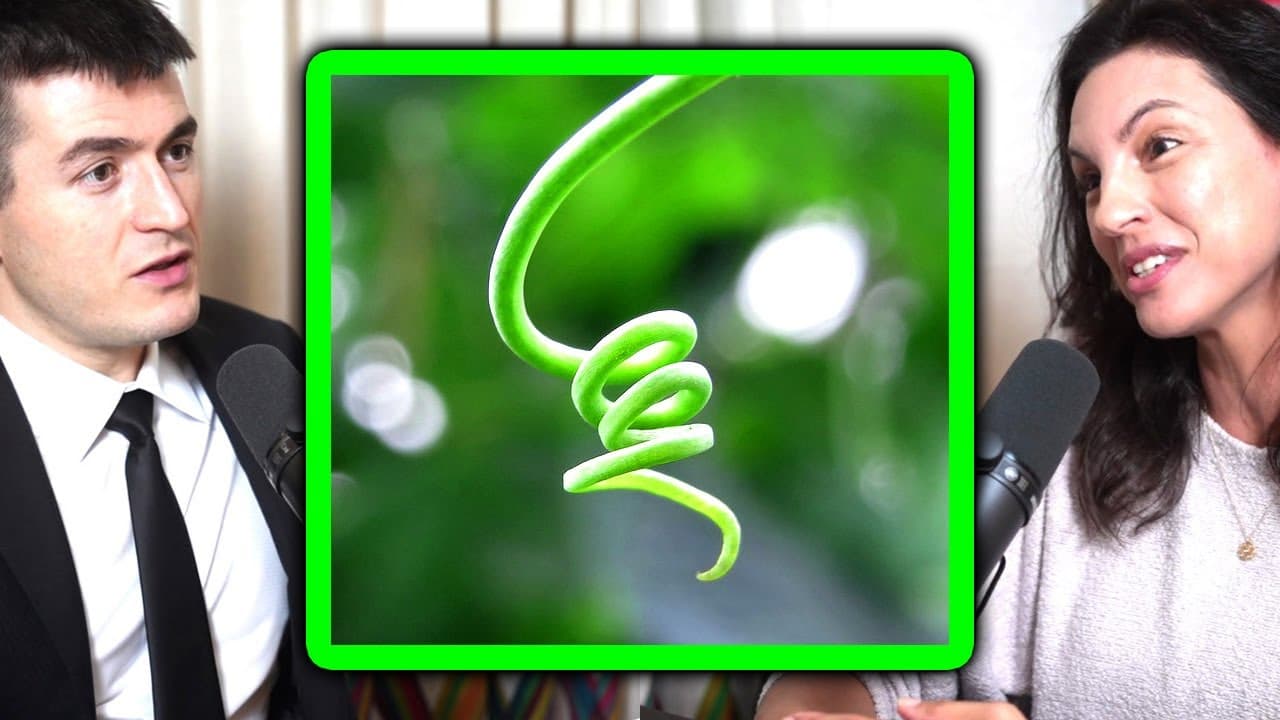
TL;DR
By comparing the behavior of plant tendrils to human decision-making, this content explores the illusion of free will.
Transcript
when you are talking about your experience of looking at at robots it reminds me of how I for many years have been looking at plants because the plant behavior and actually this is the example maybe we'll just try it out it may not work this is an example I was thinking of recently because I was reading back on the work of Mark Jaffe who did this r... Read More
Key Insights
- 🌱 Plant behavior, such as that of P tendrils, can provide insights into the determinants of human decision-making.
- 🥶 The illusion of free will stems from the complexity of the brain and its ability to generate a multitude of outputs based on various inputs.
- 🤳 Understanding that human behavior is ultimately rooted in brain processing challenges the notion of a separate, independent self.
- 🌱 The analogy of plant behavior highlights the role of external cues and subconscious processes in decision-making.
- 🥶 Reflexes and involuntary behavior differ from self-generated decisions, contributing to the illusion of free will.
- 🤳 There is a distinction between the physical processes underlying behavior and the subjective experience of will and self.
- 🧑🏭 The analogy does not discount the complexity of human decision-making but emphasizes the influence of internal and external factors.
Install to Summarize YouTube Videos and Get Transcripts
Explore YouTube Video Summarizer or Get YouTube Transcript Extractor
Questions & Answers
Q: What behaviors can P tendrils exhibit?
P tendrils can either grow straight or coil, depending on whether they encounter a branch or pole for stability. Their behavior is influenced by external cues and can be modified by direct touch and light.
Q: What did Mark Jaffe's research reveal about P tendrils?
Mark Jaffe's research showed that P tendrils have a primitive form of memory. Even when separated from the plant, they continue to exhibit the same behaviors, such as coiling when touched. Light is also necessary for the coiling response to occur.
Q: How does the analogy of P tendrils relate to human decision-making?
The analogy suggests that if P tendrils had conscious experiences, they might feel a desire or want to start coiling when encountering a branch. This analogy serves to remind us that human decision-making is influenced by numerous factors, much like the behavioral responses of P tendrils.
Q: What is the difference between voluntary and involuntary behavior?
Voluntary behavior is based on self-generated decisions and thinking processes, while involuntary behavior includes reflexes or actions forced from the outside. The illusion of free will arises from the distinction between these two types of behavior.
Summary & Key Takeaways
-
The content discusses the behavior of P tendrils, which can grow straight or coil when they encounter a branch or pole for stability.
-
Mark Jaffe's research showed that P tendrils have a primitive form of memory, reacting to light and retaining the sensation of being touched.
-
The analogy of plant behavior is used to highlight the complex nature of human decision-making and the illusion of free will.
Read in Other Languages (beta)
Share This Summary 📚
Summarize YouTube Videos and Get Video Transcripts with 1-Click
Try YouTube Summary with ChatGPT & Claude or YouTube Transcript Generator
Explore More Summaries from Lex Clips 📚
Summarize YouTube Videos and Get Video Transcripts with 1-Click
Try YouTube Summary with ChatGPT & Claude or YouTube Transcript Generator