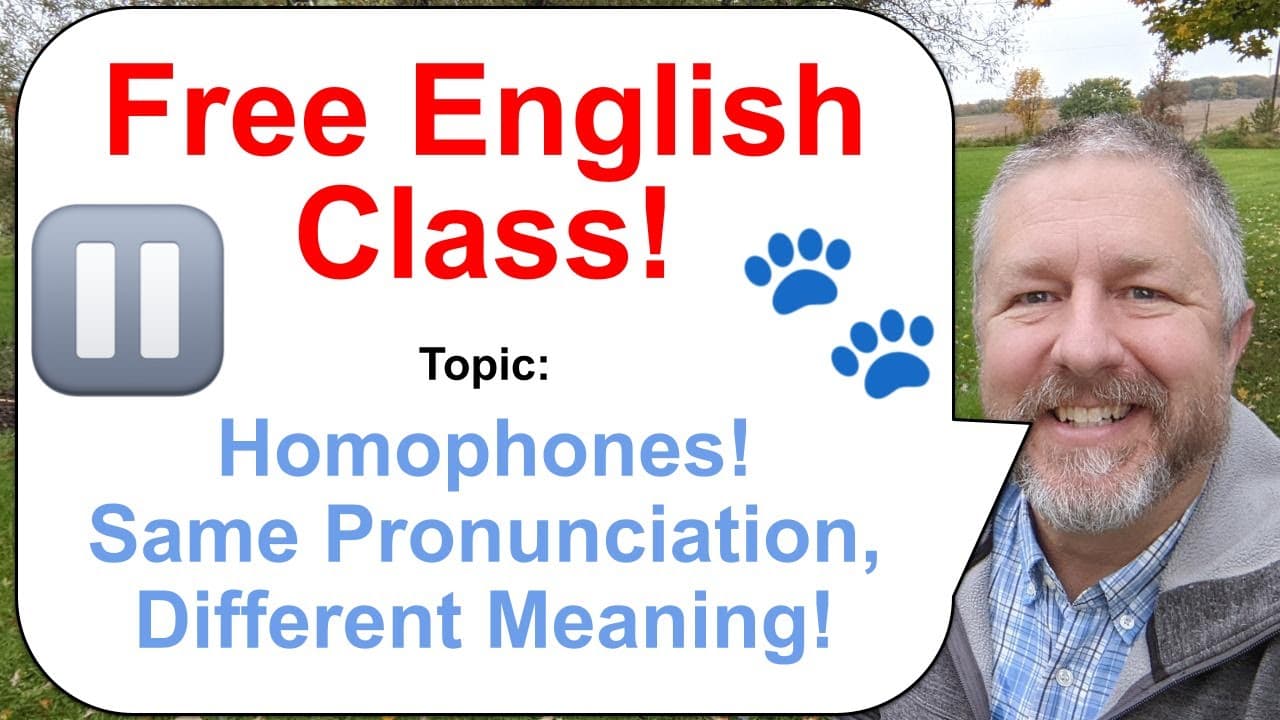
Free English Class! Topic: Same Pronunciation, Different Meanings and Spellings ⏸️🐾🐇
TL;DR
Homophones are words that have different spellings but sound the same. They can be tricky in English as they often have different meanings.
Transcript
hello everybody let me get my microphone adjusted here let me get everything in place let me make sure that uh the camera is ready to go I think it is let's see will it focus on my hand yes it will and then will it focus on me yes it will awesome hey it's good to see all of you we'll get started momentarily uh in about 15 seconds actually foreign i... Read More
Key Insights
- 👂 Homophones are words that sound the same but have different meanings.
- ❓ They can be challenging to learn as they require understanding the context and differentiating between spellings.
- 📢 Homophones are commonly used in the English language and are found in various categories, such as verbs, nouns, and adjectives.
- 🪈 Learning homophones requires practice and exposure to different examples in order to improve understanding and usage.
- 🖐️ Homophones play a significant role in language comprehension and are essential for effective communication in English.
- 😒 Homophones can be fun to learn and use, as they add richness and complexity to the language.
- ✍️ Engaging in conversations, reading, and writing activities can help reinforce the usage and understanding of homophones.
Install to Summarize YouTube Videos and Get Transcripts
Explore YouTube Video Summarizer or Get YouTube Transcript Extractor
Questions & Answers
Q: What are homophones?
Homophones are words that are spelled differently but sound the same when pronounced.
Q: Why are homophones tricky to learn in English?
Homophones can be difficult to learn because they have different spellings but the same pronunciation, which can cause confusion when using them in writing.
Q: Can you provide some examples of homophones?
Sure! Examples of homophones include hair and hare, plane and plain, tow and toe, and bear and bare.
Q: How can I improve my understanding and usage of homophones?
To improve your understanding of homophones, practice using them in sentences and pay attention to context. Additionally, engage in activities that involve listening exercises and provide exposure to homophones.
Summary & Key Takeaways
-
Homophones are words that have different spellings but the same pronunciation.
-
They can be challenging to learn as they have different meanings.
-
Examples of homophones include hair and hare, plane and plain, tow and toe, and bear and bare.
Read in Other Languages (beta)
Share This Summary 📚
Summarize YouTube Videos and Get Video Transcripts with 1-Click
Try YouTube Summary with ChatGPT & Claude or YouTube Transcript Generator
Explore More Summaries from Learn English with Bob the Canadian 📚






Summarize YouTube Videos and Get Video Transcripts with 1-Click
Try YouTube Summary with ChatGPT & Claude or YouTube Transcript Generator