Products
Features
YouTube Video Summarizer
Summarize YouTube videos
Web & PDF Highlighter
Highlight web pages & PDFs
Chat with PDF
Ask any PDF questions with AI
Ask AI Clone
Chat with your highlights & memories
Audio Transcriber
Transcribe audio files to text
Glasp Reader
Read and highlight articles
Kindle Highlight Export
Export your Kindle highlights
Idea Hatch
Hatch ideas from your highlights
Integrations
Obsidian Plugin
Notion Integration
Pocket Integration
Instapaper Integration
Medium Integration
Readwise Integration
Snipd Integration
Hypothesis Integration
Apps & Extensions
Chrome Extension
Safari Extension
Edge Add-ons
Firefox Add-ons
iOS App
Android App
Discover
Discover
Ideas
Discover new ideas and insights
Articles
Curated articles and insights
Books
Book recommendations by great minds
Posts
Essays and notes from readers
Quotes
Inspiring quotes collection
Videos
Curated videos and summaries
Explore Glasp
Glasp Story
How we grew from 0 to 3 million users
Glasp Newsletter
Weekly insights and updates
Glasp Talk
Interview series with great minds
Glasp Blog
Latest news and articles
Glasp Use Cases
Learn how others use Glasp
Build & Support
Glasp API
Access Glasp's API for developers
MCP Connector
Connect Glasp to Claude & ChatGPT
Community
Glasp Reddit Community
Students
Student discount and benefits
FAQs
Frequently Asked Questions
AboutPricing
DashboardLog inSign up

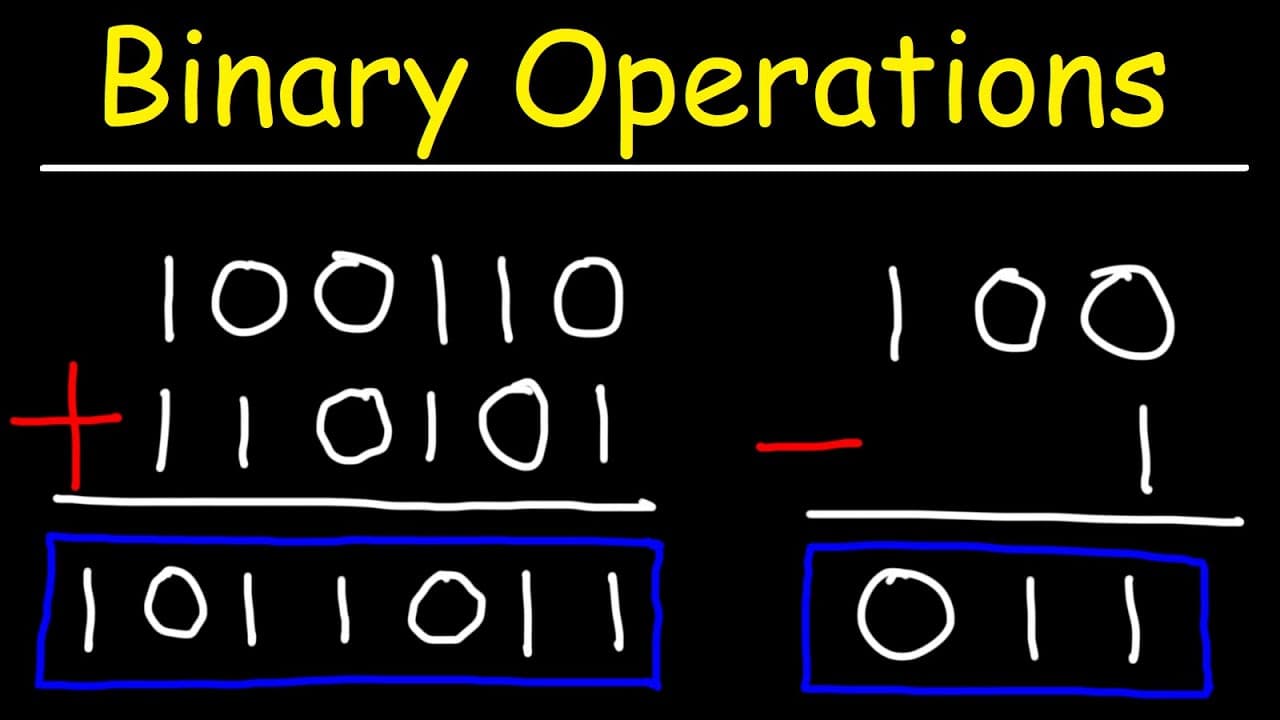
How to Add and Subtract Binary Numbers Easily
January 15, 2021
by
The Organic Chemistry Tutor
YouTube video player
How to Add and Subtract Binary Numbers Easily

TL;DR

To add binary numbers, align them by columns and sum each column, carrying over when necessary, such as for 1 + 1 equals 0 with a carry of 1. For subtraction, borrow from higher columns when needed, transforming zeros into twos for accurate calculations. Understanding these processes simplifies working with binary arithmetic.

Transcript

in this video we're going to focus on operations associated with binary numbers how do you add two binary numbers together how do you subtract them how do you multiply them how do you divide two binary numbers so let's start with the basics what's zero plus zero zero plus zero is zero now what about one plus zero how can we add those two binary num... Read More

Key Insights

  • #️⃣ Binary numbers follow similar addition and subtraction rules as decimal numbers.
  • ❓ Carrying over a 1 is an essential concept in binary addition.
  • 💁 Converting binary numbers to decimal form can help verify the accuracy of calculations.

Install to Summarize YouTube Videos and Get Transcripts

Explore YouTube Video Summarizer or Get YouTube Transcript Extractor

Questions & Answers

Q: How do you add two binary numbers together?

To add binary numbers, line them up and add each column separately, carrying over a 1 if the sum is greater than 1.

Q: What is the result of adding three ones in a binary column?

Adding three ones in a binary column produces a sum of one one, meaning one is written in that column and a one is carried over to the next column.

Q: How do you check the accuracy of binary addition?

Convert each binary number into decimal form, add them up, and compare the decimal sum with the binary sum to confirm accuracy.

Q: What is the process for subtracting binary numbers?

Subtract binary numbers similarly to decimal numbers, borrowing from higher columns if necessary and replacing zeros with twos for accurate calculations.

Summary & Key Takeaways

  • Binary numbers can be added, subtracted, multiplied, and divided just like decimal numbers.

  • When adding binary numbers, you start from the right side and add each column separately, carrying over a 1 if needed.

  • To subtract binary numbers, you may need to borrow from higher columns and replace zeros with twos to ensure accurate calculations.


Read in Other Languages (beta)

English

Share This Summary 📚

Summarize YouTube Videos and Get Video Transcripts with 1-Click

Download browser extensions on:

Try YouTube Summary with ChatGPT & Claude or YouTube Transcript Generator

Explore More Summaries from The Organic Chemistry Tutor 📚

How To Find The Amount of Excess Reactant That Is Left Over - Chemistry thumbnail
How To Find The Amount of Excess Reactant That Is Left Over - Chemistry
The Organic Chemistry Tutor
Distance, Displacement, Average Speed, Average Velocity - Physics thumbnail
Distance, Displacement, Average Speed, Average Velocity - Physics
The Organic Chemistry Tutor
How To Calculate Your Mortgage Payment thumbnail
How To Calculate Your Mortgage Payment
The Organic Chemistry Tutor
Related Rates - The Shadow Problem thumbnail
Related Rates - The Shadow Problem
The Organic Chemistry Tutor
Molarity Dilution Problems Solution Stoichiometry Grams, Moles, Liters Volume Calculations Chemistry thumbnail
Molarity Dilution Problems Solution Stoichiometry Grams, Moles, Liters Volume Calculations Chemistry
The Organic Chemistry Tutor
Integration By Parts Formula Derivation thumbnail
Integration By Parts Formula Derivation
The Organic Chemistry Tutor

Summarize YouTube Videos and Get Video Transcripts with 1-Click

Download browser extensions on:

Try YouTube Summary with ChatGPT & Claude or YouTube Transcript Generator

Apps & Extensions

  • Chrome Extension
  • Safari Extension
  • Edge Add-ons
  • Firefox Add-ons
  • iOS App
  • Android App

Key Features

  • YouTube Video Summarizer
  • Web & PDF Summarizer
  • Web & PDF Highlighter
  • Chat with PDF
  • Ask AI Clone
  • Audio Transcriber
  • Glasp Reader
  • Kindle Highlight Export
  • Idea Hatch

Integrations

  • Obsidian Plugin
  • Notion Integration
  • Pocket Integration
  • Instapaper Integration
  • Medium Integration
  • Readwise Integration
  • Snipd Integration
  • Hypothesis Integration

More Features

  • APIs
  • MCP Connector
  • Blog & Post
  • Embed Links
  • Image Highlight
  • Personality Test
  • Quote Shots

Company

  • About us
  • Our Story
  • Blog
  • Community
  • FAQs
  • Job Board
  • Newsletter
  • Pricing
Terms

•

Privacy

•

Guidelines

© 2026 Glasp Inc. All rights reserved.