What Is a 4-Bit Priority Encoder and How Does It Work?
TL;DR
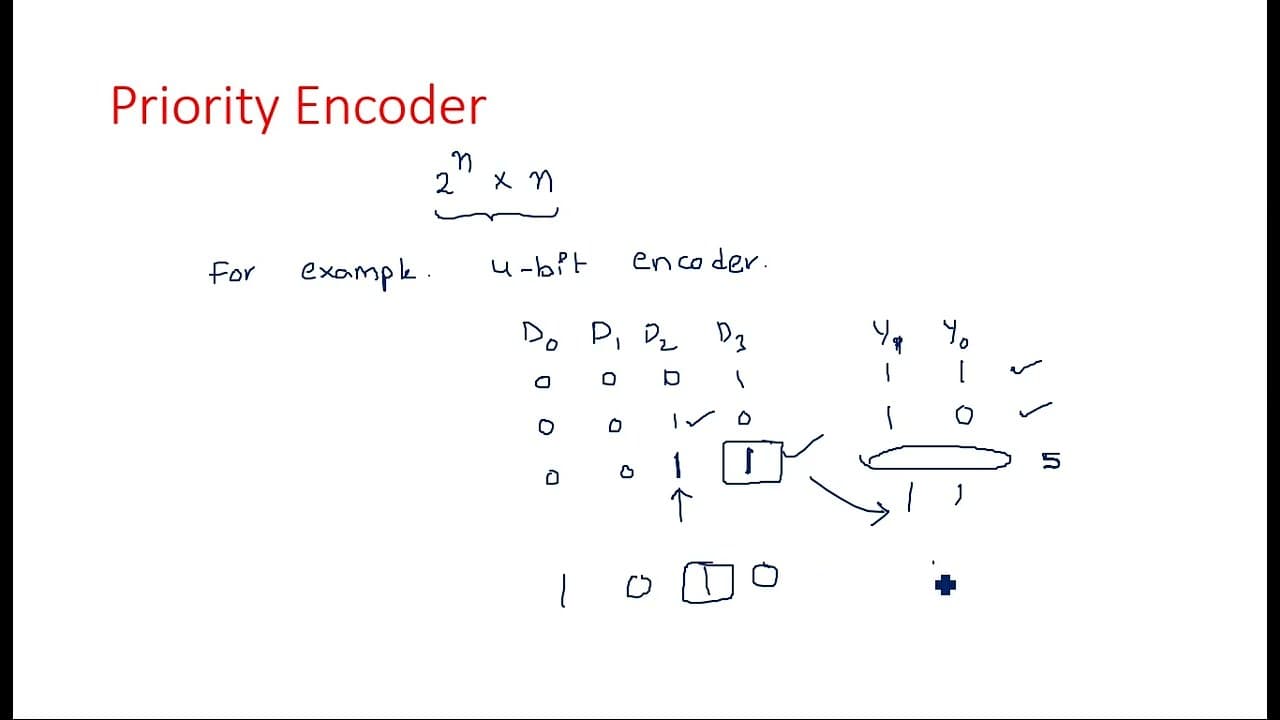
A 4-bit priority encoder converts multiple input signals into a binary output based on the highest activated input. It includes four inputs (D0 to D3) and outputs two bits alongside a valid signal. When multiple inputs are active, the encoder prioritizes the highest signal, ensuring only one signal is processed, which is essential for efficient digital circuit management.
Transcript
hi everyone in this video I'm going to tell you about priority encoder and then 4bit priority encoder so before going into 4bit priority encoder let me first explain what do you mean by priority encoder what is the encoder what do you mean by encoder we know encoder as a digital circuit which is used to convert a short form for a big data format ok... Read More
Key Insights
- 📡 Priority encoders are essential for digital systems where signal precedence is critical, such as data transmission and processing circuits.
- 🫥 The structure of a 4-bit priority encoder involves input lines corresponding to bits and output lines that give a binary notation as a representation.
- 👻 The existence of the valid signal helps manage states when no inputs are active, allowing for optimal circuit behavior.
- 😉 Logic simplifications with K-maps enable easy design of priority encoders' combinational logic circuits.
- 👻 Prioritizing inputs allows systems to effectively manage resources and output clarity in complex digital environments.
- 🍵 Understanding input-output relationships is crucial for designing circuits that efficiently handle multiple signals.
- ⌛ Priority encoders streamline processes in environments that require rapid processing and decision-making based on real-time inputs.
Install to Summarize YouTube Videos and Get Transcripts
Explore YouTube Video Summarizer or Get YouTube Transcript Extractor
Questions & Answers
Q: What is the main function of a priority encoder?
The primary function of a priority encoder is to convert multiple active input signals into a binary output that represents the highest priority signal. While conventional encoders simply convert signals, priority encoders prioritize inputs, allowing the system to react or process based on the most significant active signal.
Q: How does a 4-bit priority encoder differ from a standard encoder?
Unlike standard encoders that may output results for all active inputs, a 4-bit priority encoder specifically identifies and outputs the binary equivalent of the highest-priority activated input while discarding others, ensuring accurate representation of signal importance in digital logic.
Q: What happens if multiple inputs are active on a priority encoder?
If multiple inputs are activated simultaneously, the priority encoder determines which input holds the highest value according to its design. The encoder will only output the corresponding binary value of that input, effectively ignoring all lower-priority signals to avoid ambiguity.
Q: What does the valid signal indicate in a priority encoder circuit?
The valid signal in a priority encoder indicates whether any input is active. If all inputs are at zero (inactive), the valid signal will indicate invalid status, alerting the system that no meaningful output can be derived from the current input state.
Summary & Key Takeaways
-
A priority encoder converts multiple input signals into a binary output based on the highest priority signal that is activated, ensuring that only one signal is processed at a time.
-
The input structure for a 4-bit priority encoder includes four data inputs (D0 to D3) and outputs two bits along with a valid signal to indicate active input.
-
In situations where multiple inputs are activated, the encoder chooses the output based on predefined priorities, allowing for effective signal management in digital circuits.
Read in Other Languages (beta)
Share This Summary 📚
Summarize YouTube Videos and Get Video Transcripts with 1-Click
Try YouTube Summary with ChatGPT & Claude or YouTube Transcript Generator