How to Solve Transportation Problems with 3 Methods
TL;DR
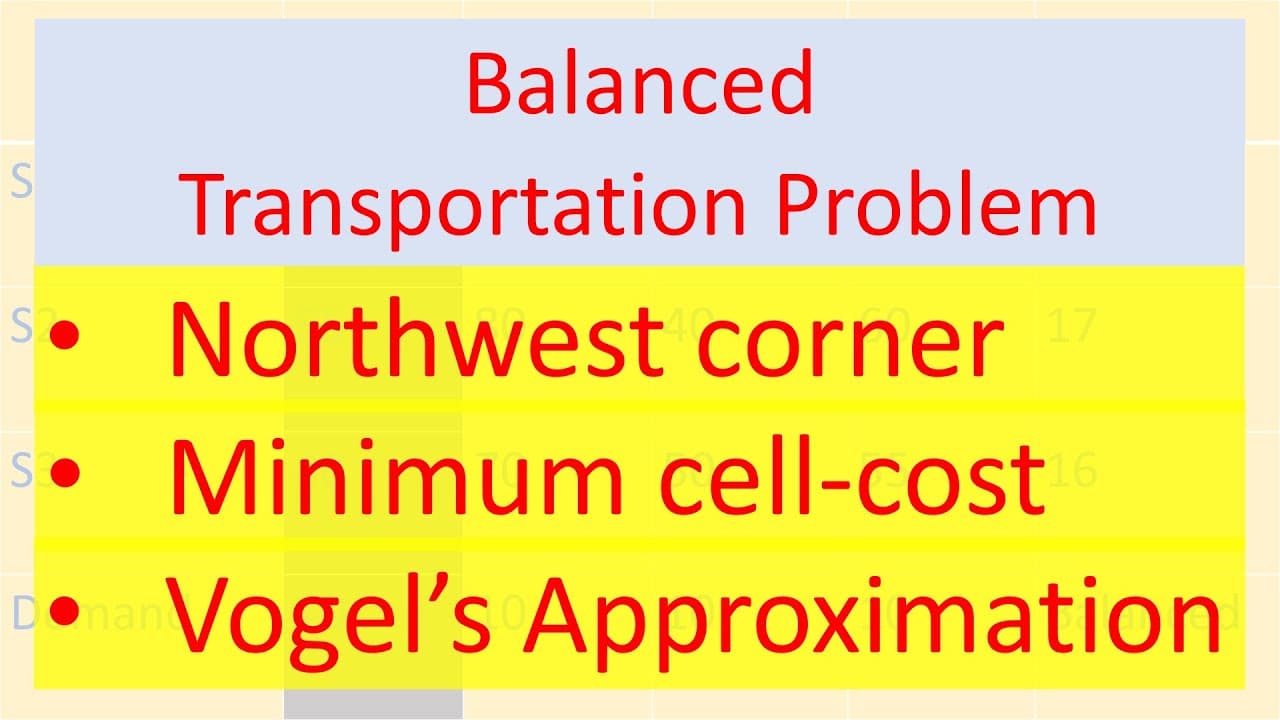
Use three effective methods to find initial solutions for balanced transportation problems: northwest corner, least cost cell, and Vogel's approximation method. Each approach has distinct steps and advantages in minimizing total shipping costs and optimizing supply allocation.
Transcript
hello everybody and welcome to lesson 13 balanced transportation problem solution previously in lesson 12 we have discussed how to formulate transportation problem from real business problem once we get the formulated transportation problem or transportation model we can say so the next task is to find out the initial solution for the problem thus ... Read More
Key Insights
- 🇨🇷 The northwest corner method is simple but does not consider transportation costs.
- 🇨🇷 The list cost method improves upon the northwest corner method by selecting cells with the lowest cost.
- ❓ Vogel's approximation method introduces penalty measures to better allocate supplies and minimize regrets.
- 🇨🇷 The choice of method can affect the total shipping cost, with Vogel's approximation often leading to the lowest cost.
- ❓ Initial feasible solutions are important for further optimization and planning in transportation problems.
- ⚖️ Balancing supply and demand efficiently is essential for successful transportation management.
- 🖐️ Transportation costs play a significant role in decision-making and can greatly impact overall expenses.
Install to Summarize YouTube Videos and Get Transcripts
Explore YouTube Video Summarizer or Get YouTube Transcript Extractor
Questions & Answers
Q: What is the objective of finding the initial feasible solution for a balanced transportation problem?
The objective is to allocate the available supplies to meet the demand in the most efficient way, considering factors like cost and accessibility.
Q: How does the northwest corner method work?
The northwest corner method starts by selecting the northwest corner cell and allocating the smaller of the supply and demand to that cell. It then adjusts the supply and demand accordingly and cancels out rows or columns with zero supply or demand.
Q: What is the main difference between the northwest corner method and the list cost method?
The northwest corner method ignores transportation costs, while the list cost method allocates to the cell with the lowest cost. This makes the list cost method closer to an optimal solution compared to the northwest corner method.
Q: How does Vogel's approximation method improve upon the list cost method?
Vogel's approximation method introduces the concept of penalty or opportunity cost. It identifies the row or column with the largest penalty and allocates to the cell with the least unit cost within that row or column. This method aims to minimize regrets or penalties caused by selecting higher-cost options.
Summary & Key Takeaways
-
This content discusses how to find the initial feasible solutions for a balanced transportation problem.
-
Three methods are commonly used: northwest corner method, list cost method, and Vogel's approximation method.
-
The content provides step-by-step instructions for solving an example using each of the three methods.
Read in Other Languages (beta)
Share This Summary 📚
Summarize YouTube Videos and Get Video Transcripts with 1-Click
Try YouTube Summary with ChatGPT & Claude or YouTube Transcript Generator
Explore More Summaries from Solomon Getachew 📚
Summarize YouTube Videos and Get Video Transcripts with 1-Click
Try YouTube Summary with ChatGPT & Claude or YouTube Transcript Generator