What Are Phrasal Verbs for Expressing Ideas in English?
TL;DR
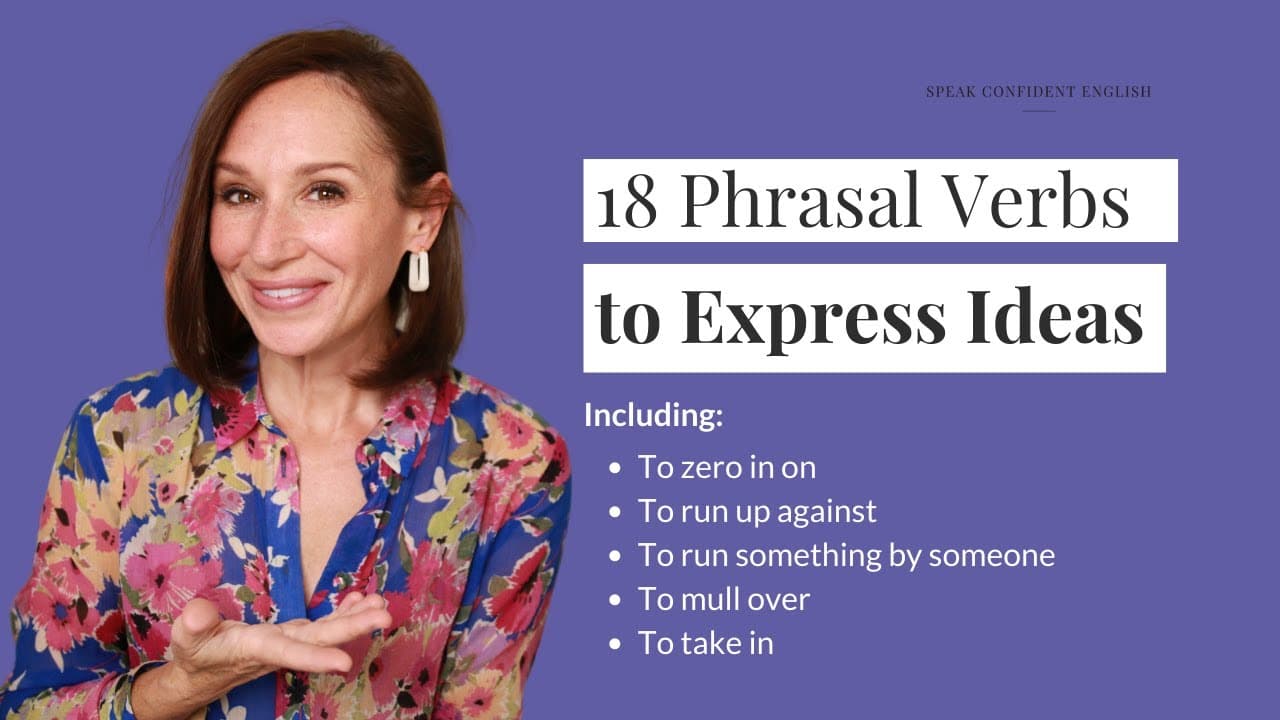
Phrasal verbs are crucial for effectively expressing ideas in English. Key phases of idea activation include brainstorming with verbs like 'figure out' and 'zero in on,' reflecting with phrases such as 'mull over' and 'sleep on,' and sharing ideas using verbs like 'weigh in' and 'put across.' Learning these around specific themes enhances recall and usage.
Transcript
When was the last time you needed to express ideas in English to solve a problem at work? Make a decision about an upcoming family vacation? Address a challenge at your child's school? Help your kids with math homework? Prepare a budget with a spouse or a partner or consider a career change? Every single day there are situations that arise that req... Read More
Key Insights
- 🔍 Phrasal verbs are important in everyday English conversations and can be challenging to learn due to their idiomatic meanings and sheer number (over 5,000).
- 🌱 Learning phrasal verbs around a specific theme helps highlight similarities among them and makes them more relevant to daily life.
- 💡 The brainstorming phase is essential for generating ideas, but some may struggle with it and prefer to have fully formed ideas before sharing.
- 🤔 Recommendations for brainstorming include learning to think out loud in English and utilizing tips for introverts.
- 🧠 Phrasal verbs for brainstorming include "figure out" (understand fully), "work out" (resolve through reasoning), "run up against" (unexpectedly encounter difficulties), "zero in on" (focus attention), and "stumble upon" (find or learn something unexpectedly).
- 💭 Asking for time to reflect is crucial during idea activation. Phrasal verbs for asking for time include "think about" (consider), "mull over" (ruminate on), "touch base" (communicate or follow up), and "sleep on" (think about something overnight to make a decision later).
- 📋 Requesting more details to evaluate pros and cons can be done using phrasal verbs like "fill in" (provide missing information), "circle back to" (return to a topic), and "take in" (process or understand information).
- 🗣️ Finally, when ready to share a complete idea, phrasal verbs like "weigh in" (express an opinion), "put across" (convey ideas effectively), "take on" (accept responsibility for), and "focus on" (concentrate and give attention to) can be used.
Install to Summarize YouTube Videos and Get Transcripts
Explore YouTube Video Summarizer or Get YouTube Transcript Extractor
Questions & Answers
Q: When should you use the phrasal verb "figure out"?
"Figure out" should be used when you want to fully understand all aspects of something or someone. For example, you can say, "We should figure out the root of the issue before responding to the client."
Q: What does the phrasal verb "run up against" mean?
"Run up against" means unexpectedly encountering a difficult situation. For instance, you can say, "We might run up against more problems if we present half-baked ideas to the client."
Q: How can you use the phrasal verb "look into"?
You can use "look into" to explore or consider a variety of options. For example, you can say, "Have you looked into a virtual assistant role? It might be a better option."
Q: What does it mean to "sleep on" something?
"Sleep on" means to think about something overnight and give yourself time to make a decision. For instance, you can say, "Let me sleep on it, and I'll get back to you tomorrow with my decision."
Q: How can you use the phrasal verb "weigh in"?
"Weigh in" can be used to make a statement of opinion. For example, you can say, "I'd like to weigh in with my thoughts on the pros and cons of taking on this project."
Summary & Key Takeaways
-
Idea-generation conversations in English often involve the use of phrasal verbs, which can be challenging to learn due to their idiomatic meanings.
-
Learning phrasal verbs around a specific theme, such as expressing ideas, can make it easier to remember and use them in daily life.
-
The content focuses on three key phases of idea activation and expression: brainstorming, reflecting, and sharing ideas, and provides examples of phrasal verbs for each phase.
Read in Other Languages (beta)
Share This Summary 📚
Summarize YouTube Videos and Get Video Transcripts with 1-Click
Try YouTube Summary with ChatGPT & Claude or YouTube Transcript Generator
Explore More Summaries from Speak Confident English 📚






Summarize YouTube Videos and Get Video Transcripts with 1-Click
Try YouTube Summary with ChatGPT & Claude or YouTube Transcript Generator