How to Calculate Volume Using the Disk Method
TL;DR
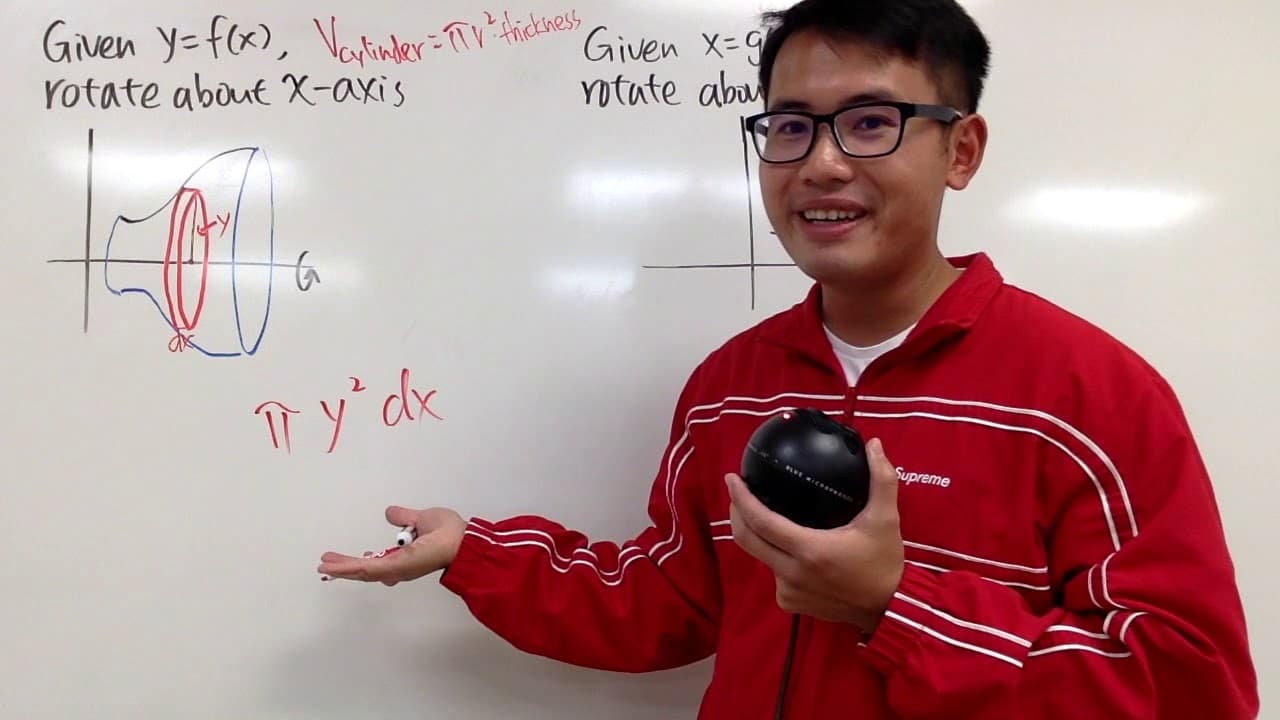
To calculate the volume of a solid of revolution using the disk method, rotate the region around the x-axis or y-axis. The volume is determined by the integrals πf(x)² dx for rotation about the x-axis and πg(y)² dy for rotation about the y-axis, where f(x) and g(y) are the functions describing the boundaries of the region.
Transcript
describe the shape if you look at this these are not pretty much cylinders okay in this video let's talk about volume this is how we are gonna do it let me show you suppose we have a curve right here and suppose that we are given Y is a function of X that describes this curve and it's similar to the area video that we have well in the area situatio... Read More
Key Insights
- ❣️ The disk method involves finding the volume of a solid by rotating a region around the x or y-axis.
- ❣️ When rotating around the x-axis, the equation is πf(x)² dx, and around the y-axis, it is πg(y)² dy.
- 😥 The integration limits are determined by the starting and ending points of the region being rotated.
Install to Summarize YouTube Videos and Get Transcripts
Explore YouTube Video Summarizer or Get YouTube Transcript Extractor
Questions & Answers
Q: How is volume calculated using the disk method?
To find the volume, we integrate the equation πf(x)² dx or πg(y)² dy, depending on whether we are rotating the region around the x-axis or y-axis.
Q: What is the difference between finding volume around the x-axis and the y-axis?
When finding the volume around the x-axis, we use the equation πf(x)² dx, while for the y-axis, we use the equation πg(y)² dy.
Q: How do we determine the range of integration when using the disk method?
The range of integration is determined by the starting and ending points of the region being rotated, represented by x-values or y-values.
Q: What is the importance of the thickness in the disk method?
The thickness, represented by dx or dy, is crucial in the disk method as it represents the small change in either x or y values and helps calculate the volume of each disk.
Summary & Key Takeaways
-
The video discusses how to find the volume of a solid by rotating a region around the x-axis.
-
It explains that the volume can be found by integrating the equation πf(x)² dx, where f(x) is the function that describes the curve.
-
The same concept is applied when rotating a region around the y-axis, using the equation πg(y)² dy.
Read in Other Languages (beta)
Share This Summary 📚
Summarize YouTube Videos and Get Video Transcripts with 1-Click
Try YouTube Summary with ChatGPT & Claude or YouTube Transcript Generator
Explore More Summaries from blackpenredpen 📚


Summarize YouTube Videos and Get Video Transcripts with 1-Click
Try YouTube Summary with ChatGPT & Claude or YouTube Transcript Generator