What Are Constant Cost Industries and Their Supply Curves?
TL;DR
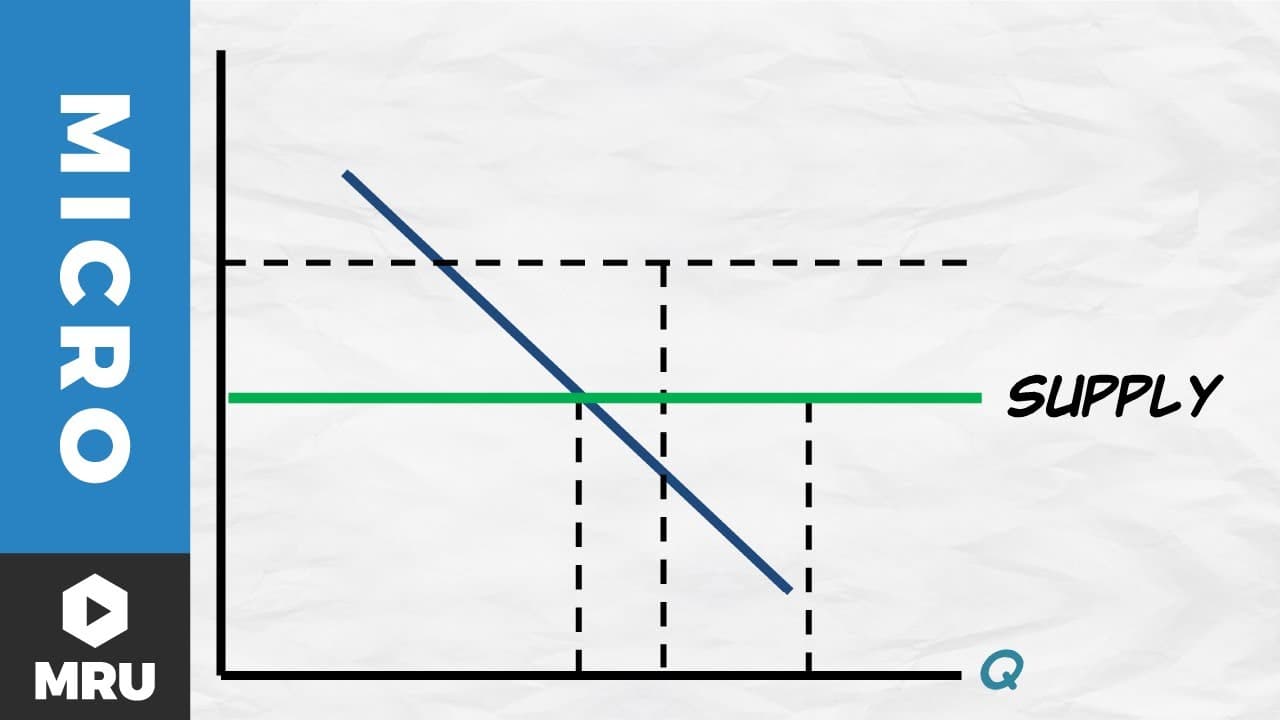
Constant cost industries, like pencil and domain name production, maintain flat supply curves because they can expand output without increasing input costs. As demand rises, prices and profits temporarily increase, attracting new firms until the market reaches a new equilibrium, where price equals minimum average cost, resulting in zero economic profits.
Transcript
♪ [music] ♪ - [Alex] Okay -- this talk is going to be a bit more involved. What we're going to show is how a constant cost industry generates a flat supply curve. Let's begin. A constant cost industry is one where it's very easy to expand output without pushing up costs. So for example, pencils, rutabagas, domain name registration -- these are all ... Read More
Key Insights
- Constant cost industries can expand output without increasing costs, resulting in a flat supply curve. Examples include pencils, rutabagas, and domain name registration.
- In constant cost industries, the demand for inputs like wood, graphite, and rubber remains negligible relative to their global supply, preventing price increases.
- The short-run supply curve is upward sloping because existing firms expand output along their marginal cost curves in response to price increases.
- In the short run, increased demand leads to higher prices and profits, attracting new firms and shifting the supply curve outward.
- New firm entry in response to profits causes the supply curve to shift right, reducing prices and bringing profits back to normal levels.
- A constant cost industry does not drive up input costs when expanding, keeping the average cost curve stable and ensuring a flat long-run supply curve.
- The long-run equilibrium is achieved when price equals the minimum average cost, resulting in zero economic profits for firms.
- The analysis of constant cost industries helps understand how different industry types respond to demand changes, influencing supply curve shapes.
Install to Summarize YouTube Videos and Get Transcripts
Explore YouTube Video Summarizer or Get YouTube Transcript Extractor
Questions & Answers
Q: What defines a constant cost industry?
A constant cost industry is characterized by its ability to expand output without increasing costs. This occurs because the industry is small relative to its input markets, preventing any significant increase in input prices as output increases. As a result, the long-run supply curve remains flat.
Q: Why do constant cost industries have flat supply curves?
Constant cost industries have flat supply curves because they can increase output without affecting input prices. This is due to their small size relative to the global supply of inputs, which ensures that increased production does not lead to higher input costs, maintaining a stable average cost curve.
Q: How do firms in constant cost industries respond to increased demand?
When demand increases, firms in constant cost industries expand output along their marginal cost curves, leading to higher prices and profits in the short run. This attracts new firms, shifting the supply curve outward and eventually reducing prices back to the level where firms earn normal profits.
Q: What happens to profits in constant cost industries when demand increases?
Initially, increased demand leads to higher prices and profits for existing firms. However, these above-normal profits attract new firms, which enter the market and increase supply. This entry shifts the supply curve outward, reducing prices and bringing profits back to normal levels in the long run.
Q: Why don't input prices rise in constant cost industries?
Input prices don't rise in constant cost industries because the industry's demand for inputs is negligible compared to the total global supply. This means that even significant increases in industry output do not significantly affect input prices, allowing for stable production costs and a flat supply curve.
Q: How does the concept of marginal cost apply to constant cost industries?
In constant cost industries, firms expand output along their marginal cost curves in response to price increases. The marginal cost remains stable because input prices do not rise, allowing firms to profitably increase output without affecting long-run supply curve flatness.
Q: What role does firm entry play in constant cost industries?
Firm entry plays a crucial role in constant cost industries by responding to above-normal profits. New firms entering the market increase supply, pushing prices down and restoring profits to normal levels. This entry ensures the long-run supply curve remains flat by preventing sustained profit increases.
Q: How is long-run equilibrium achieved in constant cost industries?
Long-run equilibrium in constant cost industries is achieved when the price equals the minimum average cost, resulting in zero economic profits. This occurs as new firms enter the market in response to initial profit increases, shifting the supply curve outward and stabilizing prices and profits.
Summary & Key Takeaways
-
Constant cost industries, like those producing pencils and domain names, can expand output without increasing costs, resulting in flat supply curves. This occurs because the demand for inputs remains negligible relative to their global supply, preventing price increases.
-
In the short run, increased demand raises prices and profits, attracting new firms and shifting the supply curve outward. As new firms enter, the supply curve shifts right, reducing prices and restoring profits to normal levels.
-
The long-run equilibrium in constant cost industries is reached when price equals the minimum average cost, resulting in zero economic profits. This stability is due to the industry's size relative to input markets, preventing input cost increases during expansion.
Read in Other Languages (beta)
Share This Summary 📚
Summarize YouTube Videos and Get Video Transcripts with 1-Click
Try YouTube Summary with ChatGPT & Claude or YouTube Transcript Generator
Explore More Summaries from Marginal Revolution University 📚


Summarize YouTube Videos and Get Video Transcripts with 1-Click
Try YouTube Summary with ChatGPT & Claude or YouTube Transcript Generator