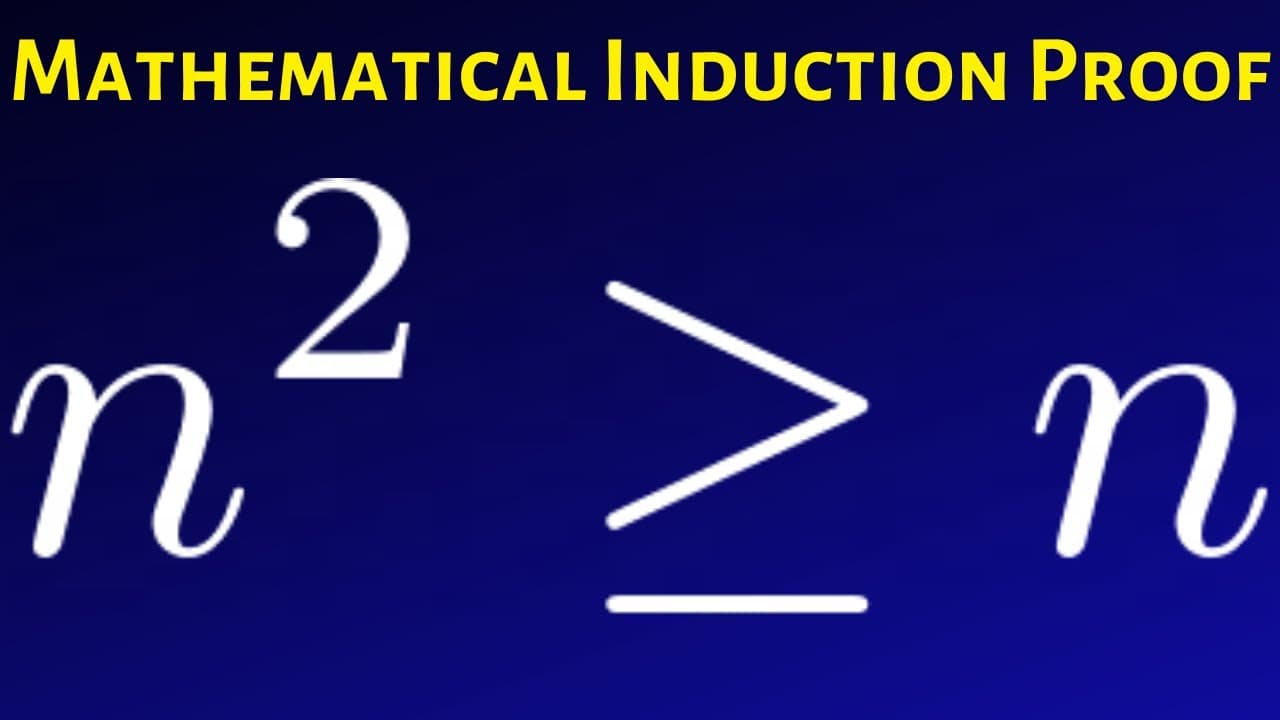
How to Write an Induction Proof for an Inequality: n^2 greater than or equal to n
TL;DR
Using the principle of mathematical induction, it is proven that n^2 is greater than or equal to n for all positive integers.
Transcript
hi everyone in this problem we're going to prove that n squared is greater than or equal to n for all positive integers n we're going to do it using something called the principle of mathematical induction so when you're using the principle of mathematical induction it's always a good idea to identify your statement so in this problem our statement... Read More
Key Insights
- 😒 The proof uses mathematical induction to show that n^2 is greater than or equal to n for all positive integers.
- 👎 The base case is proven by plugging in n = 1 and showing that 1^2 is greater than or equal to 1.
- ❓ The induction hypothesis assumes the statement is true for some positive integer k.
- 😉 The induction step involves substituting n = k + 1 into the equation and manipulating it to show that it is greater than or equal to k + 1.
- ❓ By following the principle of mathematical induction, it is concluded that the statement is true for all positive integers.
- 🛀 The proof emphasizes the importance of clearly stating the goal of showing that the given equation is true.
- 🥹 The rest of the proof involves algebraic manipulations to show that the equation holds true.
Install to Summarize YouTube Videos and Get Transcripts
Explore YouTube Video Summarizer or Get YouTube Transcript Extractor
Questions & Answers
Q: What is the principle of mathematical induction used for?
The principle of mathematical induction is used to prove statements that are true for an infinite number of positive integers. It involves proving a base case, assuming the statement is true for some positive integer k, and then proving that the statement is true for n = k + 1.
Q: What is the base step in a proof using mathematical induction?
The base step is the first step in the proof, where the statement is shown to be true for the starting point, which is usually the smallest positive integer. In this case, the base step involves proving that the statement is true for n = 1.
Q: What is the induction hypothesis in a proof using mathematical induction?
The induction hypothesis assumes that the statement is true for some positive integer k. It allows us to work with a specific value of k and prove that the statement is also true for n = k + 1.
Q: How is the induction step performed in a proof using mathematical induction?
In the induction step, we aim to prove that the statement is true for n = k + 1. This is done by substituting (k+1) into the equation, multiplying it out, and showing that it is greater than or equal to k + 1. By using the induction hypothesis and manipulating the equation, we can complete the induction step.
Summary & Key Takeaways
-
The proof is divided into three steps: the base step, where n = 1 is plugged into the statement and proven to be true; the induction hypothesis, where it is assumed that the statement is true for some positive integer k; and the induction step, where it is shown that the statement is true for n = k + 1.
-
By multiplying out the equation and replacing k^2 with k, it is shown that (k+1)^2 is greater than or equal to (k+1). Thus, the statement is proven to be true for n = k + 1.
-
By following the principle of mathematical induction, it is concluded that n^2 is greater than or equal to n for all positive integers.
Read in Other Languages (beta)
Share This Summary 📚
Summarize YouTube Videos and Get Video Transcripts with 1-Click
Try YouTube Summary with ChatGPT & Claude or YouTube Transcript Generator
Explore More Summaries from The Math Sorcerer 📚




Summarize YouTube Videos and Get Video Transcripts with 1-Click
Try YouTube Summary with ChatGPT & Claude or YouTube Transcript Generator