How to make a black hole | NASA's Michelle Thaller | Big Think
TL;DR
Black holes can form from collapsing stars or through high-energy cosmic rays, and their density depends on the amount of mass they have.
Transcript
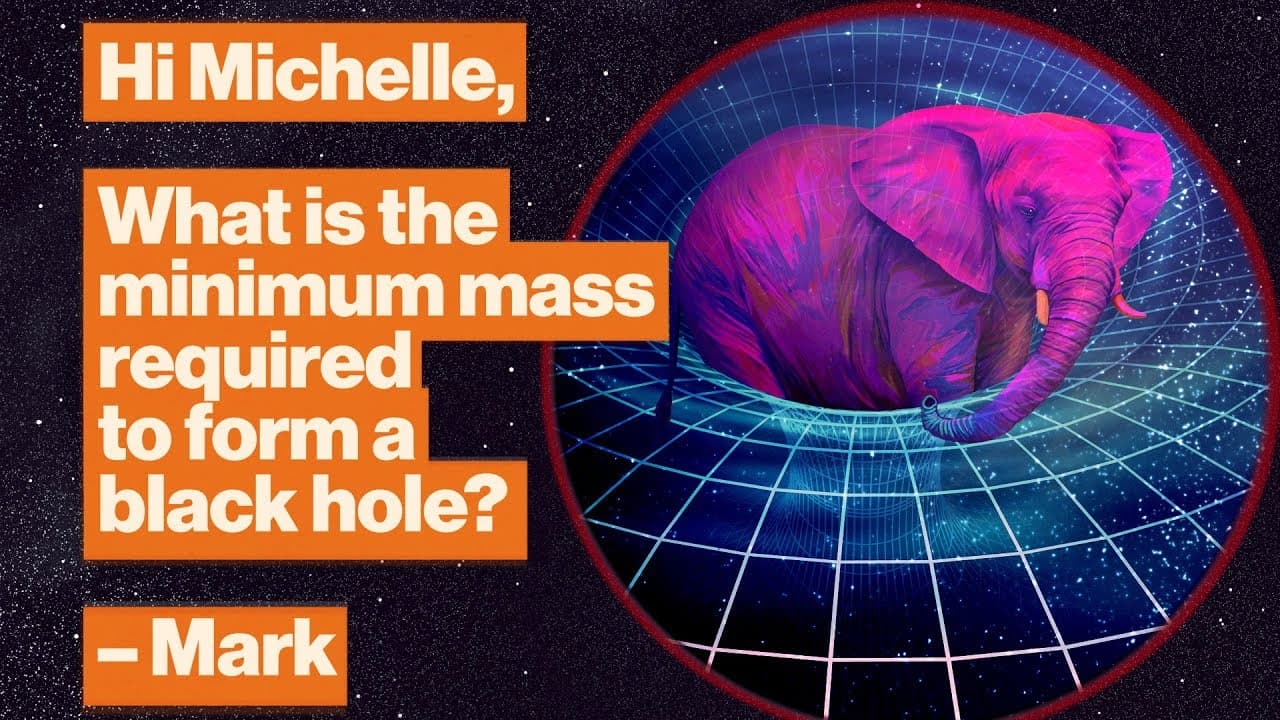
So Mark, you have a great question about black holes: Is there a minimum mass needed for a black hole to form and does a black hole form whenever a stellar object gets that dense? To begin with, let's talk about the definition of a black hole. Now, most commonly people talk about black holes as being a consequence of a giant star dying. And the ide... Read More
Key Insights
- ✴️ Black holes can form from various sources, including collapsing stars and high-energy cosmic rays.
- 🙂 There is no minimum mass required for a black hole to form; it only needs to have the right density for its gravity to become intense enough to trap light.
- 😘 Supermassive black holes found in galaxies have lower average densities despite their massive size, as the amount of mass determines the bending of space.
- 🛰️ Artificial black holes are being attempted to be created at CERN but pose no danger as the energies reached are lower than those of natural high-energy particles from space.
Install to Summarize YouTube Videos and Get Transcripts
Explore YouTube Video Summarizer or Get YouTube Transcript Extractor
Questions & Answers
Q: How do black holes typically form?
Black holes are most commonly formed from the core collapse of giant stars after they die. The intense gravity crushes the star together, trapping light within it.
Q: Can black holes be formed from other methods?
Yes, black holes can also form from high-energy cosmic rays that collide with particles in our atmosphere. These collisions can create tiny black holes with a mass of only a couple of atoms.
Q: Is it possible to artificially create black holes?
Yes, scientists at CERN, the largest particle accelerator on Earth, are attempting to create artificial black holes by colliding particles with extremely high intensities. However, these artificial black holes pose no danger as the energies reached by CERN are much lower than those found in natural high-energy particles from space.
Q: How can black holes have such different sizes and densities?
The size and density of a black hole depend on its mass. While smaller black holes formed by collapsing stars can have extremely high densities, larger black holes, such as supermassive black holes found in the center of galaxies, have lower average densities despite their massive size.
Summary & Key Takeaways
-
Most black holes are formed from the core collapse of giant stars after they die, where gravity becomes so intense that not even light can escape.
-
However, black holes can also be formed from high-energy cosmic rays that create tiny black holes, only a few atoms in mass.
-
There is no minimum mass required for a black hole to form, as long as the object has enough density for its gravity to be intense enough to trap light.
Read in Other Languages (beta)
Share This Summary 📚
Summarize YouTube Videos and Get Video Transcripts with 1-Click
Try YouTube Summary with ChatGPT & Claude or YouTube Transcript Generator
Explore More Summaries from Big Think 📚




Summarize YouTube Videos and Get Video Transcripts with 1-Click
Try YouTube Summary with ChatGPT & Claude or YouTube Transcript Generator