Commutation | Voltage / EMF | Part-5/5 | DC machines | Lec-44
TL;DR
This content explains remedies for delayed accommodation in DC machines, focusing on voltage EMF commutation and interpoles.
Transcript
hello everyone we are discussing about the what are the remedies of the delayed accommodation so generally the lady communication is a bad effect on the commutation operation so that's why we have two methods generally one is the resistance computation and another one is the voltage emf competition we already discussed about the resistance computat... Read More
Key Insights
- 🥺 Delayed accommodation can lead to significant performance issues in DC machines, necessitating effective remedies like voltage EMF commutation.
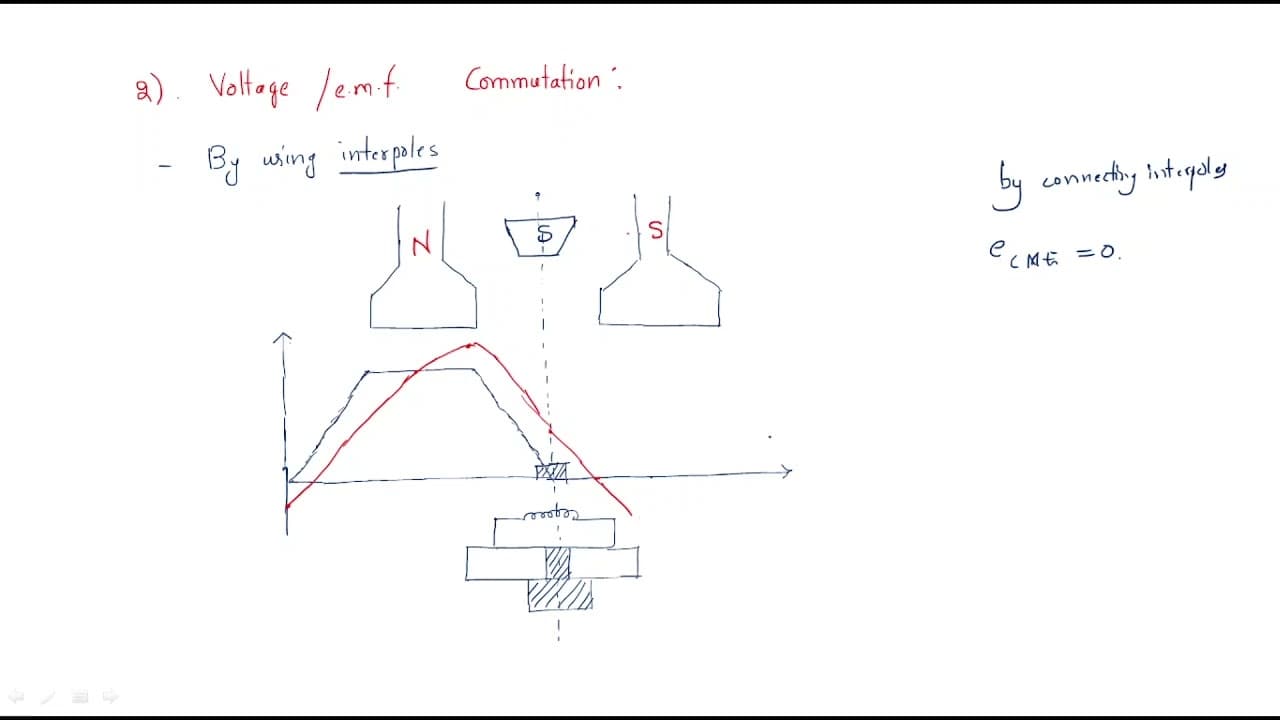
- 😵 Interpoles help minimize cross magnetization effects, which can hinder the commutation process and operational efficiency.
- 💈 The design and placement of interpoles are critical; they are typically installed in the quadrature axis opposing the main field poles to neutralize adverse magnetic effects.
- 🛟 The tapering design of interpoles is intentional, serving to reduce leakage flux and improve overall magnetic performance.
- 🤩 Neutralizing the EMFs resulting from reactance voltage is a key function of interpoles, enhancing the machine's reliability and effectiveness.
- 💈 The relationship between the number of interpoles and main field poles is important, especially in smaller machines where interpoles are often half the main pole count.
- ❓ Understanding the polarities and operational direction of interpoles in relation to generator rotation is essential for optimal performance.
Install to Summarize YouTube Videos and Get Transcripts
Explore YouTube Video Summarizer or Get YouTube Transcript Extractor
Questions & Answers
Q: What is the significance of delayed accommodation in DC machines?
Delayed accommodation refers to delays in the commutation process within DC machines, which can negatively impact efficiency and performance. This delay typically occurs due to cross magnetization effects, leading to the necessity of remedies such as resistance computation and EMF commutation to enhance operational reliability.
Q: How do interpoles function in the context of DC machines?
Interpoles are additional poles placed between the main field poles to combat cross magnetization effects. They provide a counteracting flux that neutralizes the induced EMF from reactance voltage, thereby improving commutation and reducing the risk of sparking at the brushes.
Q: What is the difference between the direct axis and quadrature axis in a DC machine?
The direct axis coincides with the main field poles in a DC machine, typically aligned with the north and south poles. In contrast, the quadrature axis is perpendicular to the direct axis and is where the interpoles are placed, which play a crucial role in mitigating unwanted magnetic effects.
Q: Why is it necessary to have interpoles connected in series with the armature?
Interpoles must be connected in series with the armature to produce a flux that counteracts the cross flux along the quadrature axis. This configuration ensures that the effective magnetic fields cancel each other out, allowing for smoother operation and reducing the chances of commutation failures.
Summary & Key Takeaways
-
The discussion revolves around remedies for delayed accommodation in DC machines, highlighting resistance computation and voltage EMF commutation as primary methods.
-
Key components include interpoles, which are strategically positioned to mitigate the effects of cross magnetization and improve generator efficiency.
-
The content explains the role of interpoles in zeroing out the induced EMFs caused by reactance voltage, contributing to better commutation in electrical machines.
Read in Other Languages (beta)
Share This Summary 📚
Summarize YouTube Videos and Get Video Transcripts with 1-Click
Try YouTube Summary with ChatGPT & Claude or YouTube Transcript Generator