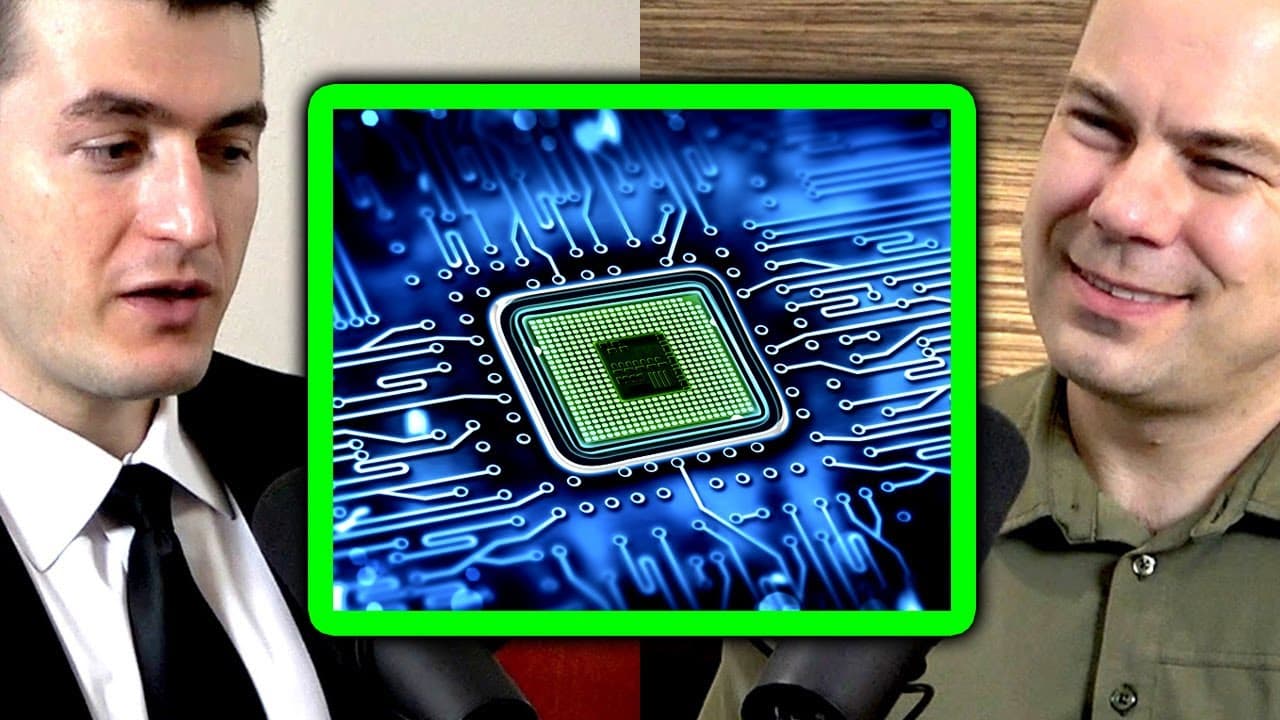
Is Moore's Law dead? | Chris Lattner and Lex Fridman
TL;DR
The interpretation of Moore's Law differs, with some stating it is dead while others believe there is still progress to be made.
Transcript
speaking of the future uh you said moore's law allegedly is dead so do you think do you agree with uh uh dave patterson and and many folks that moore's law is dead or do you agree with jim keller who says uh who's uh standing at the helm of the pirate ship saying it's uh still alive it's still alive yeah also i agree with what they're saying and di... Read More
Key Insights
- 🇨🇷 Moore's Law has different interpretations, with some focusing on technological progress and others on the economic aspect of cost per area.
- 🥺 Advances in physics and smaller geometries can still lead to progress within the context of Moore's Law.
- 🥺 Single-threaded performance no longer improves as significantly, leading to a shift in programming models and a focus on domain-specific accelerators.
- 🚨 Alternative programming models, like CUDA, have emerged to leverage GPUs for compute-intensive tasks.
- 💦 The need for different programming languages and tools arises when working with different architectures and accelerators.
Install to Summarize YouTube Videos and Get Transcripts
Explore YouTube Video Summarizer or Get YouTube Transcript Extractor
Questions & Answers
Q: Is Moore's Law dead or alive according to the speaker?
The speaker agrees with both viewpoints, acknowledging that there is still progress to be made in physics and smaller geometries, but also recognizing that the economic aspect of Moore's Law may no longer hold true.
Q: Why does the speaker consider the single-threaded performance aspect of Moore's Law to be dead?
The speaker explains that in the past, single-threaded performance meant a program would run twice as fast on a new processor. However, now there is a shift towards alternative programming models and domain-specific accelerators, changing the way performance is achieved.
Q: How does the push for alternative programming models impact Moore's Law?
The push for alternative programming models, such as CUDA for GPU computing, can still lead to performance improvements. However, it also creates a need for different programming languages and tools, as each accelerator or processor type requires specific approaches.
Q: Can we have one unified world that scales better?
The speaker believes it is possible to have one world that scales better, but it would require advancements in programming models, languages, and tools to cater to different architectures and accelerators.
Summary & Key Takeaways
-
There are different interpretations of Moore's Law, with some believing it is still alive due to potential advancements in physics and smaller geometries.
-
However, technically, Moore's Law is based on the economic aspect of cost per area, which suggests it may be dead.
-
Single-threaded performance no longer improves as significantly as it used to, leading to a push for alternative programming models and domain-specific accelerators.
Read in Other Languages (beta)
Share This Summary 📚
Summarize YouTube Videos and Get Video Transcripts with 1-Click
Try YouTube Summary with ChatGPT & Claude or YouTube Transcript Generator
Explore More Summaries from Lex Clips 📚



Summarize YouTube Videos and Get Video Transcripts with 1-Click
Try YouTube Summary with ChatGPT & Claude or YouTube Transcript Generator