Test for Goodness of Fit - Problem 5 - Chi-Square Test - Engineering Mathematics - 4
TL;DR
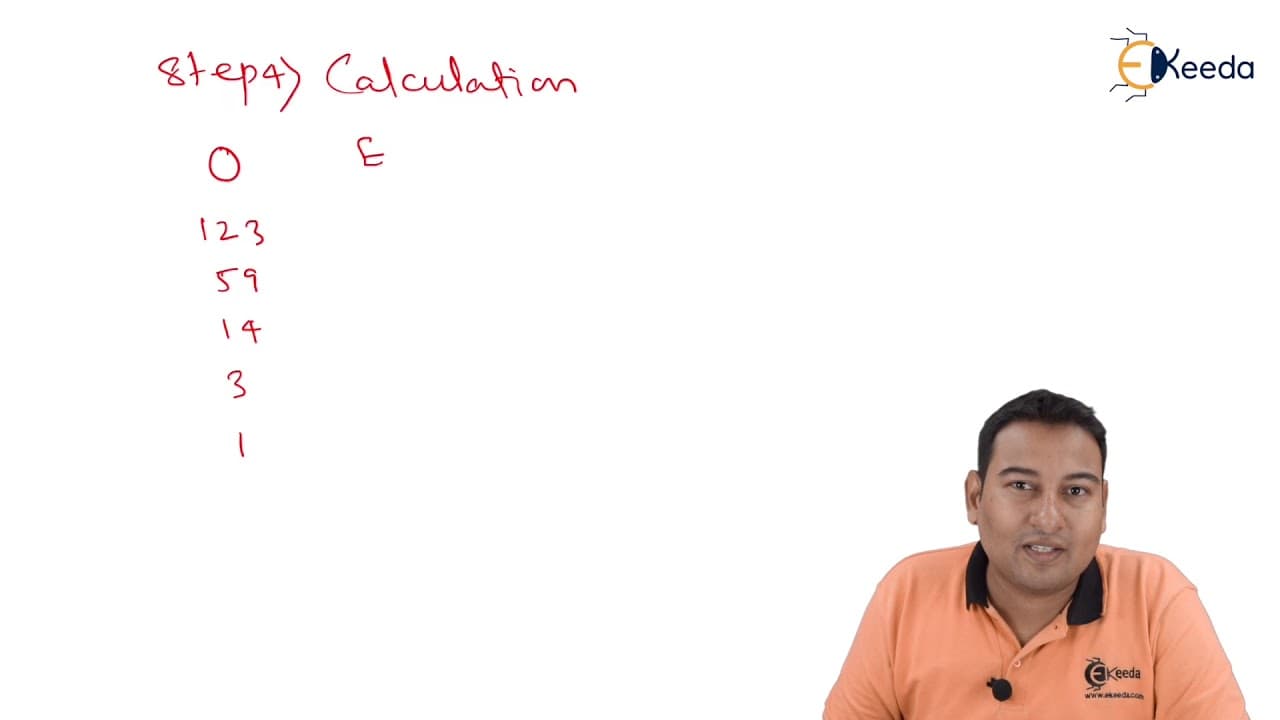
This video explains how to fit a Poisson distribution and check goodness of fit using chi-square test.
Transcript
hello friends in this video we'll be discussing chi-square test type number one that is checked for goodness of it and this is our fifth example friends in the last video we discussed how to fit a binomial distribution and check goodness of fit in this particular problem we go in to check Poisson distribution we went to fit and we're going to check... Read More
Key Insights
- 🤏 This video focuses on fitting and checking goodness of fit for a Poisson distribution using a chi-square test.
- ❓ The null hypothesis assumes that the data follows the Poisson distribution while the alternative hypothesis suggests otherwise.
- ⚾ The calculation involves finding the expected frequencies based on the Poisson distribution and comparing them to the observed frequencies.
- ❎ The chi-square value is calculated by squaring the difference between observed and expected frequencies, dividing by the expected frequency, and summing these values.
- 🤏 By comparing the chi-square value to the critical chi-square value from the table, the null hypothesis can be accepted or rejected.
- #️⃣ The number of degrees of freedom is determined by the number of categories minus one.
- ❓ The conclusion in this example is that the data follows a Poisson distribution.
Install to Summarize YouTube Videos and Get Transcripts
Explore YouTube Video Summarizer or Get YouTube Transcript Extractor
Questions & Answers
Q: What is the null hypothesis in goodness of fit tests?
In a goodness of fit test, the null hypothesis is that the data follows a specific distribution, such as a Poisson distribution.
Q: How is the expected frequency calculated for a Poisson distribution?
The expected frequency for a Poisson distribution is calculated using the principles of the distribution. This can be done by referring to previous examples or using appropriate formulas.
Q: How is the chi-square value calculated in a goodness of fit test?
The chi-square value is calculated by subtracting the observed frequency from the expected frequency, squaring the result, and dividing it by the expected frequency. This process is repeated for all categories and the values are summed.
Q: What does it mean to accept or reject the null hypothesis in a chi-square test?
If the absolute value of the calculated chi-square value is less than the critical chi-square value, we accept the null hypothesis. Otherwise, the null hypothesis is rejected.
Summary & Key Takeaways
-
The video discusses the process of fitting a Poisson distribution and checking goodness of fit.
-
It explains the steps involved in conducting a chi-square test for goodness of fit.
-
The null hypothesis is that the data follows a Poisson distribution, and the alternative hypothesis is that it does not.
Read in Other Languages (beta)
Share This Summary 📚
Summarize YouTube Videos and Get Video Transcripts with 1-Click
Try YouTube Summary with ChatGPT & Claude or YouTube Transcript Generator
Explore More Summaries from Ekeeda 📚






Summarize YouTube Videos and Get Video Transcripts with 1-Click
Try YouTube Summary with ChatGPT & Claude or YouTube Transcript Generator